You might think the best first time home buyer loans are simply the ones requiring the least amount of cash at closing, but focusing solely on the down payment can often lead to higher long-term costs. It's completely understandable to feel anxious when the average 30-year fixed mortgage rate sits near 6.99%. Between rising interest rates and the confusion surrounding private mortgage insurance, the path to homeownership can feel like a financial obstacle course.
We're here to help you discover the ideal mortgage program for your first home purchase with our expert breakdown of conventional, government-backed, and local assistance programs. This guide examines the latest 2026 loan limits, compares low-down-payment options, and highlights local Illinois programs like IHDAccess that offer up to $15,000 in deferred assistance. We'll break down these complex categories into digestible segments, ensuring you move from initial curiosity to a state of informed confidence. By exploring tailored solutions that prioritize your long-term financial health, you can secure lower monthly payments and a clear path to building equity in your new home.
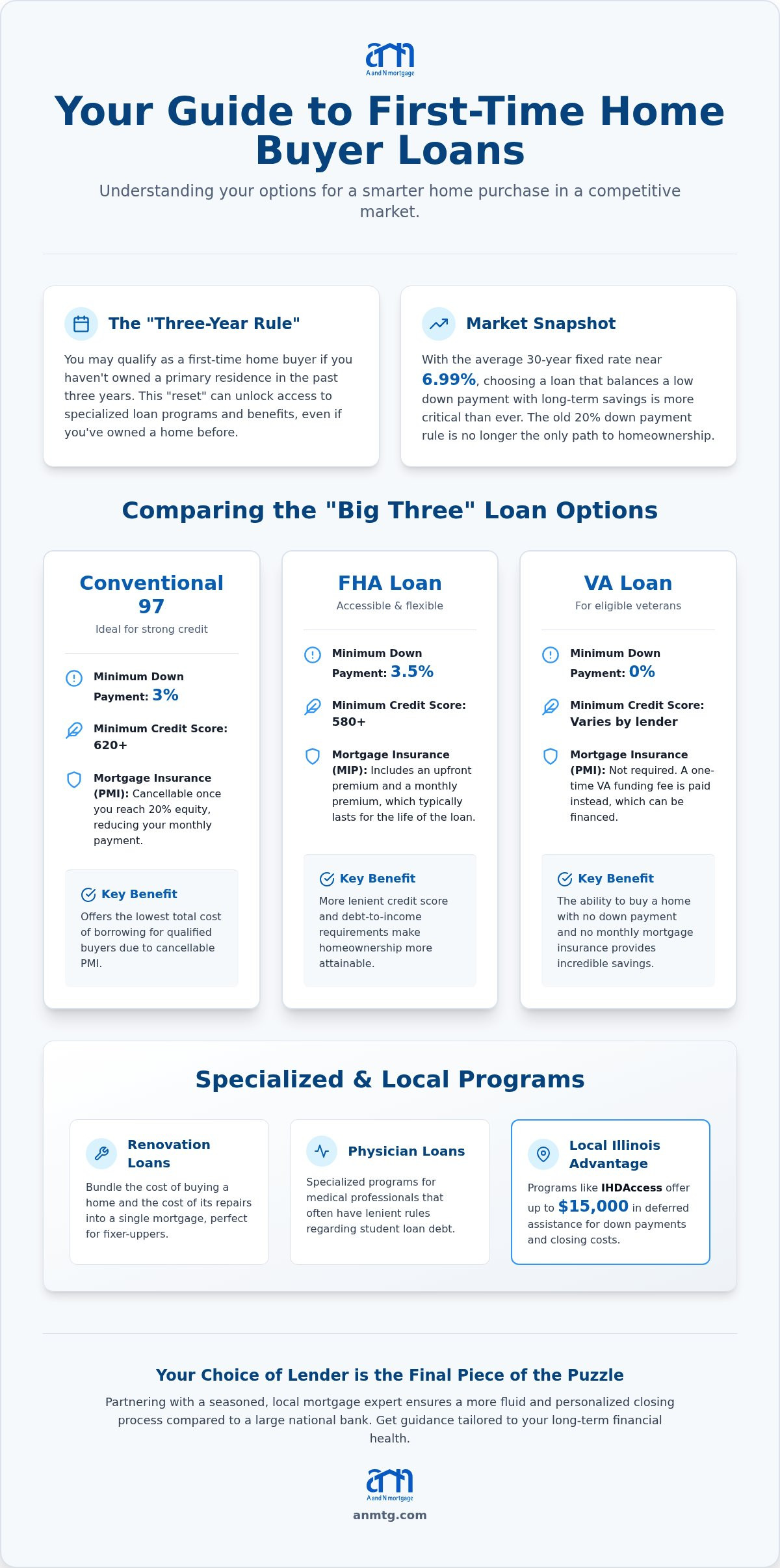
Many people assume they're ineligible for first-time buyer perks because they owned a home years ago. However, the U.S. Department of Housing and Urban Development defines a first-time buyer as anyone who hasn't owned a primary residence in the past three years. This "three-year rule" acts as a financial reset button, allowing previous homeowners to re-enter the market using specialized first time home buyer loans. Understanding this definition is the first step toward accessing programs designed to lower the barrier to entry.
The current market presents a unique challenge where emotional desires meet a complex financial reality. With the average 30-year fixed mortgage rate sitting near 6.99% as of September 2026, the old advice of saving a 20% down payment has largely become a myth. Modern programs like the Conventional 97 or FHA loans allow for down payments as low as 3% or 3.5%. Instead of waiting years to save a massive lump sum, you can step into homeownership sooner by leveraging these low-down-payment options. Having a seasoned guide like A and N Mortgage in your corner helps clarify which path fits your specific budget.
Your loan's sticker price is only one part of the story. While the interest rate determines your monthly principal and interest, the Annual Percentage Rate (APR) includes lender fees and closing costs, offering a truer picture of your expenses within the U.S. mortgage industry. Lenders also scrutinize your debt-to-income (DTI) ratio to ensure your total monthly debts don't overwhelm your earnings. Additionally, your credit score directly dictates the cost of your mortgage insurance; a higher score can significantly reduce these monthly premiums, saving you thousands over time.
Choosing the right loan isn't just about getting the keys; it's about protecting your future net worth. While a smaller down payment keeps cash in your pocket for emergencies, it can result in higher monthly insurance costs. You must weigh the "opportunity cost" of tying up all your liquidity in a house versus keeping a defensive cash reserve for life's surprises. Different first time home buyer loans build equity at different speeds, so your choice should align with how long you plan to stay in the home. The Total Cost of Borrowing represents the sum of all interest, fees, and mortgage insurance paid over the life of the loan, serving as the most accurate metric for your long-term financial success.
Most first time home buyer loans fall into three primary categories, each designed to meet different financial needs. Choosing between them isn't just about the down payment; it's about how the loan structure impacts your monthly budget and long-term equity. While big banks often push a one-size-fits-all product, a seasoned guide helps you weigh the nuances of mortgage insurance and interest rates to find your best fit.
Conventional loans are often considered the gold standard for buyers with credit scores of 620 or higher. Programs like HomeReady and Home Possible are specifically tailored for low-to-moderate-income earners, offering interest rates that are often more favorable than standard conventional products. The standout benefit here is the flexibility of Private Mortgage Insurance (PMI). Unlike government-backed loans, conventional PMI can be cancelled once you reach 20% equity in your home. This allows you to lower your monthly payment in the future without the expense of a full refinance. If your credit is strong, these programs typically offer a lower total cost of borrowing than an FHA alternative.
FHA loans serve as an inclusive path for those with credit scores as low as 580, requiring only a 3.5% down payment. They're also more lenient regarding your debt-to-income ratio, making them a popular choice in high-cost markets. However, they come with specific insurance requirements. You'll pay an upfront premium at closing, followed by a monthly Mortgage Insurance Premium (MIP) that usually lasts for the entire life of the loan. FHA appraisals also prioritize safety and habitability, which acts as a defensive shield by ensuring your first home doesn't have immediate, major structural issues. You can consult with a specialist to see if the flexibility of an FHA loan outweighs the long-term insurance costs for your specific situation.
For veterans and active-duty service members, the VA loan is arguably the most powerful wealth-building tool available. It allows for a 0% down payment and, crucially, requires no monthly mortgage insurance. This lack of PMI can save you hundreds of dollars every month compared to other first time home buyer loans. While most borrowers pay a one-time VA Funding Fee, this cost can be rolled into the loan amount. Veterans with service-connected disabilities are often exempt from this fee entirely. Because the government guarantees these loans, interest rates are frequently the lowest available in the market, providing a stable and affordable path to homeownership for those who have served.
In a competitive market, the most popular first time home buyer loans aren't always the right fit for every unique situation. Specialized mortgage products serve as a "secret weapon," allowing you to look past current limitations like high student debt or outdated property conditions. These programs aren't just transactions; they're tailored solutions that require a collaborator who understands the nuances of your career path or your vision for a fixer-upper. By expanding your search beyond standard products, you can find a path to homeownership that others might overlook.
Medical professionals often face a unique paradox: high earning potential paired with staggering student loan debt. Traditional lenders might see this debt as a barrier. Specialized Doctor Loans offer a different perspective. These programs often exclude deferred student loans from your debt-to-income (DTI) ratio, which significantly increases your buying power. Additionally, many allow for zero or low down payment options and feature no Private Mortgage Insurance (PMI), recognizing that your liquidity might be low early in your career. You can even close on your home before your residency contract officially begins, providing a stable foundation as you start your new professional role.
If you can't find your dream home on the market, you can build it yourself by purchasing a property that needs work and financing the repairs. Renovation loans allow you to roll the purchase price and the cost of improvements into a single mortgage. The Limited 203(k) is ideal for non-structural repairs up to $75,000, while the Standard 203(k) covers major renovations with a minimum of $5,000 in repairs. This process involves a HUD consultant and a licensed contractor to ensure the work meets safety standards and adds real value. Using these first time home buyer loans transforms a dated property into a modern home while building immediate equity in a way that move-in-ready houses cannot match.
Navigating these complex products requires a partner with deep industry literacy. With over 24 years of experience, A and N Mortgage acts as a defensive shield, guiding you through the documentation and contractor requirements of specialized lending. We focus on your long-term success, ensuring you don't just get a loan, but the specific path designed for your unique circumstances. Our internal processes are designed for fluidity, helping you move from a complex application to a successful closing without the typical industry delays.
National lenders often provide generic advice that ignores the powerful state-funded incentives available right here in our backyard. For those seeking first time home buyer loans, local expertise isn't just a preference; it's a financial strategy. A firm with over 24 years of experience in the Chicago market understands how to navigate the specific tax proration and title complexities that can otherwise derail a closing. We act as your collaborator to ensure you aren't leaving money on the table. Chicago's property tax system is unique, and failing to account for how taxes are billed in arrears can lead to unexpected costs at the closing table. Having a seasoned guide helps you avoid these pitfalls and ensures your budget remains accurate from day one.
The Illinois Housing Development Authority (IHDA) remains a cornerstone for local buyers. In March 2026, the IHDAccess Home program launched, providing up to $15,000 in assistance as a 0% interest, deferred second mortgage. This program saw incredible uptake, providing over $18 million to more than 1,500 buyers in its first nine weeks. You can choose between "Forgivable" options, which typically require you to stay in the home for a set period, or "Deferred" options that are repaid only when you sell or refinance. These programs have specific income and purchase price limits that vary by county, so it's vital to check the 2026 eligibility requirements for your specific area. For a deep dive into these state-funded initiatives, explore our guide on down payment assistance Illinois.
Chicago residents have access to even more targeted support. The Chicago HomeGrown Purchase Assistance Grant, which opened applications on June 8, 2026, offers up to $70,000 for down payments and closing costs depending on your income and property location. This is one of the most substantial grants in the city's history, designed to help residents build long-term wealth in their own communities. Beyond grants, Mortgage Credit Certificates (MCCs) can provide significant tax credits, allowing you to reclaim a portion of your annual mortgage interest. We often help teachers, police officers, and municipal employees layer these city-specific incentives with broader first time home buyer loans. This strategic layering can drastically reduce your upfront cash requirement while keeping your monthly payments manageable. By combining state and city programs, some buyers find they need significantly less out-of-pocket cash than they originally anticipated.
Consult with our Chicago mortgage experts to layer your assistance programs
Selecting the right partner for your first time home buyer loans is just as critical as choosing the property itself. While a national call center might offer a generic quote, they often lack the agility required to navigate the final hurdles of a complex transaction. A and N Mortgage brings over 24 years of experience to the table, acting as a defensive shield against the delays and miscommunications common in the broader industry. We don't just process applications; we anticipate potential roadblocks before they threaten your closing date. In a fast-paced market where bidding wars are the norm, our speed becomes your greatest competitive advantage. Speed wins.
Your experience begins with a discovery phase where we identify the specific path designed for your unique financial goals. We combine a tech-forward application process with a high level of attentiveness, ensuring you never feel like just another transaction. This fluidity allows us to move faster than traditional institutions while maintaining the personalized care you deserve. Having a professional in your corner provides the peace of mind necessary to navigate this high-stakes decision with confidence. You'll move through underwriting with a team that values your time and your trust.
Preparation is the key to a stress-free experience. Start by gathering your documentation, including recent pay stubs, tax returns, and bank statements, to facilitate a thorough review. It's essential to understand the distinction between a pre-qualification and a true pre-approval. A pre-approval involves a verified look at your credit and finances, giving you a much stronger standing when you submit an offer. By securing a robust pre-approval for your first time home buyer loans, you signal to sellers that you're a serious, reliable buyer ready to cross the finish line.
Partner with a lender who values your long-term success and secure your pre-approval today
Navigating the landscape of homeownership in 2026 requires more than just finding a low down payment; it demands a strategic look at your total cost of borrowing. From the inclusive flexibility of FHA options to the powerful benefits of VA programs for our veterans, the right path is out there for every unique financial situation. You've seen how local Chicago grants and Illinois assistance programs can layer together to protect your cash reserves while building long-term equity. Making sense of these various first time home buyer loans is a high-stakes decision that shouldn't be made in isolation.
A and N Mortgage brings over 24 years of Chicago mortgage expertise to your side, ensuring your journey is defined by efficiency and personalized care. As a firm named among the top mortgage providers for client care, we're dedicated to acting as your trusted ally from the initial pre-approval to the final signature at the closing table. We prioritize the speed and fluidity of our internal processes so you can compete and win in today's fast-paced market.
Start your personalized home buying journey with A and N Mortgage today
Your dream of owning a home is well within reach when you have a seasoned guide leading the way. We're ready to help you turn that vision into a reality with a mortgage plan designed specifically for your success.
The minimum credit score required for most first time home buyer loans in 2026 depends on the specific mortgage program you choose. For an FHA loan with a 3.5% down payment, a score of 580 is typically the floor, while borrowers with scores between 500 and 579 may qualify with a 10% down payment. Conventional programs usually require a minimum score of 620 to access low-down-payment options like the Conventional 97.
You can purchase a home with 0% down by utilizing a USDA loan for properties located in eligible rural or suburban areas. As of September 2026, the USDA interest rate for low-income borrowers is 5.250%. Additionally, many Chicago residents achieve a zero-down-payment equivalent by layering first time home buyer loans with local grants like the Chicago HomeGrown program, which provides substantial assistance for upfront costs.
Illinois down payment assistance primarily functions through the Illinois Housing Development Authority (IHDA) as a second mortgage. Programs like IHDAccess Home provide up to $15,000 in assistance as a 0% interest, deferred loan. This means you aren't required to make monthly payments on the assistance funds. Instead, the loan is repaid only when you sell the home, refinance your primary mortgage, or pay off the first mortgage entirely.
The primary difference involves credit flexibility and mortgage insurance rules. FHA loans are more inclusive of lower credit scores and higher debt-to-income ratios, but they require mortgage insurance for the life of the loan. Conventional loans typically require a 620 credit score but offer the ability to cancel private mortgage insurance (PMI) once you reach 20% equity, which can significantly lower your long-term cost of borrowing.
Specialized Doctor Loans are available for medical residents, fellows, and attending physicians to help them secure a home early in their careers. These programs often feature 0% or low down payment options and do not require private mortgage insurance. A key advantage is the ability to exclude deferred student loan debt from your debt-to-income ratio calculations, which increases your buying power despite having significant educational debt.
Closing costs in Chicago typically range between 2% and 5% of the home's purchase price. These expenses include lender fees, title insurance, and local items like the Chicago Transfer Tax. Because Illinois property taxes are paid in arrears, your closing statement will also include significant tax prorations. Working with a local expert ensures these complex calculations are handled accurately so you don't face unexpected financial hurdles at the finish line.
You can use a renovation loan for your first home purchase by rolling the repair costs into your primary mortgage. Options like the FHA 203(k) allow you to buy a property that needs work and finance the improvements immediately. This is an excellent strategy for building equity in a competitive market where move-in-ready homes are often priced significantly higher than properties requiring some cosmetic or structural updates.
The mortgage pre-approval process with A and N Mortgage is designed for speed to help you compete in a fast-paced market. While the exact duration depends on the complexity of your finances and how quickly you provide documentation, our fluid internal processes often allow us to issue a pre-approval much faster than traditional banks. This efficiency ensures you have a professional in your corner the moment you find the perfect home.
Welcome to a better mortgage experience! In just few minutes you can find out what you qualify for and explore multiple loan options and interest rates.
Complete our short and intuitive pre-approval interview to get started.