The best mortgage for first-time buyers isn’t automatically the one with the lowest down payment or most appealing rate. The right fit depends on your finances, eligibility, the home you’re buying, and the full cost of ownership. Conventional, FHA, VA, and USDA options each have different rules and trade-offs, so start by identifying which ones fit your situation.
Look beyond what you may qualify for. Compare the money needed upfront, estimated monthly payment, mortgage insurance, closing expenses, and lender fees. Clear guidance also matters when you’re weighing offers and preparing to make an offer on a home. This guide explains how to narrow down mortgage options, compare costs, and prepare for pre-approval in Chicago, including how to research local assistance opportunities.
The best mortgage for first-time buyers balances loan eligibility with the cash you can bring to closing, a manageable monthly payment, and terms that suit your plans. A low down payment or advertised rate may be appealing, but neither tells you the full cost of buying and owning a home. Your financing should fit your finances and the property you intend to purchase.
Approval is only one part of the decision. The amount a lender determines you may borrow is not necessarily the amount that will feel comfortable alongside your debts, savings goals, and everyday expenses.
A mortgage is a good fit when you meet its eligibility requirements, can cover the upfront costs, and can manage the full housing payment while leaving room for other financial needs.
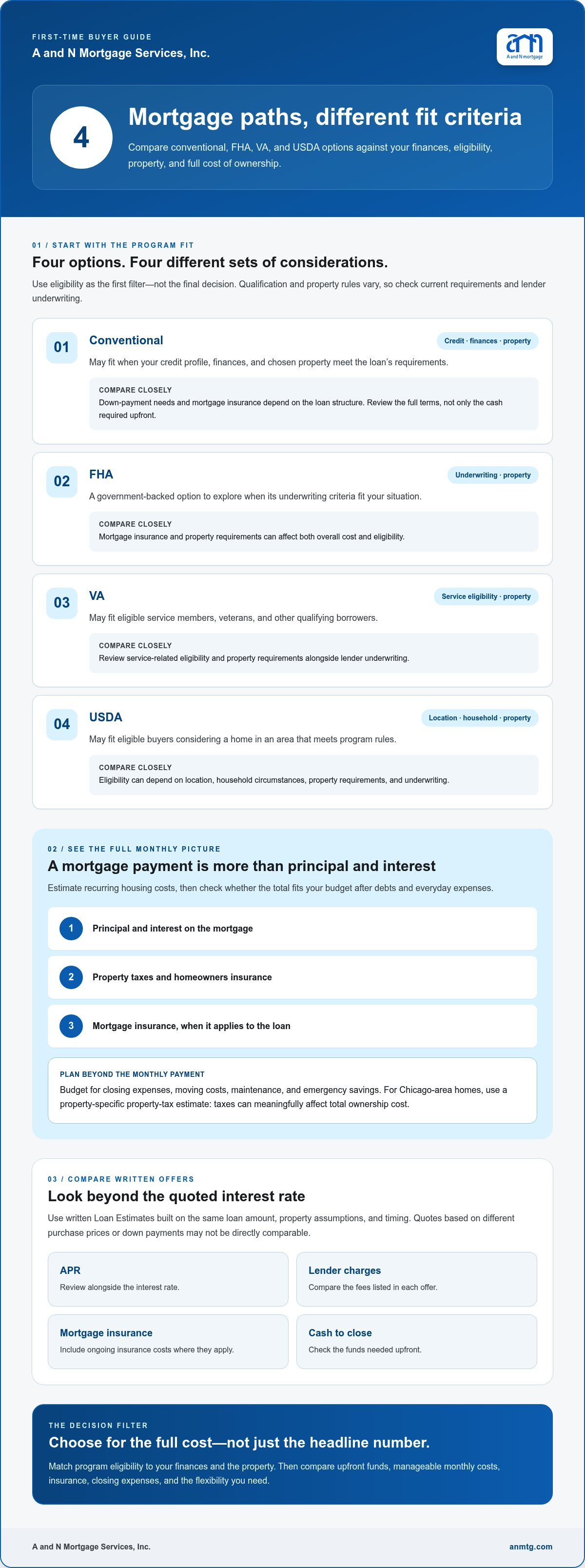
A lower down payment can reduce the cash needed upfront, but it doesn’t show whether the home will be affordable month to month. Estimate the recurring housing payment, including:
Also budget for closing expenses, moving costs, maintenance, and savings for emergencies. Using all your available funds for the purchase can leave little room for repairs or unexpected changes in your budget. In the Chicago area, property taxes can meaningfully affect a home’s total ownership cost, so include a property-specific tax estimate rather than relying on the mortgage payment alone.
Compare the estimate with your budget after accounting for debts and routine expenses. The goal isn’t merely to qualify, but to choose a payment you can manage while maintaining financial breathing room.
“First-time buyer” is a broad description, not a single rule that determines which loan you can get. Mortgage and assistance programs set their own definitions and eligibility criteria. Some may consider whether you’ve owned a home before; others may apply different requirements.
Review the specific rules before relying on a program or assistance. Evaluate each mortgage by its own eligibility criteria, too. For background on one option, see this overview of an FHA insured loan. The right fit comes from matching a program to your circumstances, not assuming that first-time-buyer status alone makes it suitable.
Begin with the loan paths that match your circumstances, then compare their costs and conditions. A conventional mortgage isn’t automatically the right default, and a government-backed option isn’t automatically easier or cheaper for every buyer. Your credit and finances, available funds, military service eligibility, and the property you plan to buy can all affect which options to consider.
Use this overview to identify programs for a closer look. Qualification and property rules vary, so review the current requirements for each option.
A conventional loan may suit a buyer whose credit history, available funds, and target property align with its terms. Compare how different down-payment amounts affect the balance you borrow and whether mortgage insurance applies. Evaluate the full loan offer and your budget rather than assuming conventional financing is reserved for a particular kind of buyer.
FHA, VA, and USDA loans serve different borrower situations. FHA may be worth considering if its underwriting and property rules fit your plans. VA depends on service-related eligibility, while USDA has location and property criteria. Review current program requirements and lender underwriting, then compare the resulting costs and terms.
Eligibility is only the first filter. If more than one option appears possible, compare required funds, ongoing insurance costs, property conditions, and flexibility. A and N Mortgage offers residential loan programs and personalized guidance to help you assess these trade-offs. For a personalized discussion of mortgage options, explore home financing with A and N Mortgage.
A low quoted interest rate can catch your eye, but it doesn’t show the whole cost or whether the offer suits your plans. For a fair comparison, use written Loan Estimates based on the same loan amount, property assumptions, and timing. If quotes use different purchase prices or down payments, their figures may not be directly comparable.
Review each offer as a package. Compare the interest rate, APR, monthly payment, repayment term, rate structure, lock period, and cash to close. APR reflects the rate and certain loan costs, while the interest rate alone doesn’t account for those costs. Review the itemized charges and payment details as well.
A lower rate may come with higher charges, a different payment structure, or a shorter lock period. An offer with a slightly higher rate could fit better if its total costs, monthly payment, and timing align with your budget and purchase plans. Compare the complete terms instead of choosing based on one headline number.
Use the standardized Loan Estimate to review each offer. Compare lender-controlled charges separately from third-party services and prepaid items, which can vary for reasons beyond lender fees. Check that the loan amount, property details, and assumptions match. Estimates help you evaluate options, but figures may change and aren’t the final closing statement.
Clear explanations are part of a useful mortgage experience. Notice whether the lender explains how fees, rate choices, and loan terms affect your costs, and whether you understand the next steps and documents needed. Helpful guidance should make trade-offs easier to assess without promising approval or guaranteed savings.
Write down the questions each estimate raises and ask for clear explanations. Comparing offers this way gives you a stronger basis for choosing financing that fits your budget and purchase plans.
A clear preparation sequence makes mortgage conversations more productive and helps you avoid shopping based on a number that doesn’t fit your finances. Start by setting a realistic budget, organizing financial documents, discussing financing options, and then planning your home search and offers.
Pre-approval can be a useful early planning tool. It gives you an initial view of financing based on information reviewed at that stage and can help shape your home search. It isn’t a guarantee of final loan approval. The lender will still need to review your application and the property as the purchase progresses.
Start with take-home income, recurring debts, savings, and expected ownership expenses, including taxes, insurance, maintenance, and utilities. Decide how much cash you want to keep available after closing, not only how much you might put toward the purchase. Gather recent income records, bank or asset statements, debt information, and identity documents for a focused financing conversation.
Your credit history, debt obligations, and other parts of your financial profile may affect which options are available. Requirements vary by program and underwriting, so don’t treat a single score or debt-ratio rule as a promise of eligibility. A lender can assess your circumstances and explain what information may be needed next.
The Illinois Housing Development Authority (IHDA) is a starting point for researching statewide homebuyer assistance. Local and state offerings have distinct eligibility rules and can change. Check current program details, application status, funding, and any participating-lender requirements before including assistance in your purchase budget.
Read the terms closely. Assistance may have conditions for eligible buyers, properties, or use of funds, and repayment terms can differ. Treat potential assistance as one part of your financing plan until you understand its requirements. The Down Payment Assistance Illinois: The 2026 Guide to Homeownership can help you identify questions to investigate as you prepare.
With your budget, documents, and assistance research organized, you can discuss financing options and approach offer planning with clearer expectations. A and N Mortgage Services, Inc. provides personalized guidance on residential financing for Chicago buyers.
Discuss your Chicago home financing options
Choosing financing is easier when you connect the options to your plans. A and N Mortgage Services, Inc. is a Chicago-based residential mortgage lender that helps buyers navigate home financing with personalized guidance. With over 24 years of experience, the firm helps clients understand how residential loan programs relate to their finances, property goals, and purchase plans.
Its programs include conventional, FHA, VA, USDA, jumbo, construction, and renovation loans. This range supports a focused discussion about which options may suit your circumstances. No single loan type is right for every buyer. The goal is to understand the trade-offs and identify options worth exploring.
Before discussing financing, note your budget, the type of property you hope to buy, your target timing, and the questions you want answered. You don’t need every detail settled. A simple outline helps keep the conversation grounded in your priorities.
Your available funds, property plans, and eligibility can lead to different questions about conventional and government-backed options. A lender can explain those distinctions and help you decide what to review next. Guidance can support an informed decision, but it can’t guarantee approval, a particular rate, or a specific result.
A and N Mortgage provides residential home financing. Bring your questions and priorities to a loan discussion, and use it to understand which options deserve closer review. You can discuss how your goals may connect to the firm’s conventional, FHA, VA, USDA, jumbo, construction, and renovation programs. The best mortgage for first-time buyers is the one that fits the borrower’s circumstances and purchase, not a one-size-fits-all ranking.
You don’t need every decision made in advance. A focused conversation can turn broad research into a manageable set of financing options as you prepare for your first home purchase.
Explore your mortgage options with A and N Mortgage
Your first home plan doesn’t need every detail settled before you move forward. Start with your priorities and use a financing conversation to clarify what you still need to learn. The best mortgage for first-time buyers is a choice you can make with clear expectations about how the financing fits your life beyond the purchase.
Bring your questions and note any trade-offs you’re weighing. A focused conversation can put possible loan paths in context and help identify next steps without requiring you to have every answer in advance.
Explore your mortgage options with A and N Mortgage
Your first home is a meaningful milestone. Take it one informed step at a time as you move toward your next chapter.
No. The best mortgage depends on your finances, the property, and any program-specific eligibility you meet. A buyer with qualifying military service, for example, may consider a VA loan, while another buyer may compare conventional and FHA options. Treat “best mortgage for first-time buyers” as a personal fit question, not a universal ranking. Compare available paths against your purchase plans and financial comfort.
Yes, some buyers may qualify for options with a relatively small down payment, but the amount depends on the loan program and borrower qualifications. Eligible conventional borrowers may be able to put down 3%, and FHA may allow 3.5% for qualifying borrowers. VA and USDA loans may offer zero-down options for eligible buyers, subject to program rules. A smaller down payment can also affect mortgage insurance and borrowing costs.
There isn’t one amount that fits every purchase. Build a budget around your down payment, estimated closing expenses, and the costs of moving and setting up the home. Keep funds available for repairs, routine upkeep, and emergencies instead of assigning all savings to closing. In Chicago, include the property’s tax estimate in your monthly planning. Ask for estimates based on the home and loan you’re considering.
You don’t have to borrow the maximum amount offered. Set a payment limit based on regular expenses, savings goals, and the costs you expect after moving in. Then discuss a lower purchase budget or a different loan structure with your mortgage professional. Qualification indicates what may be possible under review, not what you must spend.
Possibly. Illinois and Chicago-area programs may help eligible buyers with upfront homebuying expenses, but availability, funding, and terms can change. Start with the Illinois Housing Development Authority and review relevant local programs. Check each program’s current eligibility rules, participating-lender requirements, application status, and whether assistance must be repaid or has other conditions. Include assistance in your plan only after understanding its terms and how it works with your mortgage.
No. Pre-approval is an early assessment based on the financial information available at that stage. Final approval may depend on updated documentation, underwriting review, and details about the property you choose. If your income, debts, savings, or purchase plans change, share that information during the process. Treat pre-approval as a planning step that can inform your search, not as a guarantee that every future loan condition has been satisfied.
No. A rate alone won’t show all the differences between offers. Check the APR, itemized lender charges, any points, mortgage insurance, cash needed at closing, and how long the quoted rate is locked. Also consider whether explanations are clear if an estimate changes. Comparing written offers built on the same loan amount and purchase assumptions can reveal differences a headline rate may not show.
Welcome to a better mortgage experience! In just few minutes you can find out what you qualify for and explore multiple loan options and interest rates.
Complete our short and intuitive pre-approval interview to get started.