A gap between a 760 and a 640 credit score can result in paying over $72,000 more in interest over the life of a typical 30-year mortgage. It's natural to feel a sense of anxiety when you think about that three-digit number, especially if you're worried a single past mistake might lead to a mortgage rejection. You may feel overwhelmed by the conflicting data regarding FICO versus Vantage scores or wonder if the credit score needed for mortgage approval has shifted with recent 2026 market changes. We believe that homeownership should be accessible, and the first step is replacing that uncertainty with a clear, strategic plan.
This guide explains the exact requirements for every major loan program, including FHA, VA, and the updated conventional standards that now emphasize holistic credit-risk assessments. You'll discover how different credit brackets impact your monthly payment and learn the specific steps to position yourself for the most favorable interest rates. We will break down the magic numbers for each loan type and provide a roadmap to help you start the pre-approval process with total confidence in your financial standing.
Your credit score is more than just a three-digit number on a screen; it's a financial passport that determines which loan programs you can access. While many people track their credit through free apps, the specific credit score needed for mortgage approval is calculated using different algorithms than those seen by the general public. Lenders view this number as the primary indicator of your likelihood to repay a long-term debt, making it the cornerstone of your homeownership journey. In the current 2026 market, even as lending standards evolve, your score remains the most influential factor in a bank's risk assessment.
A high score doesn't just help you get a "yes" from a lender. It also significantly lowers your monthly housing costs by reducing Private Mortgage Insurance (PMI) premiums and securing more competitive interest rates. Understanding how a credit score in the United States functions is essential because it allows you to advocate for your own financial interests. By knowing where you stand, you can transition from a state of uncertainty to one of informed confidence.
The "free" scores you see on credit card statements or monitoring websites often use the VantageScore model. This is helpful for general tracking, but it isn't what mortgage lenders use to evaluate your application. For home loans, the industry relies almost exclusively on FICO Models 2, 4, and 5. These versions are specifically tuned to predict mortgage risk over several decades. Because these models weigh data like credit utilization and age of accounts differently, your mortgage score might be 20 to 40 points lower than what your consumer app shows. You should request a formal mortgage credit pull early in your search to avoid surprises when you find the right home.
Lenders pull data from the three primary credit repositories to get a complete picture of your history:
Instead of averaging these three numbers, lenders use the "middle score" as your definitive benchmark. If your scores are 680, 700, and 720, your qualifying score is 700. When two people apply together, the process becomes more conservative. Lenders identify the middle score for each borrower and then use the lower of those two numbers to determine eligibility. This ensures the loan is supported by the credit strength of both participants. Ultimately, the middle score serves as the definitive benchmark for your loan eligibility and interest rate pricing.
Every loan program operates with its own set of standards, meaning there isn't a single universal number that guarantees approval. While the credit score needed for mortgage eligibility often centers around the 620 mark, the 2026 market has seen a shift toward more holistic risk assessments. This means your score is the starting point, but lenders also weigh it against your down payment and debt levels. Before you commit to a specific path, it’s wise to check your credit and review your report for any errors that could impact your qualifying middle score.
Borrowers in the 620 to 680 range often find themselves in a "middle ground" where they qualify for multiple programs. In these cases, a Conventional loan might be possible, but an FHA loan could actually offer a lower monthly payment due to better interest rate pricing for that specific credit tier. A and N Mortgage specializes in these complex scenarios, helping you find a tailored loan solution that matches your current financial profile and long-term goals.
Conventional loans generally require a minimum score of 620. While Fannie Mae and Freddie Mac have moved toward more flexible risk assessments, most lenders still use 620 as a hard floor. To secure the most favorable interest rates and lower insurance costs, you'll typically need a score of 740 or higher. If your score sits below 620, an FHA loan is often the most viable alternative. These government-backed loans allow for scores as low as 580 with a 3.5% down payment. If you can provide a 10% down payment, you may even qualify with a score between 500 and 579, depending on specific lender overlays.
VA loans, designed for veterans and active-duty service members, technically have no minimum score set by the Department of Veterans Affairs. However, most lenders look for a score of at least 580 to 620 to ensure the borrower can manage the obligation. Similarly, USDA loans for rural properties usually require a 640 score for automated underwriting approval.
Jumbo loans exceed standard conforming limits, which in 2026 range from $832,750 to $1,249,125 depending on your county. Because these loans represent a higher risk for the lender, you'll generally need a score of 700 to 720 at a minimum. Specialized programs like Doctor loans offer more flexibility, often allowing residents and fellows to qualify with high student debt as long as their credit score is strong. Conversely, Construction and Renovation loans often require stricter credit standards. Since these "build-to-suit" projects involve more moving parts than a standard purchase, lenders typically look for a score of 680 or higher to mitigate the added risk of the construction process.
Your credit score acts as a financial lever. It determines more than just your eligibility; it dictates the actual cost of your monthly payment through interest rates and insurance premiums. While you might focus on the minimum credit score needed for mortgage approval, the real goal is reaching the next tier to trigger better pricing. Lenders use a system called Loan Level Price Adjustments (LLPAs) to account for risk. These adjustments are essentially surcharges applied to borrowers with lower scores or smaller down payments, which can be paid as a fee at closing or built into a higher interest rate.
A and N Mortgage acts as your advocate during this process. We help you analyze these pricing tiers to find the exact "sweet spot" where your score and monthly savings align. By understanding how these numbers interact, you can make an informed decision about whether to buy now or take a few months to boost your score for a better long-term return.
Mortgage pricing moves in distinct brackets or "tiers" rather than a smooth sliding scale. Typically, these tiers shift every 20 points. For example, a borrower with a 701 score might see a noticeably better rate than someone at 699. This small difference has a massive impact over time. Consider a $300,000 30-year fixed-rate mortgage using current 2026 data. A borrower with a 760 score could qualify for a 6.25% interest rate, resulting in a monthly payment of roughly $1,847. In contrast, a borrower with a 640 score might receive a 7.25% rate, pushing that payment to $2,047. That $200 monthly difference adds up to $72,000 in extra interest over the life of the loan. Interest rate spreads can vary by up to 1.5% based on credit alone.
The influence of your score extends beyond the interest rate. If you are pursuing Conventional Mortgage Loans with less than 20% down, your credit score directly dictates your Private Mortgage Insurance (PMI) costs. For every $100,000 borrowed, PMI can cost between $30 and $70 annually. Lower-credit borrowers often find themselves at the higher end of that range, adding hundreds of dollars to their yearly expenses. FHA loans offer a different path with a flat Mortgage Insurance Premium (MIP) structure that doesn't fluctuate based on your score. A higher score can also reduce certain lender fees or closing costs because the perceived risk to the bank is lower.
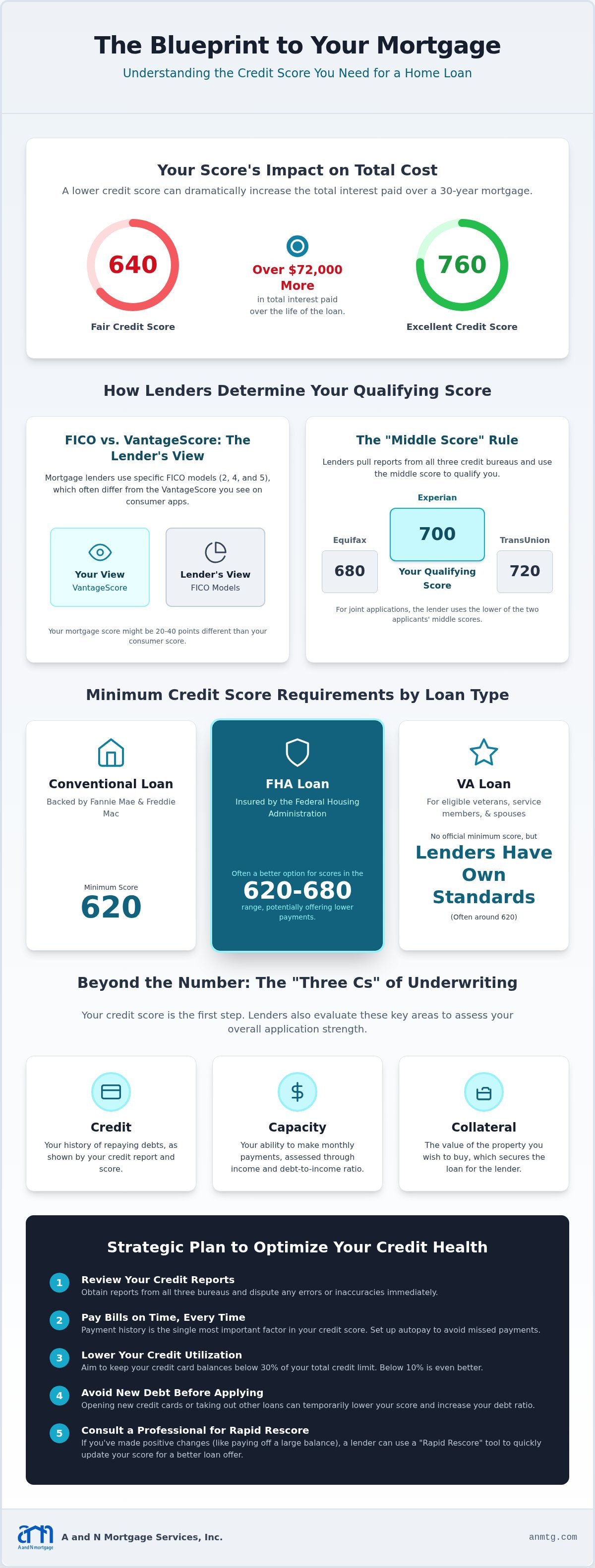
While the credit score needed for mortgage approval is a vital metric, it's only one piece of the underwriting puzzle. Lenders rely on a framework known as the "Three Cs": Credit, Capacity, and Collateral. Credit is your historical behavior, Capacity is your financial ability to handle the new payment, and Collateral is the value of the home itself. In our local Chicago market, your "Capacity" is often influenced by factors that national lenders might overlook, such as high property taxes and specific HOA fees in downtown high-rises. These local costs can push your monthly obligations higher, even if your credit score is excellent.
Underwriters also look for what's known as "credit depth." This refers to the age and variety of your accounts rather than just the final number. A 720 score based on a single credit card opened eighteen months ago carries less weight than a 720 score supported by a decade of diverse history, such as auto loans and seasoned revolving accounts. This depth demonstrates long-term reliability that a single three-digit number cannot fully capture.
Connect with a seasoned mortgage guide to review your options
Your Debt-to-Income (DTI) ratio measures how much of your monthly gross income goes toward paying existing debts. Most loan programs set limits between 43% and 50% of your pre-tax income. While a strong credit score can sometimes persuade an underwriter to allow a slightly higher DTI "stretch," it isn't a silver bullet. If your debt levels are high relative to your earnings, a perfect score won't necessarily secure an approval. If you're concerned about how your debt affects your buying power, you might consider exploring Down Payment Assistance Illinois programs to reduce your initial loan amount and improve your overall ratio.
Lenders prefer to see a two-year consistent work history within the same industry. This stability suggests that your income is reliable and likely to continue throughout the life of the loan. If your credit score is on the lower end of the spectrum, having significant "cash reserves"—money left in your bank account after closing—can significantly strengthen your application. These reserves act as a safety net, proving to the lender that you can handle unexpected expenses without defaulting on your mortgage. At A and N Mortgage, we look at the whole person. We understand that your financial story is more than just a report, and we work to highlight the strengths in your unique situation.
The path to homeownership isn't always a straight line, but you don't have to walk it alone. While the credit score needed for mortgage approval might seem like a rigid barrier, it's actually a metric we can influence through strategic planning. We believe in empowering our clients with a clear roadmap rather than leaving them to guess their standing. Whether you're ready to buy a home in the Chicago area today or you're looking to position yourself for a purchase later in 2026, having a seasoned guide in your corner makes all the difference.
At A and N Mortgage, we offer more than just loan products; we provide a partnership. Our team utilizes professional tools like a "Rapid Rescore" to help qualified borrowers update their credit profiles in days rather than months. This process can be the key to moving from one interest rate tier to the next, potentially saving you thousands over the life of your loan. We take pride in finding solutions for borrowers who might feel "outside the box" due to complex financial histories or unique income structures.
Chicago's real estate market involves nuances that national call-center lenders often miss. From understanding how Cook County property taxes affect your buying power to navigating specific HOA requirements in local condo buildings, local expertise is invaluable. Led by Neena Vlamis since 1998, A and N Mortgage brings 24+ years of residential lending experience to your side. We've navigated every market cycle, and we use that history to provide stable, reassuring guidance for first-time buyers and seasoned investors alike. Stop wondering if your score is high enough and start building a definitive path toward your new front door. We're here to turn your homeownership goals into a reality through personalized care and expert advocacy.
Schedule your personalized mortgage consultation today.
Understanding the credit score needed for mortgage approval is the first step toward securing your financial future. Your three-digit number is a strategic tool that dictates everything from your interest rate to your monthly insurance premiums. Whether you're aiming for a Conventional loan at 620 or leveraging the flexibility of an FHA program, even a small 20-point improvement can save you tens of thousands of dollars over the life of your loan. By optimizing your credit utilization and addressing report errors now, you're not just qualifying for a loan; you're actively building long-term wealth.
A and N Mortgage stands as Chicago’s trusted residential lending ally, offering 24+ years of expert mortgage guidance. We provide personalized loan programs for every credit tier. This ensures every borrower has a clear route to the closing table. You don't have to navigate these complex requirements alone when you have a seasoned partner dedicated to your success.
Get Started with an A and N Mortgage Expert Today
Your homeownership goals are within reach. We're here to provide the stability and expertise you need to move forward with total confidence.
Yes, you can qualify for an FHA loan with a score as low as 500, provided you can supply a 10% down payment. However, many Chicago lenders apply "overlays" that require a higher minimum, often 580 or 620. If your score is at this level, we recommend a personalized consultation to review your specific credit history and determine which specialized programs might be available for your unique financial situation.
Most borrowers see meaningful changes within 30 to 90 days of implementing a strategic credit plan. While some "quick wins" like paying down high credit card balances can reflect in your score within a single billing cycle, more complex issues like disputing errors may take longer. We utilize professional tools to help identify the most efficient path for the credit score needed for mortgage approval, ensuring you don't waste time.
A formal mortgage inquiry typically results in a small, temporary dip of fewer than five points on your credit report. The credit bureaus recognize that home buyers need to compare rates, so they treat multiple mortgage-related inquiries within a 14 to 45 day window as a single event. This allows you to shop for the best terms in Chicago without worrying about significant damage to your overall credit profile during the process.
A soft pull occurs when you check your own score or a lender pre-qualifies you, and it has zero impact on your credit. In contrast, a hard pull happens when a lender reviews your credit to make a final lending decision, which can cause a minor point reduction. We often start with a soft pull to provide an initial roadmap, moving to a hard pull only when you're ready to secure a formal pre-approval.
You can certainly buy a home with a 600 score, though your options will likely lean toward FHA or VA loan programs rather than Conventional loans. Having no debt is a significant advantage because it results in a low debt-to-income ratio, which strengthens your application in the eyes of an underwriter. This financial stability often helps offset a lower credit score, particularly when you're navigating the competitive Chicago real estate market.
A larger down payment significantly reduces the lender's risk and can help compensate for a lower credit score. For example, FHA guidelines require a 10% down payment for scores between 500 and 579, compared to just 3.5% for scores above 580. In Chicago's diverse market, putting more money down can sometimes help you secure a loan approval that might otherwise be out of reach due to credit challenges or strict lender requirements.
Borrowers with a 740 score often receive interest rates that are 0.75% to 1.5% lower than those offered to borrowers with a 640 score. On a $300,000 mortgage, this difference can save you over $200 per month and more than $70,000 in interest over 30 years. Achieving the credit score needed for mortgage pricing at the highest tiers is one of the most effective ways to lower your long-term housing costs.
If your application is denied, the first step is to review the "Adverse Action Notice" to understand the specific reasons for the rejection. Don't be discouraged, as many successful homeowners faced an initial setback. We suggest working with a seasoned guide to create a credit restoration plan, which may include disputing inaccuracies or restructuring existing debt. Our team specializes in helping Chicago families move toward a confident loan approval.
Welcome to a better mortgage experience! In just few minutes you can find out what you qualify for and explore multiple loan options and interest rates.
Complete our short and intuitive pre-approval interview to get started.