A mortgage, including an adjustable-rate loan, can be paid biweekly if the lender allows that schedule, although not all lenders offer biweekly programs. In the bi-weekly vs monthly mortgage payments comparison, the key difference is that paying half the monthly amount every two weeks makes 26 payments a year, equivalent to 13 monthly payments instead of 12. That extra amount can reduce principal and the interest charged over time when it’s applied to the loan balance.
When comparing bi-weekly vs monthly mortgage payments, it’s natural to focus on payment frequency as a way to manage mortgage costs. But the schedule alone doesn’t tell the whole story. How payments are applied, and whether extra money goes toward principal, also matter.
This guide explains how monthly and biweekly schedules work, how they may affect interest, and what to consider before changing your payment routine. You’ll also find alternatives for paying down principal, so you can compare options with your budget and loan terms in mind.
Monthly payments follow a regular calendar schedule: borrowers make one payment each month, usually toward principal and interest. A standard schedule has 12 payments per year. Payments are often due on the first of the month, and many loans include a grace period before a late fee applies; check your loan documents for your exact terms.
How do biweekly and monthly mortgage payments work? With monthly payments, you pay the scheduled amount once each month. With biweekly payments, you generally pay half that monthly amount every two weeks, making 26 payments a year, or the equivalent of 13 monthly payments.
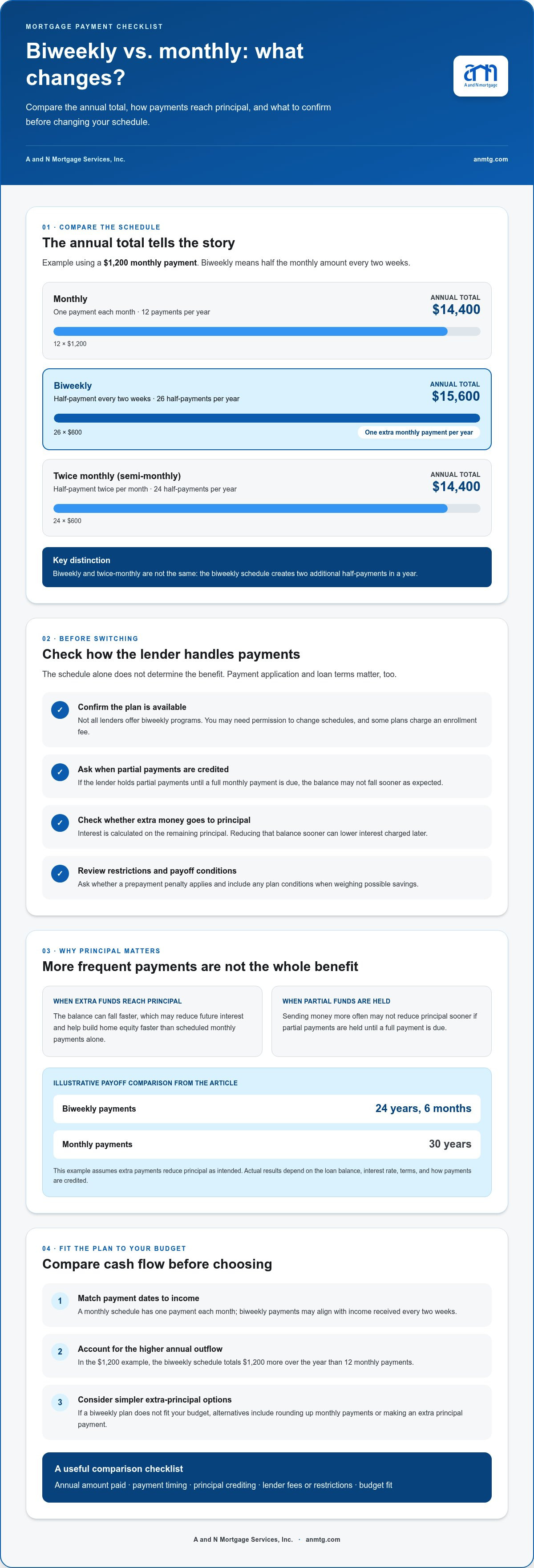
That extra monthly equivalent is the key distinction in a bi-weekly vs monthly mortgage payments comparison. For example, if the monthly payment is $1,200, a half-payment is $600. Paying $600 every two weeks totals $15,600 annually, compared with $14,400 through 12 monthly payments. The additional amount can reduce the outstanding balance when it is applied to principal.
“Biweekly” and “bimonthly” describe different calendars. Biweekly means every other week, while semi-monthly means twice per month (people often call this “bimonthly”). A twice-monthly schedule makes 24 half-payments per year, matching 12 full monthly payments. Because a year has 52 weeks, the biweekly schedule produces two more half-payments than a twice-monthly schedule.
Payment timing and processing matter, too. A lender may not offer a biweekly plan, and some charge an enrollment fee. You may also need permission to change schedules. Before switching, find out how each payment is credited, whether extra money goes to principal, and whether a prepayment penalty applies. These details determine how the schedule works in practice.
Choose a schedule that fits your pay cycle and cash flow, then compare the annual total and how your lender applies each payment.
With a monthly schedule, the payment amount is usually consistent, though it depends on the mortgage type. Principal and interest make up the loan payment, and their shares change over time. Early payments generally devote more to interest, while later payments devote more to principal. If your payment also covers taxes and insurance, those amounts are held in an escrow account. A monthly due date can make budgeting simple, while biweekly payments may align with income received every two weeks.
Consider the cash-flow difference before enrolling. A biweekly schedule spreads payments across more dates and increases the annual amount paid. A monthly schedule means one payment each month. Compare the budget impact, how payments reduce the balance, and any program conditions before choosing.
Biweekly payments may reduce interest if they lead to additional principal payments during the year. The effect depends on the loan balance, interest rate, payment application, and schedule.
Mortgage payments generally include principal and interest, but the split changes over time. Because interest is calculated on the remaining principal, reducing that balance sooner can lower interest charged later. Early in the loan, most of each scheduled payment generally goes toward interest; as repayment progresses, more goes toward principal.
When extra biweekly amounts are credited to principal, they can build home equity faster than scheduled monthly payments alone. The benefit comes from reducing the balance, not simply from sending money more often. If the lender holds partial payments until a full monthly payment is due, the timing may not reduce principal as expected. Payment processing matters as much as the schedule.
Paying an extra monthly equivalent each year can shorten the repayment period because the principal falls faster. In the illustration below, a $300,000, 30-year fixed-rate loan at 6.5% is paid off in about 24 years and 2 months when one extra monthly payment a year goes to principal. The actual effect depends on the loan balance, interest rate, and terms, so the example illustrates the mechanism rather than a universal timeline.
Before switching schedules, find out how partial payments are applied and whether the plan has an enrollment fee. Some loans also have prepayment penalties for early payoff. Include these conditions when comparing potential savings with the additional annual payment.
This illustration assumes the extra amount (one monthly payment per year, spread across the year) is applied to principal as intended. Interest savings vary with the starting balance, rate, loan terms, and how payments are credited.
Use the example as a comparison framework: consider total interest, payoff timing, and the additional annual amount required. Then compare those figures with your own loan balance and payment schedule. Paying less interest requires higher cash outflow during the year, so weigh a potentially faster payoff against your budget needs.
The key differences are the payment dates and the annual amount paid. They also determine how a biweekly schedule fits your income and loan terms.
A biweekly mortgage schedule means a payment every other week. Since a year has 52 weeks, this creates 26 payment dates, unlike twice-monthly schedules, which have 24. The extra two half-payments add up to one monthly payment when each installment equals half the monthly amount.
Some lenders offer biweekly plans, while others don’t. Some charge enrollment fees, and you may need permission to begin. An adjustable-rate mortgage may also use biweekly payments if the lender allows it, but the payment amount can change as the loan’s rate adjusts.
Payment plans don’t all apply money to the loan balance in the same way. Find out whether partial payments are credited when received or held until a full monthly amount is available. This affects when principal is reduced and how the schedule works alongside an adjustable rate.
For example, if the monthly payment is $1,200, each biweekly installment is $600. Paying $600 every two weeks totals $15,600 annually, while 12 monthly payments total $14,400. The biweekly schedule therefore requires an additional $1,200 during the year.
A bimonthly or semi-monthly plan makes 24 half-payments per year. At $600 each, that also totals $14,400, matching 12 full monthly payments. Compare the annual amount, not just the smaller installment, to see the actual cash commitment.
If your lender doesn’t offer a biweekly plan, you can make extra principal payments monthly or set money aside for an additional payment each year. Rounding up your monthly payment is another way to add principal without changing the scheduled due dates.
To test whether biweekly payments fit your budget, map each $600 installment against your pay dates and regular expenses. Then compare the total scheduled outflow across the year with your monthly payment plan, including the extra monthly equivalent. A simple framework like the 50/30/20 budgeting method can help.
Biweekly timing may align with income received every two weeks, but the additional annual amount still needs to fit your budget. Include housing costs, essential bills, and savings in the same cash-flow plan.
Separate payment frequency from the loan’s interest-rate structure. An adjustable-rate mortgage changes its rate according to its terms, while a biweekly schedule changes when payments are made. Consider both: review how a rate adjustment affects your payment, how each installment is applied, and whether the annual total remains manageable.
A biweekly plan isn’t the only way to reduce principal. Some mortgage loans have prepayment penalties, often during the first few years of the loan. Some lenders also charge enrollment fees for biweekly plans.
Making an extra payment each year can match the additional annual amount in a biweekly schedule without changing your regular monthly due dates. You can save part of each paycheck, then send the accumulated amount as one extra payment. If you can’t use a biweekly plan, monthly extra payments can spread the added cash outflow across the year.
Choose a method that fits your cash flow. A single annual payment requires setting aside money consistently, while monthly additions reduce principal more gradually. Both add to your scheduled payment, so budget for regular housing costs first. The main difference is timing: a lump sum reaches the loan balance at once, while smaller additions reach it over several payments.
For a practical routine, decide how much you can set aside from each pay period, then keep it separate from funds reserved for scheduled mortgage payments. At year’s end, use the saved amount for an extra payment. If an unexpected expense changes your budget, you can adjust monthly contributions before making the extra payment.
The purpose of an extra payment is to reduce the outstanding principal, not simply to pay future installments early. Make the payment through the lender’s designated process, and label the additional amount for principal. Payment records should show the extra funds applied toward the balance; otherwise, the intended reduction may not happen as planned.
Rounding up is another flexible option. Add a manageable amount to each monthly payment and direct it toward principal. Unlike a fixed annual extra payment, rounding up creates a smaller, repeated contribution. You can adjust the amount to fit your budget while keeping it separate from the scheduled payment.
Keep the payment components clear. A mortgage payment includes principal and interest, and interest is based on the remaining principal balance. Extra funds reduce future interest only when they lower that balance. Paying a future installment early is not necessarily the same as making an extra principal payment; the accounting treatment can differ.
Before choosing a method, review your loan’s prepayment terms and payment instructions. A prepayment penalty may affect the cost of paying down a mortgage early, while an enrollment fee applies to joining a biweekly plan. Compare these conditions with the flexibility of making extra monthly payments or saving toward an annual payment.
The term “bimonthly” can be confusing because it is sometimes used to mean twice-monthly payments. For mortgage comparisons, focus on the actual payment dates: twice monthly, every other week, or once monthly.
A calendar year has 12 months and 52 weeks. Those calendars create different payment counts, even when each installment is half the regular monthly amount. The distinction matters for budgeting and for understanding whether a schedule adds money toward the mortgage over the year.
With twice-monthly payments, the two installments together equal one monthly payment. The dates can follow a set pattern, such as two chosen dates each month. This gives borrowers a predictable monthly total divided into smaller amounts.
Biweekly payments follow the week calendar instead. Biweekly payment dates do not align with calendar months, so some months may include an extra scheduled payment. Those dates create the extra half-payments that distinguish the schedule from twice-monthly payments.
Compare each plan by its annual total, due dates, and how the lender applies funds. Dividing a mortgage payment into installments doesn’t automatically reduce principal sooner; processing determines when the balance changes. Find out how partial payments are credited, whether a biweekly plan has an enrollment fee, and whether your loan permits the schedule. A mortgage advisor can help organize these details into a practical comparison.
For a clear budget check, list your income dates alongside mortgage drafts and recurring bills. Total the scheduled payments across the full year instead of comparing one installment with one monthly payment. Include the additional annual payment created by a biweekly schedule, and keep enough cash available for months with three drafts.
If your lender doesn’t offer biweekly payments, monthly extra principal payments or saving toward an additional annual payment are alternatives. Find out how extra amounts are applied so you can distinguish a principal reduction from funds held for a future scheduled payment.
A and N Mortgage Services, Inc. helps borrowers explore residential home financing, including Conventional Loans, while comparing mortgage options and payment plans. Payment frequency affects budgeting and how extra funds may reduce principal, while the loan program shapes the mortgage structure. Considering both can help you make a more informed borrowing decision.
If you’re weighing a conventional mortgage against a Jumbo Loan or FHA Loan (including the disadvantages of FHA loans), A and N Mortgage Services, Inc. offers personalized guidance through the home financing process. Discuss your priorities, payment approach, and loan options together to understand how they fit your plans, including how much house you can comfortably afford.
Contact A and N Mortgage Services, Inc. or visit anmtg.com to discuss your mortgage options.
Your payment approach should support, not compete with, your broader homeownership plans. Before changing schedules, consider how predictable you need your monthly cash flow to be, how you want to direct extra funds, and whether flexibility or paying down principal is your priority. These priorities can help make the bi-weekly vs monthly mortgage payments decision a practical part of your overall financing plan.
If you’re preparing to buy or reviewing your options, A and N Mortgage Services, Inc. can help you consider a Conventional Loan, Jumbo Loan, or FHA Loan in light of your goals. Discussing the loan structure alongside your payment approach can help you move forward with a clearer plan.
Contact A and N Mortgage Services, Inc.
Take the next step with a thoughtful plan and a clearer view of the path ahead.
A bimonthly mortgage usually means a schedule with two payments each month, rather than a different type of mortgage loan. The term can be ambiguous, so check the due dates and annual payment count. A twice-monthly plan divides the regular monthly amount into two installments. A biweekly plan instead follows a two-week cycle and the calendar year’s weeks.
Savings depend on the loan balance, rate, terms, and how payments are credited. In the illustration above, a $300,000, 30-year loan at 6.5% saves roughly $87,000 in interest when one extra monthly payment a year goes to principal. Treat that as an illustration, not a forecast. Compare projected interest totals using your loan’s actual balance, rate, and payment application.
In the illustration above, the extra principal pays off the 30-year mortgage in about 24 years and 2 months, nearly 6 years sooner. Your timeline depends on the mortgage’s balance, interest rate, terms, and whether the extra amount reduces principal. Compare payoff estimates using the same loan assumptions and confirm that the payment schedule credits extra funds to the balance rather than holding them for a future installment.
Start with your scheduled monthly principal-and-interest payment. Divide it by two to estimate each biweekly installment, then multiply that installment by 26 to find the annual biweekly total. For the monthly schedule, multiply the monthly amount by 12. Compare the annual totals, payment dates, and projected interest, using the same loan balance, rate, and term. Include any plan fees in your comparison if they apply.
Yes. To match the extra annual amount in a biweekly schedule, divide one monthly payment by 12 and add that portion to each monthly payment, directing it toward principal. This spreads the additional amount across the year rather than making it through biweekly installments. Check your payment records to ensure the extra funds reduce principal. The timing may differ, so the interest result can differ too.
Biweekly payments arrive every other week, while semi-monthly payments are scheduled twice each month. The distinction is the calendar: biweekly timing creates 26 half-payments per year, while semi-monthly timing creates 24. If each installment is half the monthly amount, the biweekly total includes an extra monthly equivalent. For budgeting, map each schedule against income dates and compare annual totals, not just installment sizes.
Welcome to a better mortgage experience! In just few minutes you can find out what you qualify for and explore multiple loan options and interest rates.
Complete our short and intuitive pre-approval interview to get started.