A lower initial payment can come with a trade-off: an adjustable-rate mortgage can change after its introductory fixed period, while a fixed-rate mortgage keeps the same interest rate for the life of the loan. In the fixed rate vs. adjustable rate mortgage decision, the right fit depends on whether payment stability or a potentially lower initial rate better suits your plans and budget.
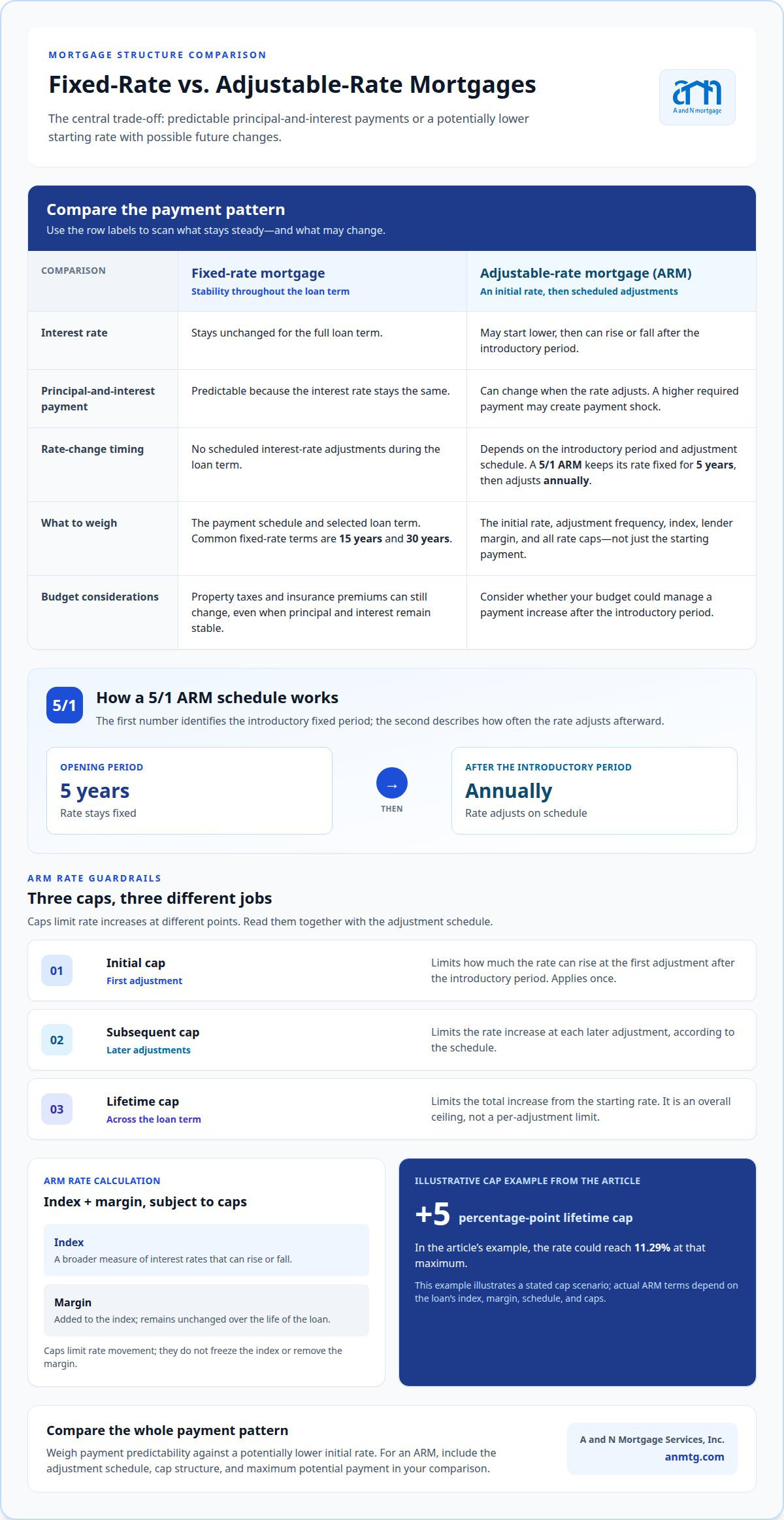
It’s understandable to value predictable payments, especially when you’re planning for the long term. An ARM may begin with a fixed rate for a set period, then adjust at regular intervals, so its payment can rise or fall. For example, a 5/1 ARM keeps its rate fixed for five years before adjusting annually.
This guide explains how the two mortgage types affect payments, when an ARM’s rate can change, and how adjustment caps limit possible increases. It also explains how the time you expect to stay in the home can influence your choice, helping you weigh the initial payment against potential future changes.
An adjustable-rate mortgage may appeal if you value a lower starting rate and can plan for possible future changes. Its caps limit rate increases, while the index, margin, adjustment schedule, and loan term determine how those limits apply. A fixed rate vs adjustable rate mortgage comparison should account for both the initial payment and potential adjusted payments.
An initial cap limits how much the rate can rise at the first adjustment after the introductory period. A subsequent cap limits increases at later adjustments, while a lifetime cap restricts the total increase over the loan term. Each cap applies at a different point, so one does not replace the others.
For example, a 5/1 ARM may have a five-year introductory period, then adjust annually. If that loan started at 6% and had a five-percentage-point lifetime cap, its rate could never go above 11%, no matter how high the index climbs.
At each scheduled adjustment, an ARM’s rate is based on an index plus a lender margin, subject to the loan’s caps. The index reflects a broader measure of interest rates and can rise or fall. The margin is added to the index and remains unchanged over the life of the loan.
Caps limit how far the rate can move at an adjustment or over the full loan term. They don’t freeze the index or remove the margin. If you qualify for an ARM, compare its index, margin, adjustment frequency, and cap structure to understand how changes in the index could affect your rate.
For a practical comparison, read all three cap limits together, then map them to the ARM’s adjustment schedule. A 10-year introductory period delays the first adjustment longer than a 5/1 ARM, but the lifetime cap still governs the maximum increase over the loan term.
Consider whether you could manage a payment that changes after the introductory period. Fixed-rate loans offer more predictable principal-and-interest payments. An ARM may start with a lower rate, but later adjustments can raise or lower the payment. A fixed rate vs adjustable rate mortgage decision should account for the maximum potential payment, not just the starting amount.
Choose an ARM only if its adjustment schedule and caps fit your budget plans. If payment predictability matters most, a fixed rate may be the clearer fit.
A fixed-rate mortgage keeps the interest rate unchanged throughout the loan term. That stability makes the principal-and-interest portion of each monthly payment predictable, which can help households plan recurring expenses without forecasting future rate adjustments. The payment schedule is set when the loan begins, so market rate changes don’t alter that agreed interest rate.
In the United States, common fixed-rate terms are 15 years and 30 years. A 15-year term generally means payments are spread across a shorter period than a 30-year term. The selected term affects the payment schedule, while the fixed interest rate stays unchanged for that loan’s full term. Compare term and payment together, rather than treating the rate as the only decision.
Predictability applies specifically to principal and interest. Property taxes and insurance premiums can still change, even with a fixed interest rate, affecting your total housing expenses. For example, if property taxes rise while the mortgage rate stays the same, the principal-and-interest payment remains stable, but your overall monthly housing costs may increase.
An adjustable-rate mortgage can start with a lower interest rate than a fixed-rate option. That can make its initial payment attractive, but it doesn’t ensure the payment stays lower. After the introductory period, the rate can adjust according to the loan’s schedule. If rates rise, the payment can rise too, making future budgeting less predictable.
That change can cause payment shock: your budget must absorb a higher required payment after an adjustment. Consider someone whose income and regular expenses leave little room for change. A lower initial ARM payment may help at first, but a later increase could strain the budget. A fixed rate instead offers consistent principal-and-interest payments to plan around.
To compare the options, separate the starting payment from the payment pattern over time. With a fixed-rate mortgage, focus on the monthly principal-and-interest amount and the selected term. With an ARM, consider its initial rate and possible later changes. A lower starting payment alone doesn’t show how affordable the loan may feel after an adjustment.
Choose based on the role predictability plays in your situation. If a stable principal-and-interest payment supports your budget, a fixed rate may align with that priority. If you’re weighing different mortgage structures, compare payments with our mortgage calculators as part of your comparison.
An ARM’s introductory rate and adjustment schedule determine when its rate can change. ARMs often start with a lower rate than a comparable 30-year fixed loan, though the size of that gap changes with the market and isn’t guaranteed.
An introductory rate stays in place for the opening period of an adjustable-rate mortgage. For example, a 5/1 ARM holds its initial rate for five years, while a 7/1 ARM holds it for seven. Those terms describe how long the initial rate lasts, not the full loan term. Their appeal is the starting rate; the trade-off is that adjustments follow.
After the introductory period, the adjustment schedule sets how often the rate can change. A 5/1 ARM typically adjusts annually after its first five years. A 30-year 10/6 ARM holds its introductory rate for 10 years, then adjusts every six months for the remaining 20 years. The schedule matters because it determines when a new rate can affect payments.
For buyers comparing an ARM with fixed-rate financing, published average rates offer a snapshot, not a promise of the rate available to any borrower. Mortgage interest rates can be influenced by credit score, loan length, loan size, and inflation. These factors help explain why two buyers may see different offers, even while considering the same type of mortgage.
Before choosing an ARM, read its adjustment timing alongside its introductory period. Identify when the first adjustment can occur, then note how frequently later changes may follow. For example, a buyer expecting to move before a 5/1 ARM’s first adjustment faces a different timeline than someone planning to keep the loan beyond that point. Plans can change, so the schedule still matters.
Refinancing can shift a borrower from a fixed-rate mortgage to an ARM, or from an ARM to a fixed rate. Either type of refinance can involve closing costs. Compare the new loan’s rate and payment structure with your existing loan, and weigh those costs against the expected benefit. Refinancing changes the financing arrangement, but you still need to assess future payments.
Rate stability is one factor in this decision. A fixed rate keeps principal-and-interest payments consistent, while an ARM’s rate can change after its introductory period. A lower initial ARM rate may appeal if you expect to move sooner, but the adjustment schedule determines when that initial rate ends. Consider both your timeline and the loan’s later rate changes.
Use published averages as a rough comparison point, then evaluate the specific rate, introductory period, and adjustment frequency on the loan you’re offered. Different ARM structures are priced differently. Matching the schedule to your plans helps clarify whether introductory pricing or longer-term stability better fits your situation.
How long you expect to stay in the home helps frame the choice, but your plans and budget both matter. Compare the ARM’s introductory period with your likely move date and your ability to manage later payments.
Borrowers planning to stay fewer than 10 years may benefit from an ARM, especially if they expect to sell or refinance before its initial fixed-rate period ends. That possibility depends on the timeline and the loan terms, not simply the lower starting payment. A fixed rate may suit people expecting a longer stay or those who would find a payment increase stressful.
Use your likely move date as a planning point, not a certainty. For example, someone expecting to remain for seven years can compare that timeline with a 5/1 ARM’s five-year initial period. The ARM could begin adjusting while that borrower still owns the home, so the timing deserves attention.
An ARM may fit a plan to sell or refinance before its introductory period ends, provided you can manage possible increases if your plans change. A five-year ARM, for example, begins adjusting after five years. If your move is delayed beyond that point, you may face a new rate and payment before selling.
Compare the adjustment period with a realistic range of move dates. A fixed-rate loan keeps principal-and-interest payments stable for its term, while an ARM can change after the introductory period. That difference matters if your income varies or your housing budget has little room for a payment increase.
Map three timelines before deciding: how long you expect to stay, when the ARM’s first adjustment occurs, and how long selling or refinancing could take. If those dates overlap, account for the possibility of making adjusted payments. Refinancing either loan type can involve closing costs, so don’t treat refinancing as an automatic way to avoid future adjustments.
Then weigh the potential savings from an ARM’s starting rate against the risk of keeping the loan past its introductory period. If you expect to move before the adjustment, you may prioritize the initial payment. If you’re uncertain about moving, you may value fixed-rate stability. Either way, budget for housing costs and possible changes in income.
A practical approach is to compare the loan’s first adjustment date with your planned stay, then consider what happens if you remain longer. If the ARM adjusts before a likely move, weigh the possible payment change against your budget. If a higher payment would disrupt essential expenses, a fixed rate may better support predictable planning.
Finally, consider whether your finances can withstand a change. A planned sale or refinance may not happen on schedule, but the ARM’s adjustment period still applies. Choose an ARM only if both your initial timeline and the possibility of staying beyond it make sense for your finances.
An ARM’s initial fixed period determines how long its starting rate remains unchanged. Compare that period with your plans to see whether the first adjustment could arrive while you still own the home.
Common introductory periods are three, five, seven, or 10 years. A 5/1 ARM keeps its initial rate for five years, while a 7/1 ARM holds it for seven. The first number describes the fixed introductory period; the second describes how often the rate adjusts afterward. These labels help distinguish the initial window from the later schedule.
Choose the period by comparing its end date with your likely housing timeline. For example, if you plan to stay for seven years, consider whether a five-year introductory period leaves two years before your planned move. A longer initial period may keep the starting rate in place closer to that move, but it doesn’t guarantee you’ll move on schedule.
The period ends according to the loan contract, not when you feel ready for a new payment. Afterward, the rate can adjust at regular intervals, such as annually or every six months, depending on the ARM. The schedule affects how often the rate and monthly payment can respond to index changes. The adjustment schedule and any rate caps set the limits.
Loan term and initial period describe separate parts of the mortgage. A 30-year 5/1 ARM has a five-year initial period, followed by potential annual changes for the remaining 25 years. A 30-year 10/6 ARM has a 10-year initial period, followed by adjustments every six months for the remaining 20 years. The introductory period is not the payoff deadline.
Before choosing, compare the first adjustment date with your plans to stay, then consider what happens if you move later. Assess whether your income could support a higher payment if the initial period ends before you sell or refinance. Credit score, loan length, loan size, and inflation can influence mortgage rates, so compare the offered terms rather than assuming every ARM has the same starting rate.
The key takeaway is simple: match the initial period to a realistic timeline, then account for the adjustment schedule if your plans change. A longer introductory period gives you more time before rate changes begin, while a shorter one brings that decision point sooner. If you prioritize certainty throughout the loan term, you may prefer the stability of a fixed rate.
A and N Mortgage Services, Inc. helps borrowers compare mortgage choices based on payment stability, an ARM’s introductory period, and plans for the home. If you’re weighing fixed and adjustable rates, the team can help you connect those trade-offs with your financing needs and suitable loan options, including Conventional, Jumbo, FHA, and VA loans.
Consider reaching out when you’re ready to discuss how your timeline and budget shape the decision.
Contact A and N Mortgage Services, Inc.
Turn your mortgage comparison into a clear personal decision brief. Write down what you need your housing payment to support, which financial changes you could absorb, and what future plans may affect your time in the home. These priorities can help you evaluate loan options without letting a single advertised rate dominate your decision.
Your fixed-rate versus adjustable-rate mortgage choice should suit the life you expect to build, not just the day you close. If your plans or finances change, revisit the assumptions behind your choice before making another borrowing decision.
A and N Mortgage Services, Inc. can help you consider your financing needs and loan options. Contact A and N Mortgage Services, Inc. to discuss your next step.
With a thoughtful plan and guidance tailored to your situation, you can move forward with greater clarity.
Yes, borrowers can switch from an ARM to a fixed-rate mortgage, or the reverse, by refinancing into a new loan. For example, if your ARM is approaching an adjustment, you might consider whether a fixed rate better suits your current budget. Refinancing either loan type can involve closing costs, so compare those costs with the value of the new payment structure before deciding.
An adjustable-rate mortgage starts with an initial rate that stays in place for a set period, then adjusts according to the loan’s terms. The new rate is based on an index plus a lender margin, subject to applicable caps. When comparing offers, focus on the first adjustment date, how often later adjustments occur, and how the contract limits rate changes.
An ARM can offer a lower initial rate than a fixed-rate mortgage, which may benefit you if you expect to sell or refinance before adjustments begin. The trade-off is uncertainty: later rate changes can raise payments and complicate budgeting. A fixed-rate loan offers steadier principal-and-interest payments, but its starting rate may be higher than an ARM’s. Consider both the initial cost and the risk of future changes.
The central difference is how the interest rate behaves after closing. A fixed-rate mortgage keeps its rate unchanged for the loan term, while an ARM can change after its introductory period. For instance, a household that needs stable principal-and-interest expenses may favor fixed financing. A borrower with a shorter expected holding period may compare an ARM’s opening rate with its adjustment timeline and payment limits.
After the initial period, the ARM rate is calculated using its index and the lender’s margin, subject to the contract’s caps. The index can move with broader interest rates, while the margin stays unchanged over the loan term. For a clear comparison, consider how the index could affect the rate at each adjustment, then account for the cap that limits the change.
The first number in an ARM label identifies the years in its introductory fixed period; the second indicates the adjustment frequency in years. A 5/1 ARM has an initial five-year period, then typically adjusts annually. A 7/1 and a 10/1 follow the same pattern, with seven- and 10-year introductory periods. Compare the first adjustment date with how long you expect to keep the mortgage.
Rate caps limit how much an ARM’s interest rate may rise at the first adjustment, at later adjustments, or over the full loan term. The adjustment period is the interval between rate reviews after the introductory period. These protections work together: a lifetime cap sets the overall increase limit, while adjustment caps restrict individual changes. Review each limit to understand the contract’s boundaries.
The payment change depends on the new interest rate, the remaining loan balance, the time left to repay, and the contract’s caps. A higher rate can raise principal-and-interest payments; a lower rate may reduce them, depending on the ARM’s terms. To assess affordability, compare your current payment with payments calculated at the contract’s allowed rate limits, not just the introductory rate.
Welcome to a better mortgage experience! In just few minutes you can find out what you qualify for and explore multiple loan options and interest rates.
Complete our short and intuitive pre-approval interview to get started.