Paying more upfront for a mortgage can reduce your monthly payment, but it doesn’t always save you money overall. Understanding how mortgage points work starts with a simple rule: one discount point costs 1% of the loan amount and is paid at closing in exchange for a lower interest rate. Whether that trade-off pays off depends on how long you keep the loan and how much the rate reduction saves.
It’s reasonable to want a clear answer before adding another closing cost. To understand how mortgage points work, compare the upfront amount with the savings over the time you expect to keep the mortgage, rather than judging the offer by its lower rate alone.
This guide explains how discount points differ from origination points, how to estimate costs and savings, and how to calculate the break-even point. You’ll also learn when mortgage points may be tax deductible and what you may be able to negotiate, including a seller contribution. With those details in view, you can weigh the offer against your plans and decide whether paying points fits your home financing needs.
Buying discount points means paying more at closing in exchange for a lower mortgage interest rate. To decide whether the trade-off makes sense, compare the upfront cost with the monthly savings and how long you expect to keep the loan.
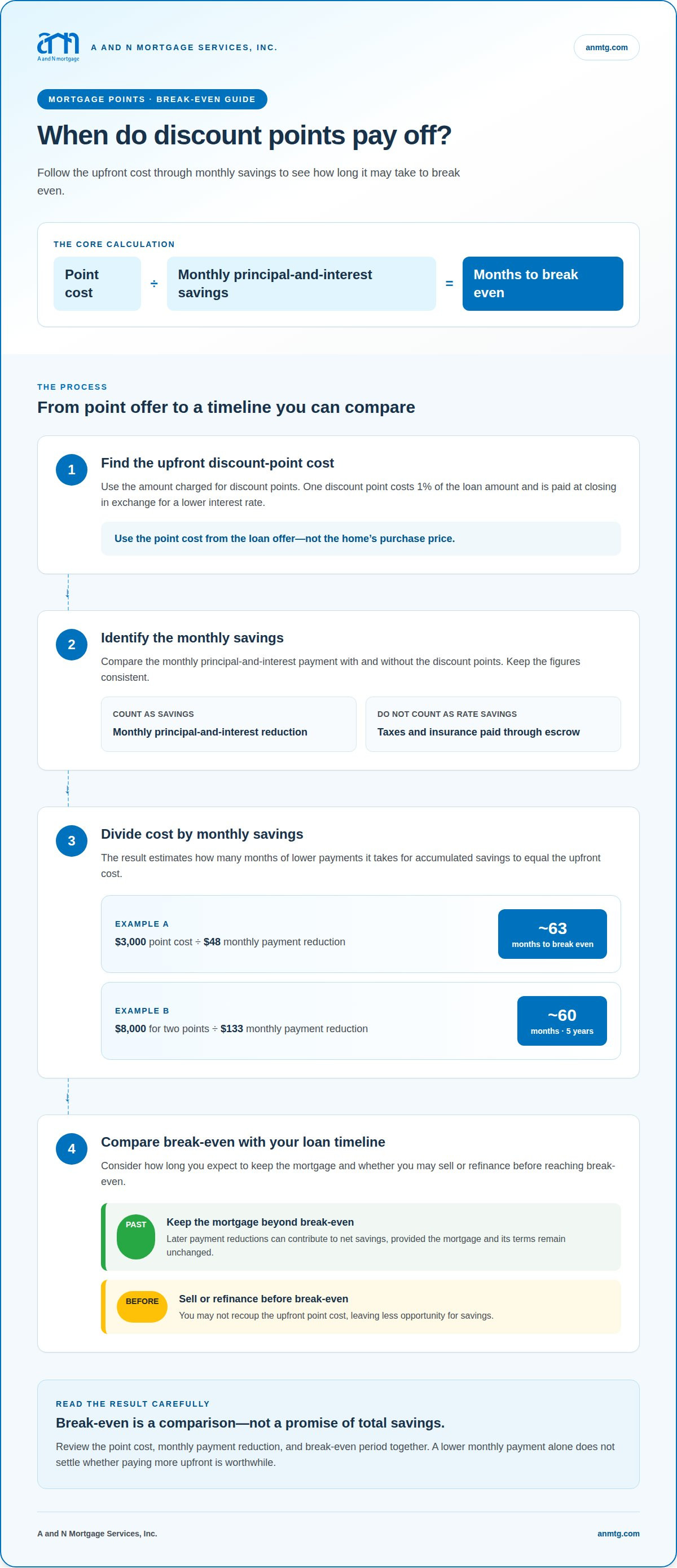
The break-even point is when accumulated monthly savings equal the upfront cost of discount points. It helps you assess whether buying points may pay off before you sell or refinance. Divide the point cost by the monthly payment reduction to estimate how many months it takes to recover the cost.
For example, if points cost $3,000 and reduce the monthly mortgage payment by $48, divide $3,000 by $48. The result is about 63 months to break even. After that, the monthly savings may outweigh the upfront expense, provided the borrower keeps the mortgage and its terms unchanged.
The discount-point break-even period is how long it takes to recover the upfront expense through lower payments. This matters because if you expect to sell or refinance before reaching break-even, you may not recoup the cost.
In another example, two points cost $8,000 and lower payments by $133 monthly. That upfront cost takes about 60 months, or five years, to recover. A borrower expecting to keep the mortgage longer than that has more time to benefit from the reduced payment, while a shorter timeline leaves less opportunity for savings.
Use the same calculation for each offer: divide the discount-point cost by the monthly principal-and-interest savings. Keep the figures consistent. A mortgage payment may also include taxes and insurance paid through escrow, but those amounts are not savings from a lower interest rate.
Break-even is a useful comparison, not a promise of total savings. Selling the home or refinancing before the break-even period ends can leave you short of recovering the point cost. If the mortgage remains in place beyond that point, later payment reductions can contribute to net savings.
Compare the result with how long you expect to stay in the home and your plans for the loan. The longer you expect to keep the mortgage, the more likely you are to pass the break-even point. Points may be less appealing if your plans could change before then.
A lower monthly payment alone doesn’t settle the decision. Review the point cost, payment reduction, and break-even period together, then weigh them against your likely timeline. This gives you a clearer basis for deciding whether the discount is worth paying for upfront.
Discount points are prepaid interest used to lower a mortgage rate; origination points are lender charges for arranging a loan. Refinances, investment-property mortgages, and government-backed loans follow the same basic distinction, though the loan program and transaction can affect available terms.
Discount points are an upfront payment exchanged for a lower interest rate, which can reduce principal-and-interest payments. The rate reduction matters because it affects your payment and the interest you pay over time.
There’s a trade-off: you pay more at closing to reduce borrowing costs later. Buying more discount points can lower the rate further, but the added upfront expense needs to fit your finances and the time you expect to keep the loan. A lower rate alone doesn’t establish whether the offer is worthwhile.
Lender credits work in the opposite direction from discount points: the lender helps cover closing costs in exchange for a higher interest rate. This matters if you’re weighing available cash at closing against future monthly payments. Points mean paying more upfront for a lower rate; credits can reduce upfront costs while increasing borrowing costs over time.
Origination points don’t buy a lower rate. They are charges for originating the mortgage, so ask how each charge is categorized in the loan offer. A fee labeled as a point isn’t necessarily a discount point. The purpose of the charge, not just its label, determines whether it lowers the interest rate.
That potential rate reduction may appeal if you expect to keep the mortgage, while a higher upfront cost can be a drawback when cash is limited or your plans may change.
Review each offer’s rate, upfront charges, and monthly principal-and-interest payment together. Compare the same loan amount and term, then identify which charges lower the rate and which cover origination. This makes the trade-off clearer than considering the rate alone.
Loan terms can differ across refinances, investment properties, and government-backed programs. The basic difference between rate-buydown points and origination charges remains useful, but each loan’s offered terms determine how those charges apply. Our guide to the true cost of a low online mortgage rate can help as you consider which financing structure fits your plans.
A mortgage point is calculated from the loan amount, not the home’s purchase price. Since one point equals 1% of the loan, the upfront cost rises or falls with the amount borrowed.
One mortgage point costs 1% of the loan amount, so the calculation is the loan amount multiplied by 0.01. This matters because a larger mortgage creates a larger upfront charge, even when the borrower buys the same number of points.
For example, on a $350,000 loan, one point costs $3,500, half a point costs $1,750, and two points cost $7,000. These figures describe point costs only, not the total closing costs of a mortgage transaction.
A fraction of a point uses the same calculation. The loan amount is the base, so a down payment affects the point cost only if it changes how much you borrow.
Each discount point’s cost is tied to the loan amount, while its rate reduction depends on the lender and market conditions. The same point percentage can therefore produce different savings across loan offers.
A point typically reduces the interest rate by 0.25 percentage points, though the actual reduction varies. Treat that as an example, not a universal exchange rate for every lender or loan.
Buying more points can increase the upfront cost and reduce the rate further. Compare that offer with the one-point option and the no-points rate, rather than assuming each additional point saves the same amount.
For a refinance, use the new loan amount to calculate any points you’re considering. The rate offer and payment savings still depend on the specific terms, so weigh the new loan’s costs against its expected monthly payment.
Before deciding, separate the upfront point charge from other closing costs, then compare the quoted rate and payment for each option. The rate reduction, savings, and time you expect to keep the loan all matter.
Mortgage points may be deductible for qualifying homeowners, but eligibility and mortgage-debt limits matter. Discount points and origination points also receive different tax treatment, so identify the type of charge before considering a potential deduction. A point is not automatically deductible simply because it appears among closing costs or reduces the loan’s interest rate.
For mortgage debt taken out after Dec. 15, 2017, qualifying homeowners may deduct mortgage interest and points on up to $750,000 of mortgage debt, or $375,000 if married filing separately, according to the Internal Revenue Service. For debt taken out on or before Dec. 15, 2017, the limit is $1 million, or $500,000 if married filing separately.
These are limits on the mortgage debt for qualifying homeowners, not a guarantee that every borrower can deduct every point paid at closing. The loan date and filing status determine which limit applies. For example, a qualifying homeowner whose loan was taken out after Dec. 15, 2017, and who files separately falls under the $375,000 limit rather than the $750,000 limit.
The $750,000 limit was originally set by the Tax Cuts and Jobs Act for tax years 2018 through 2025. Legislation passed in 2025 made it permanent, so it continues to apply for 2026 and later years. You generally need to itemize deductions to benefit, and points on a refinance are usually deducted over the life of the loan rather than all at once.
The purpose of a charge matters. Points paid as prepaid interest to lower the rate may be deductible, while fees for specific lender services generally aren’t, even if they’re labeled as points. Reviewing closing documents can help you separate these categories, and a tax professional can confirm how the rules apply to you.
For a practical review, identify the loan date, filing status, mortgage-debt limit, and whether the charge is a discount point or an origination point. Then consider the relevant tax year alongside your closing records. These details help distinguish a possible deduction from an assumed one, while keeping the point’s upfront cost and rate effect clear in the broader mortgage decision.
Mortgage points can be part of the closing-cost discussion, not a take-it-or-leave-it choice. A lender may offer a fraction of a discount point through three points, and a seller may contribute toward the cost. You can negotiate how much you pay upfront, who pays it, and whether the resulting rate fits your plans.
Ask the lender to show the loan with no discount points and with the points offered. Compare the interest rate, upfront charge, and monthly payment for each version, then calculate how long the payment savings take to offset the extra cost. A lower rate matters in context: the added closing expense must work with your cash needs and the time you expect to keep the mortgage.
Use the Loan Estimate to examine the proposed costs. The Consumer Financial Protection Bureau says borrowers receive a Loan Estimate within three business days of applying for a mortgage. That gives you a document to review as you discuss the point charge and the terms tied to it. Focus on whether a charge buys down the rate or covers another loan cost.
A seller may contribute toward mortgage points, reducing the amount you pay upfront. Loan programs cap how much a seller can contribute toward your costs, so confirm the limit for your loan. This can be part of a purchase negotiation, especially if you want a lower rate but need to preserve cash for other closing costs. Specify the requested contribution and how it would be applied to discount points.
You can also negotiate by comparing different point amounts. Ask how the rate and monthly payment change when the offer moves from a fraction of a point to a larger amount, up to three points where available. The lender’s terms determine the actual rate reduction, so compare each option rather than assuming additional points produce equal savings.
Timing matters. The Consumer Financial Protection Bureau says borrowers receive a Closing Disclosure at least three business days before closing. Review it against the Loan Estimate and confirm that the agreed point charge, rate, and seller contribution appear as expected. If the figures differ, raise the discrepancy before closing so the final terms are clear.
The strongest negotiation considers the full loan offer, not just the point count. A clear comparison of costs, rates, and contributions helps you decide which structure suits your budget and timeline.
A and N Mortgage Services, Inc. can help you understand how mortgage points fit into your home financing decision. If you’re weighing an upfront discount against monthly savings, personalized guidance can clarify how the rate and loan terms affect your choice.
Whether you’re considering a Conventional Loan, Jumbo Loan, FHA Loan, or VA Loan, start by comparing your financing needs with the terms available for that loan. A and N Mortgage Services, Inc. offers guidance as you assess your options and decide what questions to resolve before moving forward.
Contact A and N Mortgage Services, Inc.
Knowing how mortgage points work gives you a framework for assessing a loan offer, but your choice also needs to fit your broader home-financing plans. Consider how much cash you want available after closing and whether a lower rate supports your priorities over time. Weigh the mortgage alongside the rest of your budget, not in isolation.
Before moving forward, identify the trade-offs that matter most to you: preserving upfront funds, reducing ongoing borrowing costs, or keeping flexibility for future plans. Then discuss how the available loan structure aligns with those priorities. A clear conversation can make complicated terms easier to understand and help you feel prepared to decide.
Contact A and N Mortgage Services, Inc.
Take the next step at your own pace, with a financing decision grounded in your needs.
Buy discount points when you expect to keep the mortgage long enough to recover their upfront cost and the payment reduction suits your budget. Keep enough cash available for other closing costs and household needs before committing funds to a lower rate. If you plan to move or refinance soon, compare that timeline with the point’s break-even period before choosing.
Many lenders allow borrowers to buy up to three or four mortgage points, though available choices depend on the lender and loan terms. Offers can also include a fraction of a point. Rather than choosing the largest amount available, compare each option’s upfront cost, interest rate, and monthly principal-and-interest payment. The right point amount fits your finances and the time you expect to keep the mortgage.
Discount points can reduce borrowing costs by lowering the mortgage interest rate and principal-and-interest payment. This can leave more room in your monthly budget or reduce interest over the time you keep the loan. The benefit must be weighed against the money paid at closing. Consider how much cash you want to preserve for moving, repairs, or other home expenses before deciding.
Buy down your rate with points when the lower payment and the time you expect to keep the mortgage justify the upfront expense. Compare a no-points offer with the point options, using the same loan amount and term. Then consider your plans for the property and whether paying more at closing would leave enough cash for other needs. The lowest offered rate isn’t automatically the best fit.
A discount point’s value has two parts: its upfront cost and the rate reduction the lender offers in exchange. The cost is tied to the loan amount, while the savings depend on the resulting rate and how long the mortgage remains in place. For a useful comparison, assess the point’s effect on monthly payments and total interest, rather than judging its value by the rate alone.
Mortgage points are charges associated with a home loan. Discount points are prepaid interest exchanged for a lower rate; origination points are lender charges for arranging the loan and don’t buy down the rate. Review the itemized charges in the Loan Estimate to understand what each point pays for. This distinction helps you compare upfront costs with the loan terms they affect.
One discount point costs 1% of the mortgage loan amount, so one point on a $350,000 loan costs $3,500. The calculation uses the amount borrowed, not the home’s purchase price. If a down payment changes the amount financed, it also changes the point cost. Check the quoted loan amount and point charge together when reviewing an offer.
One discount point typically lowers the interest rate by 0.25 percentage points, but the reduction varies with the lender and market conditions. For example, a lender’s offer could provide a different rate change for the same point amount than another offer. Compare the actual quoted rates and resulting payments for each option. Don’t assume a fixed rate reduction applies to every mortgage.
Welcome to a better mortgage experience! In just few minutes you can find out what you qualify for and explore multiple loan options and interest rates.
Complete our short and intuitive pre-approval interview to get started.