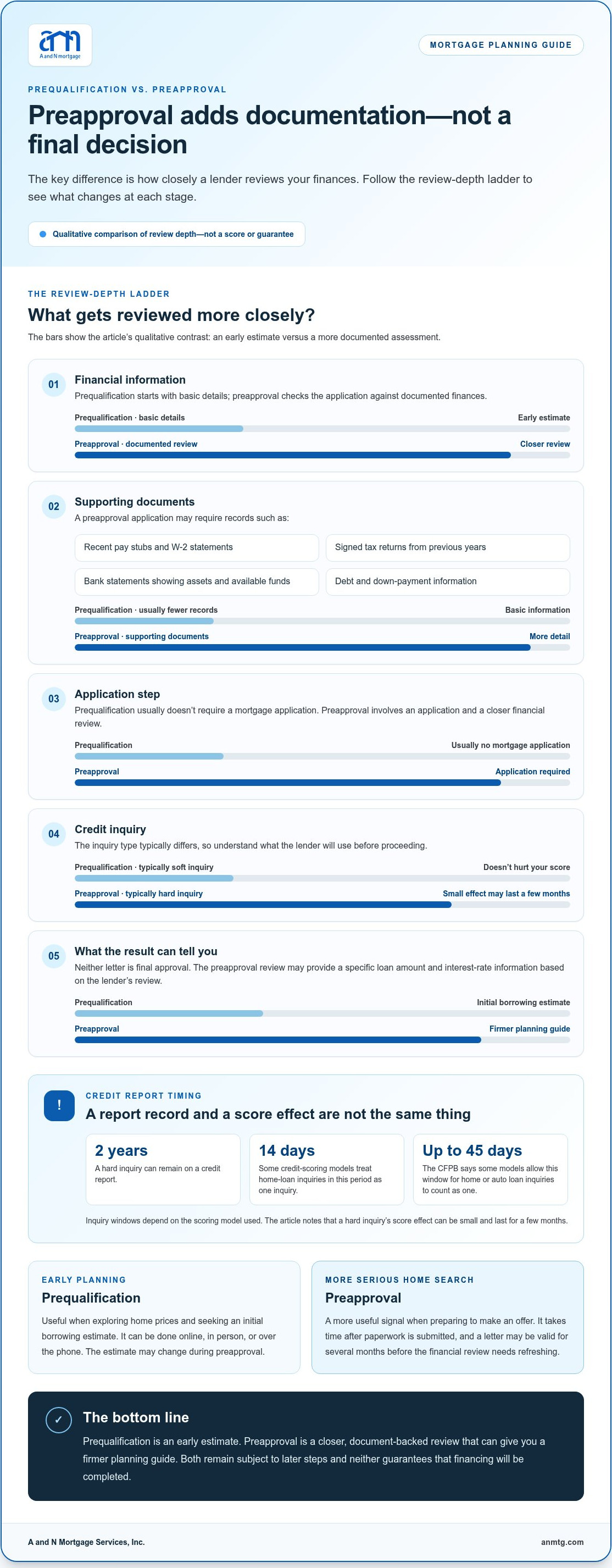
Preapproval offers more certainty than prequalification, but neither is a final mortgage decision. The difference between pre-qualified and pre-approved is how much financial information a lender reviews: prequalification is usually an early estimate, while preapproval involves an application and a closer review of your finances. That makes preapproval a more useful signal when you’re preparing to make an offer.
It’s understandable to want a clear answer before you start looking at homes. The terms can sound interchangeable, yet each process can shape how confidently you plan your budget and approach a purchase.
This guide explains what lenders typically review at each stage, how the level of certainty differs, and when each option may suit your home-buying plans. You’ll also learn how credit checks and supporting documents can factor into the process, so you can decide what to do next.
No. A mortgage prequalification or preapproval letter is not final loan approval, and neither guarantees that financing will be completed. The difference between pre-qualified and pre-approved offers lies in how closely the lender reviews your finances, but both are subject to later steps.
Credit checks are one part of the difference (our guide to credit scores for a mortgage covers what lenders look at). Knowing whether a lender uses a soft or hard inquiry helps you understand how the step may affect your credit history.
Mortgage prequalification typically involves a soft inquiry, which doesn’t hurt your credit score. It gives the lender an early view of your credit history and the information you provide, rather than the fuller review associated with preapproval. A lender may still check your credit when preparing a prequalification letter, so prequalification doesn’t mean your credit is never reviewed.
Mortgage preapproval typically involves a hard inquiry as part of a closer financial review. A hard inquiry can have a small effect on credit scores for a few months and can remain on a credit report for two years. Preapproval offers for credit cards and personal loans also aren’t completed approvals: the lender or issuer still reviews the application before making a final decision.
For a home loan, the distinction between a score effect and a credit-report record matters. An inquiry’s presence on a report doesn’t mean the score impact lasts for the same period. If you’re comparing mortgage offers, some credit-scoring models treat home-loan inquiries within a 14-day period as one inquiry. The Consumer Financial Protection Bureau says some models allow up to 45 days for home or auto loan inquiries to count as one. These windows depend on the scoring model used.
Auto financing follows a related but distinct process. Prescreening, prequalification, and preapproval typically use soft inquiries, while submitting a credit application can lead to a hard inquiry. An auto financing prequalification or preapproval is generally an early indication rather than a final loan decision. This differs from a mortgage preapproval’s documented review, but neither letter completes the loan process.
Before proceeding, identify the type of financing and inquiry involved. Ask whether the step is an early estimate or a formal application, then consider whether you’re ready for a hard credit check. Choose prequalification for an early mortgage estimate, and preapproval when you’re prepared for a more detailed review and a hard inquiry.
To get preapproved for a mortgage in the United States, submit an application and provide financial documents, such as pay stubs, bank statements, and tax information. The lender reviews those details and your credit to assess your finances and estimate a loan amount.
Prequalification is usually an earlier, less detailed step. You provide basic financial information, including income, assets, and debts, so a lender can estimate what you may be able to borrow. The estimate may also take your credit history and score, an affordable home price, and your down payment into account.
For example, someone exploring homes without a set price range might start with prequalification. It can be completed online, in person, or over the phone, and usually doesn’t require a mortgage application. Because the lender reviews fewer financial records, the estimate may change during preapproval.
Preapproval requires an application and more supporting documents. Depending on your financial situation, a lender may request:
These records help the lender compare the information in your application with documented finances. For instance, stated income can be assessed alongside pay stubs, W-2 statements, and tax returns. Bank statements can show assets that may contribute to the down payment. The lender may then provide a specific loan amount and information about the interest rate, based on its review.
Preparation can make the process easier to follow. Gather income records, bank statements, and tax information before completing the application (our 2026 pre-approval checklist lists what to collect), then check that the figures you enter match those documents. If you have more than one source of income, organize the records for each so the lender can review your full financial picture.
Think of prequalification as an initial estimate based on basic details, and preapproval as a more documented assessment. Neither replaces the remaining steps before a mortgage is finalized. If you’re organizing your information and considering financing options, mortgage guidance can help you understand the path ahead.
Preapproval can take time after you submit the required paperwork. A preapproval letter may be valid for several months, giving you a window to shop before refreshing your financial review. See how pre-approval timelines work during a home search.
Choose prequalification if you’re still exploring home prices and want an initial borrowing estimate before starting a full mortgage application. It typically comes before preapproval. For example, if you’re comparing neighborhoods but haven’t settled on a budget, an early estimate can help focus your search. Treat it as a guide, not a firm loan amount.
Choose preapproval when you’re ready to shop seriously or make an offer. The lender reviews more financial information and can provide a specific amount to guide your search. A preapproval letter may also help you discuss an offer with a seller by showing that financing has been reviewed.
Timing matters. Many U.S. buyers wait until they’re ready to shop seriously, but getting preapproved earlier can reveal credit issues while there’s still time to address them, as a smarter pre-approval can show. If you’re months away from searching, consider whether you want an early estimate or are prepared to complete a more detailed application. A letter valid for several months may expire before your search ends.
A preapproval is not final mortgage approval. The lender must complete the remaining loan steps, and your financial picture may change between the letter and the final decision. Keep your documents current and don’t treat the amount on the letter as a spending target. You don’t have to borrow the full amount, and choosing a lower purchase price can leave more room in your budget.
Use these practical cues to choose your next step:
For example, a buyer planning to tour homes and make an offer soon may benefit from preapproval. Someone comparing locations without a target purchase range may start with prequalification, then move toward preapproval when the search becomes serious. In either case, base your budget on a comfortable payment, not simply the maximum amount in a lender’s letter. Here’s how much house you can comfortably afford.
A mortgage prequalification or preapproval letter gives you a general borrowing range based on stated assumptions. Preapproval carries more weight because it follows a review of financial documents, sometimes by an underwriter. Final loan approval comes after the lender completes the remaining steps, so treat either letter as guidance, not a completed loan decision.
Prequalification offers an early estimate based on information you provide. A lender may revise the amount after reviewing your financial records during preapproval. Preapproval can identify a specific loan amount and interest rate, but those details reflect the lender’s review at that stage. Changes to your finances or the property may affect the later assessment.
For a home offer, a preapproval letter can show a seller that a lender has reviewed your finances and is generally willing to lend up to a stated amount. That may inspire more confidence than an early estimate alone. The letter represents a specific lender’s assessment, not a universal commitment from every lender.
Compare lender letters by looking beyond the maximum amount. A higher borrowing limit doesn’t automatically make a letter the better fit for your budget. Review the proposed loan amount and interest rate, then consider whether the monthly payment leaves room for your other expenses; the 50/30/20 budgeting method is one way to check. How much you can borrow and how much you choose to spend are separate decisions.
Before relying on a letter, take these steps:
A seller may view preapproval as a stronger financing signal, but the letter doesn’t replace final underwriting or the lender’s remaining review. Use it to frame an offer and understand your likely borrowing range, while basing your decision on a comfortable budget rather than the highest number on the page.
The difference between pre-qualified and pre-approved offers is the depth of the lender’s review and what the letter can support. Prequalification usually relies on information you provide without a mortgage application. Preapproval involves an application, supporting financial records, and a more specific assessment of your borrowing capacity.
That distinction matters because an estimate and a reviewed loan amount serve different stages of home buying. Prequalification can help you begin setting a budget while you explore neighborhoods. A preapproval letter can give you a more specific range for planning an offer, based on the records reviewed by the lender or underwriter.
The application also changes what the lender evaluates. Prequalification may consider basic information about income, assets, debts, and credit history. Preapproval requires more documentation and information about your down payment. For example, the lender can compare your stated finances with the records submitted in your application, instead of relying only on what you report.
Follow the stages in order when they fit your plans. Start with prequalification if you’re comparing home prices and need an initial frame for your search. Move toward preapproval when you’re ready to shop seriously, so the lender can assess a fuller financial picture and provide a letter for a seller.
Neither stage replaces the remaining mortgage process. Preapproval reflects the lender’s review at that point, while final loan approval comes after additional steps. Treat the letter as a planning tool, not permission to spend the full amount. If the approved range exceeds your comfortable budget, base your home search on a payment you can manage.
In practical terms, choose based on your next decision: use prequalification to explore a possible price range, and preapproval to support a serious home search or offer. Keep your application information accurate and consistent because the lender relies on those details when assessing the loan.
A and N Mortgage Services, Inc. can help you move from understanding preapproval to considering a residential mortgage that fits your plans. If you’re ready to explore a Conventional Loan (see how the 2026 conforming loan limits affect buyers), its mortgage guidance can help you understand the financing process and your next steps.
A Conventional Loan may be one option to consider as you compare your budget and home-buying plans. A and N Mortgage Services, Inc. also offers Jumbo Loans, providing another residential financing option. Discuss your goals and the loan path you’re considering, and remember that a preapproval letter is not final approval.
For guidance on your mortgage plans, contact A and N Mortgage Services, Inc. or visit anmtg.com.
Your next move can be guided by more than a letter. Consider your home-buying timeline, the payment that feels manageable, and how prepared you are to share financial documents. Understanding the difference between pre-qualified and pre-approved offers can help you choose a financing conversation that matches your situation, without rushing into a step before you’re ready.
A and N Mortgage Services, Inc. offers Conventional Loans, Jumbo Loans, and FHA Loans. As you consider your plans, think about which mortgage type fits the home you’re seeking and the budget you want to maintain. A focused conversation can help you organize your questions and understand which financing path to explore next.
Contact A and N Mortgage Services, Inc.
You’ve taken an important step by learning how to approach the decision. Move forward at a pace that feels right, with a clearer plan for your home search.
Mortgage prequalification is an early estimate of how much you might borrow, based on financial details you provide. It can help you compare broad home-price ranges before choosing a property. For example, if you’re weighing condos against single-family homes, use the estimate to shape an initial search. Revisit your budget if your income, debts, or planned down payment changes.
A mortgage prequalification credit check is typically a soft inquiry, which doesn’t hurt your credit score. Preapproval typically involves a hard inquiry, which may have a small score effect for a few months and remain on your credit report for two years. The Consumer Financial Protection Bureau says some scoring models count home or auto loan inquiries within a period of up to 45 days as one inquiry.
Pre-approved means a lender has reviewed an application and financial details, then indicated what it may be willing to lend. The term describes a stage in the lending process, not money already issued or a completed loan. A pre-approved borrower still needs to complete the lender’s remaining steps before financing can be finalized.
Pre-qualified means a lender has used information about your finances to provide an initial borrowing estimate. It’s a starting point for planning, not a confirmed loan amount. If you’re early in your search, use it to frame a realistic range of homes to explore. Avoid making a purchase decision based only on an estimate, before the lender reviews your records.
“Preapproved” is another spelling of “pre-approved”; the meaning is the same. In a mortgage context, it refers to a lender’s preliminary decision after reviewing an application and financial information. A preapproval letter can help show sellers that you’ve taken a financing step. Keep the letter with your home-search records so you can refer to its terms as you compare properties.
“Prequalified” and “pre-qualified” are spelling variants for the same early estimate. The word doesn’t mean a lender has promised a particular amount. An estimate based on your stated income, for instance, may differ from the amount calculated after the lender reviews supporting documents. Treat it as a planning reference, and update your financial details if your circumstances change.
For a mortgage, pre-qualified generally means a lender has estimated your borrowing range using information you supplied. For auto financing, prequalification is also an estimate based on details a potential borrower provides. In either case, the term helps you understand an early financing picture. It doesn’t mean funds are ready to use or the application process is complete.
For a mortgage, pre-approved means a lender has assessed an application and may issue a letter stating a potential loan amount. For auto financing, preapproval is conditional, and borrowers still need to submit a credit application. If you’re buying in Chicago, A and N Mortgage Services, Inc. can guide you through mortgage preapproval and help you understand what your letter means for your home search.
Welcome to a better mortgage experience! In just few minutes you can find out what you qualify for and explore multiple loan options and interest rates.
Complete our short and intuitive pre-approval interview to get started.