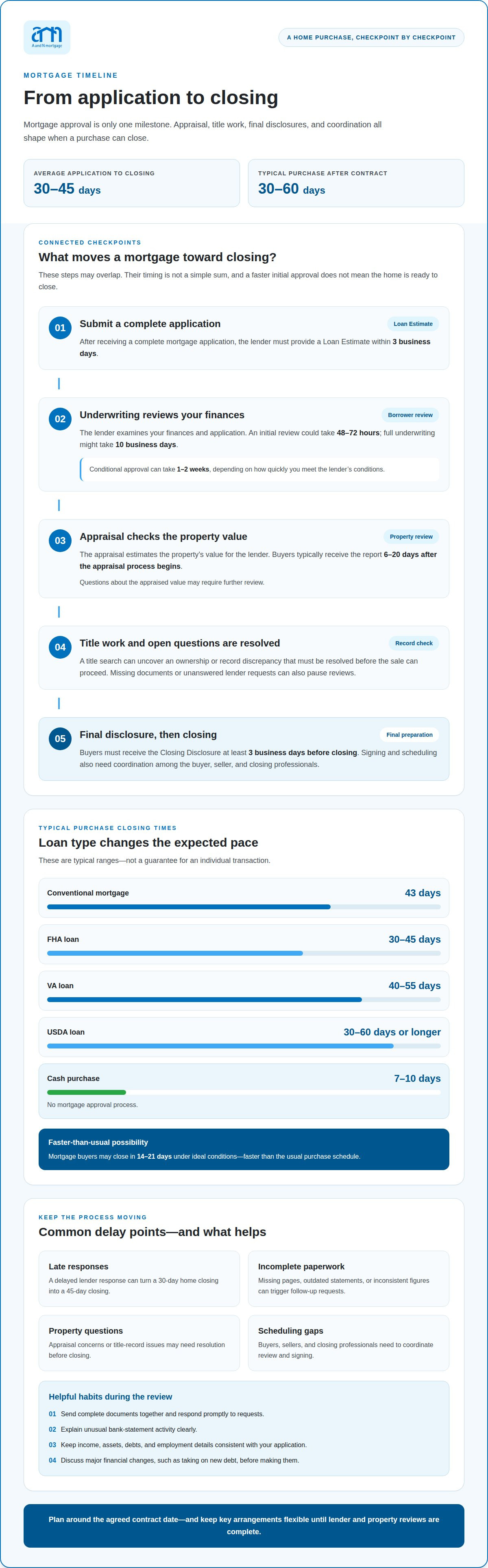
A fast mortgage approval doesn’t necessarily mean a fast closing. The average time from mortgage application to closing is about 30 to 45 days, although the timeline depends on the loan, the property, and how quickly each milestone is completed.
It’s understandable to want a firm date when you’re planning a move, coordinating paperwork, or waiting to take ownership. The key is to look beyond initial approval: underwriting, the appraisal, title work, and final disclosures all play a part in getting a purchase to closing.
This article explains the milestones to expect, how loan type and lender coordination can shape the pace, and what commonly causes delays. You’ll also see how responding quickly to document requests and communicating clearly can help keep the process moving, so you can plan more realistically for the weeks ahead.
A U.S. home purchase typically takes 30 to 60 days after contract, while the full mortgage process from application to closing may take 30 to 45 days. The schedule includes approval, property review, and final preparations, not just underwriting.
The average mortgage-to-closing timeline is the period from submitting a loan application to completing the purchase. Many purchase loans close in roughly 30 to 45 days. That range gives buyers a useful planning reference, but the contract date and application date mark different starting points, so the timelines are not interchangeable.
For a buyer, knowing the distinction helps set realistic expectations for moving plans and other arrangements. A conventional financing purchase generally closes 30 to 45 days after signing the contract, while application-to-closing timing can also depend on how promptly the buyer supplies requested documents and resolves questions about loan terms.
Closing timelines by loan type are typical ranges for completing a purchase with different financing programs. Conventional and FHA purchase loans often close in about 30 to 45 days. VA loans can fall in a similar range or take a little longer, and USDA loans may take longer still because USDA reviews the file after the lender does.
Cash purchases follow a different path because there is no mortgage approval process: they can often close in 7 to 10 days. By contrast, mortgage buyers may close in 14 to 21 days under ideal conditions, but that is faster than the usual purchase schedule. The loan type helps buyers anticipate the process, not assume every transaction will match a typical range.
Appraisal and underwriting are separate reviews that can run alongside other closing tasks. The appraisal estimates the property’s value for the lender’s review; buyers typically receive the report 6 to 20 days after the appraisal process begins. Underwriting examines the borrower’s finances and application, with an initial review that could take 48 to 72 hours.
Full underwriting might take 10 business days, and conditional approval can take one to two weeks depending on how quickly the buyer meets the lender’s conditions. These stages can overlap, but unresolved questions or missing documents may extend waiting. A faster initial approval therefore doesn’t, by itself, mean the home is ready to close.
These national figures don’t provide a separate closing average for each state; they describe U.S. purchases overall. In practice, location can affect scheduling because of local transaction procedures, property records, and the availability of the people involved in completing the sale.
For buyers, the useful comparison is between the agreed contract deadline and the milestones still outstanding, such as appraisal, underwriting, and title work. The Consumer Financial Protection Bureau says buyers must receive the Closing Disclosure at least three business days before closing. That required waiting period belongs in the final schedule, whether the purchase is in Chicago or another U.S. region.
A closing date depends on several moving parts, not approval alone. A missing pay stub, an unanswered underwriting request, or a title record that needs clarification can hold up other steps. If you’re buying after selling a home, coordinating both transactions adds another dependency: you may need proceeds from the first home for the next purchase.
Document gaps are a common source of avoidable delays. If an application lists income that doesn’t match recent pay stubs, or bank statements show a deposit without an explanation, underwriting may need more information. Each new request creates a handoff. The review may need to pause while the lender waits for documents that clarify an open question.
Property and transaction issues matter, too. An appraisal that raises questions about value may require further review. A title search may uncover an ownership or record discrepancy that must be resolved before the sale can proceed. Changes to a buyer’s finances during underwriting can also prompt a closer review of the application and loan terms.
Moving plans can become difficult when these steps fall behind. A delayed closing may affect movers, temporary housing, or the timing of a sale tied to the purchase. Plan around the agreed contract date, but keep key arrangements flexible until the lender and property reviews are complete.
To reduce preventable delays, send complete documents together, respond promptly to requests, and explain unusual bank-statement activity clearly. Keep income, assets, debts, and employment details consistent with your application. Before making a major financial change, such as taking on new debt, discuss how it could affect the loan review. Clear communication helps identify open items before they become last-minute obstacles.
If you’re preparing a home purchase, our pre-approval checklist can help you gather documents up front and keep the financing process organized.
A home purchase moves through connected checkpoints, from application intake to the lender’s final decision. Each milestone answers a different question: Is the application complete? Does the borrower qualify? Does the property support the requested financing? Knowing what each checkpoint covers helps explain why approval involves several reviews rather than a single decision.
Once a lender receives a complete mortgage application, the Consumer Financial Protection Bureau says it must provide a Loan Estimate within 3 business days. This document outlines estimated loan terms and projected costs. It gives buyers a structured way to review the proposed financing early, while the lender continues evaluating the application and property.
Providing verification documents is another early milestone. Income, assets, and debts typically take less than a week to document. The lender uses that information, along with credit details, to assess whether the application meets its requirements. A missing statement or unclear deposit can prompt a follow-up request, extending the time before the file is ready for a full decision.
Underwriting is the lender’s detailed assessment of the borrower and loan request. The underwriter reviews the financial record, checks that documents support the application, and considers property information. Conditional approval means the file has advanced, but the borrower still needs to satisfy the stated conditions before the lender can complete its review.
Conditions are specific to each file. For example, an underwriter may need a clearer explanation of a bank deposit or an updated income document. Sending the requested item promptly lets the review continue; leaving a request unanswered can hold up the file. Conditional approval can take one to two weeks, depending on how quickly the borrower meets the lender’s conditions.
Timing also depends on how the milestones overlap with other purchase work. A home purchase may involve document review, property appraisal, and title work at the same time. If one review raises a new question, the lender may need additional information before final approval. Buyers planning around a 45-day closing period should therefore distinguish early approval from completion of every loan condition.
Before closing, buyers review the final loan disclosures and confirm that the terms reflect the transaction. Reviewing and acknowledging mortgage disclosures usually takes a few days, but no more than a week. The Closing Disclosure must arrive at least three business days before closing, giving buyers time to examine the final figures and ask about discrepancies.
Three property checks answer different questions during a U.S. home purchase. An appraisal estimates the home’s value for the lender, an inspection assesses its condition, and a title search examines ownership records. These tasks can happen alongside loan approval, but an issue in any review may require follow-up work before closing.
The appraisal connects the agreed purchase price with the property’s estimated value. Buyers typically receive the report 6 to 20 days after the appraisal process begins. If the report raises a value concern, the lender may need to review how it affects the loan terms. After an appraisal report is submitted, closing generally takes 2 to 3 weeks.
An inspection looks at the home’s structural and mechanical condition, rather than the borrower’s credit or income. The inspection itself can take 2 to 4 hours. The inspection step in the purchase timeline is estimated at 7 to 14 days, reflecting that arranging access and completing follow-up can take longer than the visit.
For example, a buyer may schedule an inspection while the lender orders an appraisal. If the inspection identifies a repair concern, the buyer and seller may need to discuss how to proceed. That discussion can affect the schedule, especially if it changes the agreed terms or calls for another review. Responding promptly to scheduling and document requests helps prevent avoidable pauses.
A title search checks records connected to the property’s ownership. It often takes a few days to a couple of weeks, and a record that needs clarification can require additional work before the transaction moves forward. The search is distinct from the appraisal: one concerns ownership records, while the other supports the lender’s assessment of the property’s value.
These reviews don’t always happen in a strict sequence. A title search and inspection can proceed while the appraisal is underway, but an unresolved finding can hold up later decisions. Buyers can help by making the property accessible for scheduled reviews, responding to requests, and sharing relevant information promptly. The lender considers the appraisal alongside the borrower’s application and other purchase details.
The loan type shapes which eligibility rules, documents, and property details enter a lender’s review. A conventional, FHA, VA, or jumbo application can therefore follow a different review path, even when buyers purchase similar homes. The useful comparison isn’t simply which loan closes fastest. It’s how the financing requirements fit the borrower, property, and contract schedule.
For example, a buyer applying for a conventional loan and a buyer using VA financing may need different program-specific reviews. FHA and jumbo applications also have distinct eligibility and documentation considerations. These differences affect what the lender must assess, while a complete application gives the review a clearer starting point. The right loan type is the one whose terms and requirements suit the buyer’s circumstances.
Lender efficiency is the ability to move a complete file through intake, review, and follow-up without avoidable gaps. It depends on clear communication, coordinated processing, and timely attention to questions, not on skipping necessary checks. A mortgage preapproval may take 1 to 3 business days, but preapproval is an early assessment. It doesn’t mean the lender has completed the full review for a specific real estate purchase.
Pay attention to how the process handles each handoff. When an application is submitted, the lender reviews it for completeness, identifies missing documents, and communicates what the underwriter needs. If an updated bank statement is requested, responding promptly can help return the file to review sooner. If the request remains open, the next decision may wait, even while other parts of the purchase progress.
Track milestones rather than relying on a single estimate. Ask which review is underway, what information remains outstanding, and whether the appraisal or title work is progressing alongside underwriting. These questions help identify the actual bottleneck. For instance, if underwriting has the completed income documents but the appraisal report is pending, sending more income paperwork won’t resolve the property-review wait.
The key takeaway is that loan type sets the review requirements, while lender coordination and complete information affect how smoothly the reviews progress. Understanding both helps you plan around real milestones instead of treating approval as the finish line.
A and N Mortgage Services, Inc. helps buyers plan around real milestones, from application and document review through underwriting, appraisal, and closing. Purchase financing options include Conventional, Jumbo, FHA, and VA loans. Contact A and N Mortgage Services to discuss your timeline and which loan fits your purchase.
Connect the timeline to your own purchase plans. Before arranging a move or committing to a closing date, identify which loan conditions and property reviews remain open. That gives you a practical basis for coordinating decisions with the people involved in the transaction. The average time from mortgage application to closing is a planning reference, but your own milestone schedule is what turns that reference into a workable plan.
If you’re choosing financing, A and N Mortgage Services, Inc. offers Conventional, Jumbo, FHA, and VA loan options. A conversation can help you consider which path fits your home purchase and what information will support your application. Bring questions about loan terms, timing, or outstanding requirements, and take the next step with a clearer picture of the process.
Connect with A and N Mortgage Services
With a clear plan and informed support, you can approach the next stage of your home purchase with confidence.
A mortgage-financed purchase may close in 14 to 21 days under ideal conditions, while cash purchases can often close in 7 to 10 days. The shorter mortgage schedule requires the financing and property reviews to stay on track. For example, a buyer with a complete application and promptly completed lender requests has fewer avoidable hold-ups. A cash transaction skips mortgage underwriting, but still involves purchase arrangements and ownership transfer.
Before the final closing appointment, buyers typically prepare an application, provide financial documents, and complete lender and property reviews. Mortgage preapproval may take 1 to 3 business days, while completing a formal application typically takes 1 day. After receiving a complete application, the lender provides a Loan Estimate within 3 business days, according to the Consumer Financial Protection Bureau. Buyers can use this early period to organize records and clarify proposed loan terms.
The full mortgage process from application to closing often takes 30 to 45 days. Keep in mind that the clock can start at different points: one measure starts with the mortgage application, while another starts when the purchase contract is signed. For a practical schedule, identify the application date, contract deadline, and outstanding lender or property milestones.
A mortgage underwriting review typically takes one to three days, though a full review might take 10 business days. An initial review could take 48 to 72 hours. These estimates describe different stages, not necessarily the complete approval period. For instance, an underwriter may finish an initial assessment but still need an updated document or explanation before completing the file. Responding to each specific request helps the review continue.
Conventional and FHA purchase loans often close in about 30 to 45 days. VA loans can fall in a similar range or take a little longer, and USDA loans may take longer because USDA reviews the file after the lender does. These are typical ranges, not a ranking of which program suits a buyer. Compare eligibility, property requirements, and the lender’s outstanding conditions alongside timing when choosing financing.
The process generally moves from application and disclosures to document review, underwriting, property appraisal, title work, final approval, and signing. Some reviews can proceed at the same time. The lender must provide a Loan Estimate within 3 business days after receiving a complete application, according to the Consumer Financial Protection Bureau. Buyers must receive the Closing Disclosure at least three business days before closing, leaving time to review final terms.
Missing paperwork, unanswered lender requests, appraisal questions, and title-record issues can hold up a purchase. A delayed response to the lender can turn a 30-day home closing into a 45-day closing. For example, an unexplained deposit in a bank statement may prompt a request for additional information. Keeping documents organized and replying promptly can help address open items before they disrupt moving arrangements.
Buyers typically receive an appraisal report 6 to 20 days after the appraisal process begins. A title search often takes a few days to a couple of weeks. A home inspection can take 2 to 4 hours, while the inspection stage in the purchase timeline is estimated at 7 to 14 days. The appointment itself is only part of scheduling: property access, report completion, and follow-up questions can affect when each review is finished.
Welcome to a better mortgage experience! In just few minutes you can find out what you qualify for and explore multiple loan options and interest rates.
Complete our short and intuitive pre-approval interview to get started.