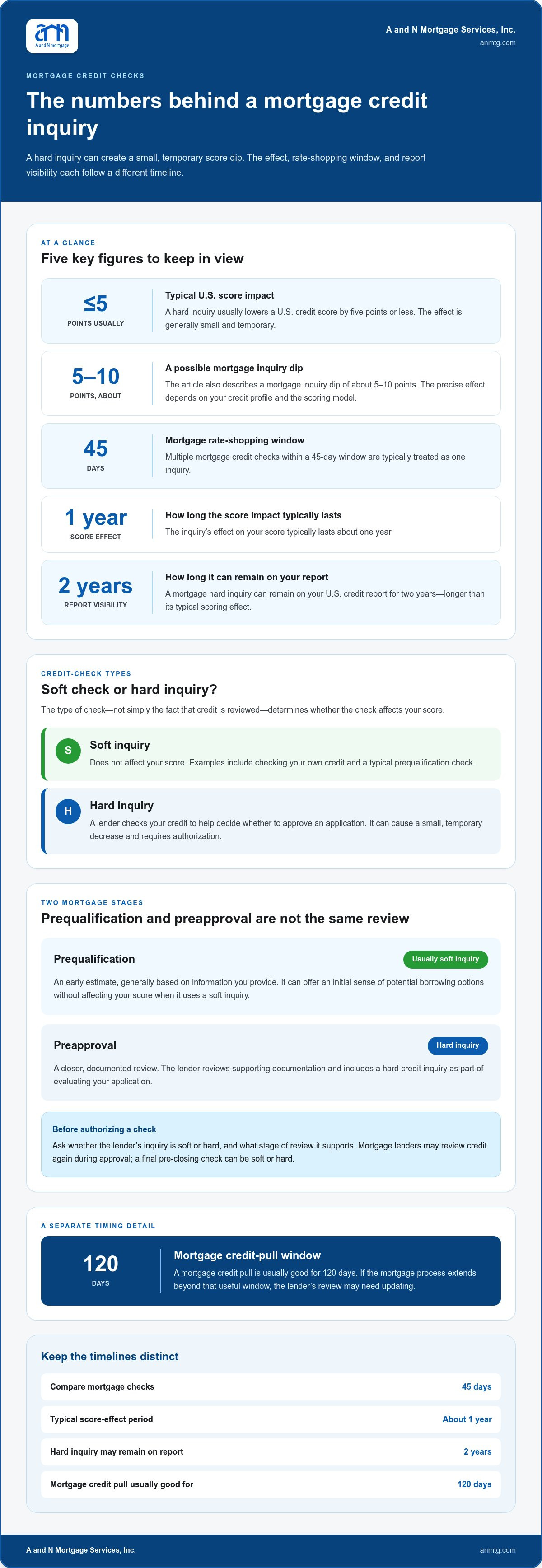
A mortgage application can temporarily lower your credit score: a hard inquiry usually reduces a U.S. score by five points or less. If you’re wondering whether applying for a mortgage hurts your credit, the key distinction is whether the lender makes a hard inquiry or a soft one. Multiple mortgage credit checks within a short rate-shopping window (14 to 45 days, depending on the scoring model) are typically treated as one inquiry.
It’s understandable to worry about your credit score when you’re preparing for a major financial decision. But a credit check is only part of the picture: prequalification and preapproval can involve different types of inquiries, and applying for other credit while your mortgage is in progress can matter, too.
This guide explains how mortgage credit checks can affect your score, how prequalification differs from preapproval, and what you can do to limit their impact. You’ll also learn why timing a credit card or car loan application around your mortgage process can help avoid unnecessary pressure on your credit profile.
Yes, a mortgage application can affect your U.S. credit score when the lender makes a hard inquiry. The effect is usually small and temporary, and mortgage inquiries within a short rate-shopping window are typically treated as one.
A hard inquiry occurs when a lender checks your credit to help decide whether to approve an application. A soft inquiry includes checking your own credit or undergoing a prequalification check, and it doesn’t affect your score.
The distinction matters before you authorize a mortgage credit check. A soft inquiry lets you review your credit without affecting your score; a hard inquiry is a normal part of applying for a mortgage. For example, reviewing your own credit report is different from authorizing a lender’s application review.
A hard inquiry can cause a small, temporary decrease in your score. For most people, a single hard inquiry lowers a FICO score by fewer than five points.
The precise effect depends on your credit profile and the scoring model. The inquiry is also reported to credit bureaus, where other lenders may see it as a sign that you’re considering new debt. One mortgage application won’t necessarily lower your score by the same amount as another borrower’s.
Mortgage rate shopping has a specific scoring consideration: multiple mortgage credit checks within a short window (14 to 45 days, depending on the scoring model) are typically treated as one inquiry. This helps distinguish comparing mortgage options from repeatedly seeking separate types of credit. Keeping mortgage applications within about two weeks is the safest way to stay inside that window when you compare Loan Estimates.
A hard inquiry from a mortgage application can remain on your U.S. credit report for two years. That reporting period is longer than the period it typically affects your score, which is about one year.
So, an inquiry that’s still visible after a year doesn’t necessarily continue to lower your score. For instance, a mortgage check from eighteen months ago may remain on your report even though its scoring effect has typically passed. The report records the inquiry, but the score impact follows a shorter timeline.
Mortgage lenders may review your credit again during the approval process, and a final pre-closing check can be soft or hard. Whether that check affects your score depends on its type. A hard inquiry requires authorization, so understand what kind of check you’re authorizing.
Keep the two timelines separate: the inquiry can stay on your report for two years, while its score effect typically lasts about one year. And when comparing mortgage lenders, the rate-shopping window is the key period for grouping multiple mortgage checks as one inquiry.
Prequalification and preapproval can both help you understand your mortgage options, but they may involve different credit checks. Knowing which step involves a hard inquiry helps you plan before authorizing a lender to review your credit.
Mortgage prequalification is usually based on information you provide and uses a soft credit inquiry. A soft inquiry doesn’t affect your credit score, so this early review can give you an initial sense of potential borrowing options without affecting your score.
Think of prequalification as an early estimate, not a documented application review. For example, you might share financial information and receive an initial assessment. Because the lender relies on details you provide, the result reflects those details rather than a full review of supporting documents.
You can also check your own credit report or score as you prepare. That self-check is a soft inquiry and doesn’t lower your score. It can help you understand your starting point before discussing mortgage options, without adding a hard inquiry just because you reviewed your own credit.
Mortgage preapproval requires documentation and includes a hard credit inquiry. The lender reviews your credit as part of evaluating your application, making this step more substantial than an initial estimate based on information you provide.
That difference matters when deciding whether to move from exploring homes to pursuing financing. Prequalification can help with early planning; preapproval gives the lender a documented application to review. For instance, if you’re comparing homes and want a more developed mortgage assessment, understand that preapproval includes a hard inquiry.
Hard inquiries require authorization. Before proceeding, ask whether the lender’s check is soft or hard and what stage of review it supports. This simple question clarifies the likely credit impact before you agree to a full review.
A mortgage credit pull is usually good for 120 days. That period can help you understand why a lender’s review may need updating if your mortgage process extends beyond the credit pull’s useful window.
Prequalification and preapproval serve different planning needs, so choose the step that matches your next decision. An early estimate can support initial exploration; a documented review is relevant when you’re advancing toward a mortgage application. Keep the inquiry type clear at each stage, especially if you’re comparing lenders within the mortgage rate-shopping window.
As you prepare for a documented review, a clear explanation of mortgage application guidance can help you understand what to expect at each stage.
You can’t avoid every mortgage-related credit check, but you can strengthen the rest of your credit profile. Focus on accurate reports, timely payments, and manageable card balances as you prepare your application.
Start by reviewing your credit reports for errors and correcting any you find promptly. Consumers in the United States can get a free report from each of the three major credit reporting agencies each week through AnnualCreditReport.com. Reviewing your own report is a soft inquiry, so it doesn’t lower your score.
Read each report carefully instead of checking only the score. Confirm that account balances and payment records are accurate and that the listed accounts belong to you. For example, if a report shows a late payment you believe is incorrect, address the error promptly with the reporting agency. Correcting inaccurate information can prevent it from affecting a lender’s view of your credit history.
Keep a record of the item you’re disputing and the correction you requested. This gives you a clear reference if the same error appears when you review your reports again. Checking reports from all three agencies matters because their records may differ.
Paying bills on time and keeping credit utilization low matter more to your score than a single inquiry. Amounts owed, which includes credit utilization, accounts for about 30 percent of a FICO credit score, so card balances deserve attention as you prepare for mortgage review.
If you regularly use a credit card, pay attention to its reported balance, not just whether you make the minimum payment. Lower utilization means using less of your available credit. Avoid running up balances while preparing documents and arranging your mortgage application.
Consistent payments also help maintain a positive credit history. Set reminders for bill due dates or use an existing payment routine to avoid missed payments. A mortgage inquiry may be temporary, but a pattern of late payments can carry more weight than one credit check.
As you prepare, make deliberate choices rather than reacting to a small score change. If you spot an error, work to correct it; if balances are high, focus on reducing utilization and keeping payments current. These steps address parts of your credit profile beyond the inquiry itself.
Use your weekly report access to track whether corrections appear and account details remain accurate. A clear, consistent credit record helps keep the application process focused on your actual financial history, rather than preventable reporting mistakes or avoidable balance increases.
Wait to apply for a credit card, car loan, or other borrowing until your mortgage is finalized. A new application can prompt a separate hard inquiry, while a newly opened account may change the credit picture your mortgage lender reviews.
A lender’s hard inquiry can signal to other lenders that you may be taking on new debt. If you apply for a car loan while your mortgage is underway, both the inquiry and the potential new payment may be relevant to your overall credit profile.
A credit card application also deserves careful thought. You might plan to use the card for just one purchase, but the application still asks a lender to assess your credit. If approved, the new account adds another piece of credit information while your mortgage financing is being evaluated.
This doesn’t mean every new application automatically changes a mortgage decision. But seeking additional credit can introduce changes you don’t need during the home loan process. Waiting until the mortgage is finalized prevents the application and any new account from overlapping with that review.
Consider delaying these applications until your home loan is complete:
For example, if you’re buying a car while arranging a mortgage, waiting can avoid adding a new inquiry and credit account during the same period. If new furniture can wait, postponing a store or general-purpose credit card application follows the same principle. It’s one of the most common first-time buyer mistakes, and it matters even more during the holiday season.
During the mortgage process, use existing accounts carefully and keep paying bills on time. If a planned purchase seems to require new credit, separate that decision from your mortgage timeline. Make the home loan your priority until it’s finalized, then reassess your borrowing needs.
If you’re unsure whether a planned application can wait, identify what you need the credit for and whether the purchase is essential before closing. A replaceable appliance or optional furnishing may be easier to postpone than a necessary expense. Avoid treating a preapproval as the finish line; the mortgage still needs to reach finalization.
After your home loan is finalized, you can consider other credit based on your budget and needs. Until then, delaying a credit card or car loan application reduces the chance of adding an avoidable inquiry or new borrowing obligation while your mortgage is in progress.
Yes. The three major credit reporting agencies may show different credit information, so scores associated with a mortgage application can differ. A score isn’t a single universal number; it reflects the report data and scoring model used.
Each agency maintains its own credit report, and the information may not match exactly. For example, a creditor’s update might appear on one report before another. If one report shows a different balance or payment record, a score calculated from it may also differ.
Scoring models can contribute to differences, too. Each model evaluates the information in a credit report according to its own method. So, scores based on different reports or scoring models may not be identical, even when checked around the same time.
A mortgage inquiry may appear in bureau records used to calculate scores, but that doesn’t mean every bureau will show precisely the same result. The inquiry’s effect is considered alongside the information in each report. It’s more useful to understand why scores differ than to assume one number represents every bureau’s view.
Before applying for a mortgage, review reports from all three major agencies rather than relying on a score from one source. Consumers in the United States can access a free report from each agency every week through AnnualCreditReport.com. Checking your own credit is a soft inquiry and doesn’t lower your score.
Look for differences in account balances, payment histories, and accounts listed under your name. For example, an account might appear on one report but not another, or a reported balance may have changed at different times. Note the agency and specific entry so you can address any error with the right reporting agency.
Reviewing each report also helps you distinguish an actual credit change from a reporting difference. If a score varies, compare the underlying entries first. A different balance, missing account, or inaccurate payment record may explain why the results don’t align.
Don’t assume a score shown by one bureau predicts the score associated with every report. Use the reports to understand the information behind the numbers and focus on accurate account details. That gives you a clearer picture before the lender reviews your mortgage application.
Compare all three reports before applying, then follow up on any incorrect information. This helps you spot differences early rather than discovering them while reviewing mortgage paperwork.
After reviewing how credit checks work, you can explore residential mortgage options with A and N Mortgage Services, Inc. If you’re considering a Conventional Loan (see how the 2026 conforming loan limits affect buyers), the next step is to understand how it fits your home financing needs and application.
A and N Mortgage Services, Inc. also offers Jumbo Loan, FHA Loan, and VA Loan options. Comparing these choices with your goals can help you prepare focused questions about the mortgage process, including when credit may be reviewed and what documentation supports your application.
For guidance as you consider a Conventional Loan or another mortgage option in Chicago, contact A and N Mortgage Services, Inc. or visit anmtg.com.
If you’re weighing whether applying for a mortgage hurts your credit, consider the broader decision alongside your score. Choosing a home loan involves more than one number: it means understanding your goals, reviewing available financing options, and deciding what questions you need answered before moving forward.
A and N Mortgage Services, Inc. offers Conventional Loan, Jumbo Loan, and FHA Loan options. Exploring these paths can help you have a focused conversation about financing your home in Chicago and the next steps. Bring your priorities and questions so the guidance you receive relates to the decision you’re making.
Contact A and N Mortgage Services, Inc.
With clear information and a thoughtful plan, you can approach your mortgage decision with greater confidence. Take the next step at a pace that feels right for you.
It can cause a small, temporary score decrease if the lender makes a hard inquiry. The effect is separate from other factors lenders may consider, such as payment history and outstanding balances. If you’re preparing to compare mortgage offers, keep your applications within the rate-shopping period. For example, avoid spreading mortgage inquiries across several months when you can complete comparisons in a shorter span.
Multiple mortgage inquiries made within a short window, 14 to 45 days depending on the scoring model, are typically treated as one inquiry. This lets you compare offers without each mortgage check necessarily counting separately. For instance, you could submit applications to several lenders during one concentrated shopping period. If inquiries fall outside the window, they may be treated separately, so plan comparisons around your home-buying timeline.
A mortgage application generally includes a hard inquiry because the lender checks your credit as part of its decision. This type of check requires your authorization. An early prequalification based on information you provide may instead use a soft inquiry. Before moving from an initial estimate to a documented application, clarify whether the credit check is soft or hard and what review it supports.
For most people, a single hard inquiry lowers a FICO score by fewer than five points. The effect varies with the scoring model and your credit profile. For example, a borrower with a strong history may see a different change than someone with recent credit activity. Treat these figures as general ranges, not a personal score prediction.
A mortgage hard inquiry can remain on a U.S. credit report for two years, though its effect on a score typically lasts about one year. The entry may still be visible after it stops affecting your score. If you review a report later, distinguish the inquiry’s presence from its scoring impact rather than assuming every visible item continues to lower your score.
Credit scoring models typically treat multiple mortgage inquiries made within a short window of 14–45 days as one inquiry. Newer FICO Score versions generally use a 45-day window, while older FICO versions and VantageScore use 14 days. Completing your comparisons within about two weeks is the safest way to keep inquiries grouped under any model.
Yes. Prequalification is usually based on information you provide and uses a soft inquiry, while preapproval requires documentation and includes a hard inquiry. For example, an early estimate can help you explore a potential budget without affecting your score. A documented review is a more formal step, so understand the type of credit check before proceeding and consider where you are in your home search.
They may be treated as one inquiry if the mortgage checks fall within the scoring model’s rate-shopping window, which ranges from 14 to 45 days. Applications submitted a few weeks apart may or may not fit inside that period, depending on the model. If the checks extend beyond the window, they may not receive the same grouping treatment. Keep a record of application dates, then compare them with the window before beginning additional lender applications.
Welcome to a better mortgage experience! In just few minutes you can find out what you qualify for and explore multiple loan options and interest rates.
Complete our short and intuitive pre-approval interview to get started.