The best mortgage for investment property isn’t always the one with the lowest advertised rate. A loan that looks attractive upfront may not fit your rental plan, cash available for closing, or longer-term ownership goals.
If you’re unsure how investment-property financing differs from a mortgage for your own home, you’re not alone. Lenders may assess your debts, credit profile, available assets, property details, and potential rental income. That means qualifying can involve more than comparing monthly payments.
This guide explains how to compare financing options, understand what lenders evaluate, and weigh rates, fees, and cash-to-close details. You’ll also learn how your current mortgage and expected rental income may factor into an application. A and N Mortgage Services, Inc. is a Chicago-based direct lender with a “Banker, Not A Broker” approach, competitive rates, access to a vast amount of products, and personalized guidance. The goal is to help you make a clearer, more confident financing decision for your investment property.
An investment-property mortgage finances a home you intend to purchase primarily to earn rental income, rather than to occupy as your main residence. That planned use shapes the financing conversation. Lenders consider the property’s intended occupancy and rental strategy alongside your personal financial picture. The best mortgage for investment property is therefore connected to what you plan to do with the home, not simply its location or purchase price.
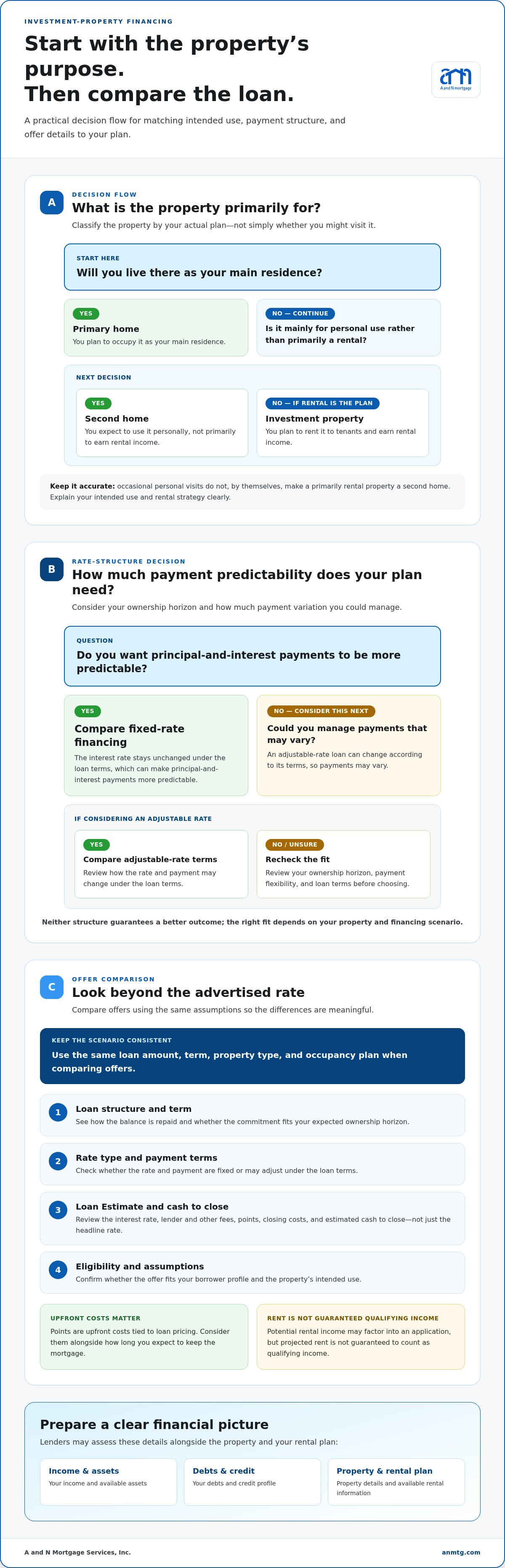
A second home is generally bought for personal use (see our guide to second home mortgage requirements), such as a place to stay during visits, while a rental property is intended to generate rent. An owner might occasionally stay at a second home without making rental income its primary purpose. The distinction is about your actual plan, not simply whether you might visit the property. The buy-to-let mortgage concept offers a useful comparison: financing is connected to a property’s intended rental use. Being clear about that purpose helps keep your mortgage discussion aligned with your plans.
Before comparing financing, describe how you expect to use the property and whether you plan to rent it. A home intended mainly for personal stays presents a different scenario from one purchased primarily for tenants. Don’t describe a rental purchase as a second home just because you may occasionally visit it. Accurately explaining your intended use gives the lender a clearer basis for evaluating your application.
Set out your plan before weighing mortgage options. These details can make comparisons more useful:
Keep financing decisions distinct from rental operations. Choosing a mortgage doesn’t determine how you’ll handle tenants, property management, maintenance, or the investment’s eventual performance. Include those considerations in your broader plan, but don’t treat them as outcomes a mortgage can promise. Mortgage eligibility depends on the borrower, property, and loan requirements. A clear explanation of your intended use gives you a more practical starting point.
A useful comparison starts with the loan structure, then tests whether its terms fit your rental plan and finances. Look beyond the advertised rate. The overall offer also depends on payment terms, upfront costs, and how long you expect to own the property. The best mortgage for investment property is the one whose trade-offs make sense for your plans, not necessarily the one with the most appealing headline number.
Your finances, the property’s intended use, and loan requirements can all affect which options fit your situation. Compare offers based on the same assumptions, including loan amount, term, property type, and occupancy plan. Otherwise, differences in the quoted rate or cash required at closing may reflect different loan scenarios rather than a better deal.
A fixed-rate mortgage keeps its interest rate unchanged under the loan terms, which can make principal-and-interest payments more predictable. An adjustable-rate mortgage can change according to its terms, so payments may vary. Neither structure guarantees a better outcome. Consider your expected ownership horizon, how much payment variation you could manage, and whether you might sell or refinance before choosing. The right structure depends on your property and financing scenario.
Review each Loan Estimate (here’s what a Loan Estimate can reveal about a lender), including the interest rate, lender and other fees, any points, closing costs, and estimated cash to close. Points are upfront costs tied to a loan’s pricing, so consider them alongside how long you expect to keep the mortgage. A lower advertised rate may come with different upfront costs. Compare the full figures rather than assuming it means a lower overall expense.
Match the loan amount, term, rate type, property use, and other assumptions across offers. Then consider how the payment fits your plan, including the possibility of changes if the rate is adjustable. If estimates use different assumptions, note those differences before drawing a conclusion. This gives you a clearer view of the trade-offs.
For more context as you review your choices, explore mortgage resources from A and N Mortgage. Its “Banker, Not A Broker” approach, competitive rates, and broad product access support a personalized comparison without treating one advertised number as the whole story.
Assess the mortgage against three parts of your plan: your finances, the property’s intended use, and how long you expect to own it. A loan can be suitable for financing without making the property profitable. Rent, vacancies, repairs, taxes, and other costs affect investment performance. No mortgage can guarantee rental income or returns. The right choice is one whose obligations and trade-offs you understand and can manage.
Start by deciding what matters most. Do you value predictable payments, flexibility if your plans change, or terms that align with an expected sale or refinance? For example, an investor planning to hold a property for the long term may prioritize payment stability, while someone with a shorter ownership horizon may weigh flexibility differently. Neither goal makes one loan type universally best. The fit depends on your borrower profile and property plans.
Use each lender’s Loan Estimate to compare payment structure, costs, and cash to close. Then look for differences in the assumptions behind the figures. Is the loan amount or term the same? Does each estimate reflect the same property use and rate structure? If a detail differs, ask A and N Mortgage to explain it before deciding. A lower advertised rate alone doesn’t establish that an offer is better if other terms or upfront costs differ.
Before choosing, consider these questions:
A and N Mortgage emphasizes personalized mortgage guidance and clear communication to help borrowers understand their financing choices. Its “Banker, Not A Broker” approach, competitive rates, and access to a broad range of products support a comparison based on your circumstances, not simply the lowest advertised rate. That careful review can help you decide whether a mortgage fits your plan, while keeping financing decisions separate from uncertain property performance.
Good preparation makes it easier to discuss your financing clearly and identify information that may need follow-up. Start with your own financial picture, then gather what you know about the property and its likely rental use. This keeps the mortgage conversation grounded in your actual plans rather than assumptions about rent, approval, or future costs. For Chicago buyers, consider the property and building details that could affect your ownership plans as well as your financing.
Lenders assess an application using relevant information about income, assets, debts, and credit. Organize records that help explain your financial position, including existing housing payments, other recurring debts, and funds you may use toward the purchase. The documents and review process depend on the borrower and loan scenario, so use this as a preparation guide rather than a universal application checklist or a promise of approval.
Consider the specific building, not only the unit. For a condominium or shared property, gather available association and building information (a full condo review can help) that could affect your ownership plans or expenses. Include Illinois property taxes and insurance in your affordability planning, and consider location-related due diligence that may influence your view of the property. Keep expected rent separate from confirmed qualifying income: projected rent isn’t guaranteed to count toward a lender’s assessment.
Use this readiness checklist to organize the conversation:
Loan requirements can depend on the property and transaction. A and N Mortgage can help you discuss the information relevant to your Chicago investment-property financing and understand how it fits your circumstances. An organized overview of your finances and property plan makes it easier to evaluate the best mortgage for investment property while keeping financing questions distinct from property management and investment-performance assumptions.
Discuss your rental-property mortgage plans
Comparing investment-property financing can feel complicated, especially when your pScenarioPurpose and expected occupancyQuestions to resolvePrimary homeYou plan to live there as your main residence.Will you occupy it as your home?ersonal finances, property plans, and loan requirements all shape the conversation. A and N Mortgage Services, Inc. offers a borrower-focused starting point. Its “Banker, Not A Broker” approach means it is a direct lender, rather than a broker acting as an intermediary. You can discuss your financing needs directly and work through how mortgage terms may fit your goals.
A and N provides personalized guidance through the residential mortgage process, helping borrowers consider their circumstances and compare financing choices. Its Chicago roots and over 26 years of experience bring local presence and a long-standing background to those conversations. The company emphasizes competitive rates and access to a vast amount of products, while recognizing that one rate or option won’t suit every investor.
That distinction matters when you’re evaluating the best mortgage for investment property. A competitive rate is one part of an offer, not a promise of approval or a complete measure of fit. Your intended property use, financial profile, and ownership plan all belong in the discussion. A and N Mortgage is listed among Top 100 Mortgage Companies, and its NMLS number is 19291. These details offer context about the company while keeping the focus on understanding your options and the terms available for your situation.
Before starting, gather an overview of your income, assets, debts, current mortgage obligations, and the property you’re considering. Note its intended use and any rental information you have, keeping estimates distinct from verified figures. Organizing these details can make it easier to discuss your financing priorities, identify application questions, and compare options with a clear picture of your plans.
A and N offers a short, intuitive online pre-approval interview as a way to begin, and our 2026 pre-approval checklist shows what to gather. Pre-approval is a step in the mortgage process, not a guarantee of a particular loan, rate, or outcome. Use the conversation to clarify what information is relevant, understand possible next steps, and consider how available choices align with your investment plan. You don’t need every detail settled before beginning. A clear outline of what you know and what you’re still weighing is a useful starting point.
Explore your mortgage options with A and N and take a considered next step toward financing your investment property.
Explore your mortgage options with A and N
Your financing decision can be a practical next step toward the investment you have in mind. Use your priorities, property plans, and ownership timeline to guide the conversation, and revisit your assumptions as you learn more. The best mortgage for investment property should support a plan you understand, not depend on assumed rent or a promised return.
A and N Mortgage’s “Banker, Not A Broker” approach, over 26 years of experience, and recognition among Top 100 Mortgage Companies reflect a foundation for personalized mortgage guidance. Bring your questions and the details you’ve gathered, then explore how available mortgage options may align with your goals. You can begin even if you’re still working through some of the details.
Explore your investment-property mortgage options with A and N
With a thoughtful plan and guidance from a Chicago mortgage lender, you can move forward with greater clarity and confidence.
Investment-property mortgage rates may differ from rates for a primary residence because lenders assess the property and borrower scenario differently. The rate you’re offered depends on factors such as the loan program, property, and borrower profile. Compare the rate alongside points, closing costs, and cash needed to close. Our post on the true cost of a low online mortgage rate explains why. A lower quoted rate by itself doesn’t show which offer is more suitable for your plans.
Keeping your current home doesn’t automatically prevent you from applying (see keeping a low-rate mortgage while buying your next home), but the lender will consider its mortgage payment and your other debts as part of your financial picture. For example, if you’re buying a Chicago rental while still paying your existing mortgage, organize information about both properties and their associated obligations. Qualification depends on the complete application and applicable loan requirements, so approval can’t be assumed.
It may help, but lenders don’t necessarily count all projected rent as qualifying income. How rental income is assessed depends on the property, documentation, and loan scenario. A listing’s estimated rent is not a guarantee that the lender will use that amount to qualify you. Keep expected rental income separate from income that has been reviewed for your application.
Buying through an LLC can affect which mortgage programs and ownership arrangements are available, including non-QM loan options. The borrower on the loan and the property’s legal owner may need to meet specific lender and program requirements, so don’t assume you can close in an LLC under the same terms as an individual borrower. Consider your intended ownership structure early, and review legal or tax implications with a qualified professional before committing to it.
The down payment depends on the property, loan program, and borrower’s financial profile. A larger down payment may affect the loan terms and the funds left for reserves or repairs. Discuss your available funds and property plans with A and N Mortgage so you can understand how they factor into your financing options. Don’t treat a general estimate as a promise that you’ll qualify for a particular mortgage.
No, private mortgage insurance isn’t a universal requirement for every investment-property loan. Whether it applies depends on the loan program, down payment, and lender’s terms. Learn more about private mortgage insurance (PMI). Don’t infer the answer from an advertised rate or a general rule about owner-occupied mortgages. Review the Loan Estimate for any mortgage insurance cost, and compare the complete cash-to-close and payment figures before deciding whether an offer fits your budget.
Choose based on your comfort with payment changes and how long you expect to keep the loan, rather than trying to predict future rates. A fixed-rate loan can suit an investor who values steady principal-and-interest payments; an adjustable-rate loan may fit someone whose plans and budget can accommodate adjustments under its terms. Compare the adjustment provisions and possible payment impact, then discuss how the structure fits your property and loan scenario.
Welcome to a better mortgage experience! In just few minutes you can find out what you qualify for and explore multiple loan options and interest rates.
Complete our short and intuitive pre-approval interview to get started.