Could your second-home approval depend as much on how you plan to use the property as on your credit score? Lenders assess second home mortgage requirements by looking at the property and your complete financial picture, not just one number. Your current mortgage, household expenses, and savings can all affect how comfortably a new payment fits.
It’s understandable to focus first on the down payment or wonder whether an existing home loan could affect approval. But there’s no single threshold that tells the whole story. In 2026, the property’s intended use, your income and debts, credit profile, loan size, and cash reserves all help determine what financing may fit.
This guide explains how lenders weigh those factors, what information to gather before discussing a loan, and how to account for the full cost of owning a second property. You’ll also learn when conventional and jumbo financing may be relevant. A and N Mortgage offers personalized guidance to help Chicago-area buyers build a clear financing plan for a second home.
Financing another home can feel complicated when your budget already includes a mortgage, utilities, insurance, and everyday expenses. Start by looking beyond a single qualifying number. Lenders assess how you’ll use the property alongside your credit history, income, recurring debts, down payment, cash reserves, and the home itself. Knowing what each factor means can help you prepare without treating an online guideline as a decision on your application.
One useful distinction: a mortgage for a second home is not automatically a second mortgage. The phrase “second mortgage” commonly refers to an additional loan secured by a property that already has a mortgage. A second-home mortgage finances a home you plan to use in addition to your primary residence.
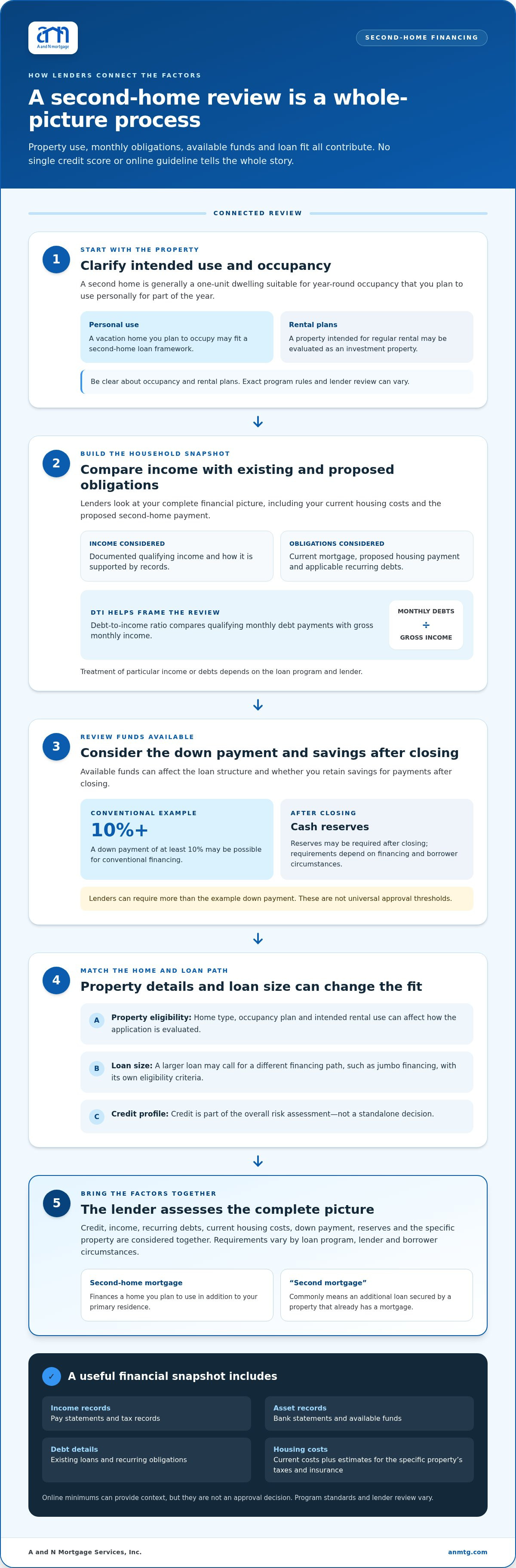
Classification depends on the property and your intended use. A second home is generally a one-unit dwelling suitable for year-round occupancy that you plan to occupy personally for part of the year. It’s distinct from your primary residence, where you live most of the time, but exact program rules and lender review can vary.
Rental plans matter. Occasional personal use and rental activity may be treated differently from buying a property primarily to generate income. For example, a home you plan to use during vacations may fit a second-home loan framework, while a property you plan to rent out regularly could be evaluated as an investment property. Be clear about occupancy and rental plans so the lender can assess how the home will be used.
Second-home financing may involve a closer review of your finances and the property than a primary-home application. For conventional financing, a down payment of at least 10% may be possible, though lenders can require more based on the borrower and transaction. Cash reserves may also be required after closing. These are examples, not universal approval thresholds.
Requirements vary by loan program, lender, and borrower circumstances. A one-unit home intended for personal use may be treated differently from a property with multiple units or a rental-focused plan. Loan size matters too: a larger loan may call for a different financing path, such as jumbo financing, with its own eligibility criteria.
Online minimums can provide context, but they aren’t an approval decision. Lenders review how the details fit together, including your household budget and the specific property. A useful first step is to write down how you’ll use the home, then organize your income, debts, available funds, and current housing costs. For Chicago-area buyers, include estimates for the specific property’s taxes and insurance in your personal budget rather than relying on the costs of your current home.
Already carrying a mortgage doesn’t automatically rule out buying another home. The lender’s question is whether your documented finances can support the new housing payment alongside your existing obligations. Approval depends on the whole picture, not simply the number of properties you own.
Second-home approval reflects your overall financial profile, including income, recurring debts, housing costs, available funds, and the proposed new payment. That combined review is why second home mortgage requirements can’t be reduced to one online credit score or debt ratio.
Debt-to-income ratio, or DTI, compares qualifying monthly debt payments with gross monthly income. It helps an underwriter understand how much income is already committed and how a new mortgage could fit. The calculation generally considers housing obligations and recurring debts, though the treatment of particular income or debts depends on the loan program and lender.
To document your finances, lenders may request pay statements, tax records, bank statements, and information about existing loans or other recurring obligations. They’ll review the amount and documentation of your income, then compare it with payments such as your current mortgage, the proposed second-home payment, and applicable debts. Program standards vary, so a payment that seems manageable in your personal budget isn’t automatically an approval, and an online cutoff doesn’t determine your application.
Think of the review as a household snapshot. If income is steady but existing obligations are substantial, the new payment may leave less room in the calculation. If recurring debts are lower or documented income is stronger, the overall picture may look different. Neither factor alone tells the full story.
Reserves are eligible funds you have left after required transaction expenses, subject to the loan program’s rules. Lenders may look at reserves as evidence that you can manage housing payments after closing. Requirements depend on the financing and borrower profile. The funds needed to complete the purchase and the money remaining afterward serve different purposes, so plan for both.
Qualification and personal comfort are separate tests. A lender may assess specified housing payments and debts, while your own budget should account for the practical costs of keeping two homes. Taxes, insurance, utilities, maintenance, and travel can affect your day-to-day finances even when they aren’t treated the same way as mortgage debt in underwriting.
Build a simple monthly plan: list take-home income, current-home costs, the estimated second-home payment, other recurring debts, and property-related expenses. Then note your savings after closing and consider whether the plan still works if repair or travel costs arise. This isn’t an approval formula. It’s a way to see the commitment clearly before moving forward.
A personalized review can help connect those numbers to a financing path. A and N Mortgage provides residential home-loan guidance for Chicago-area buyers. To discuss your plans, review second-home financing options.
There isn’t one financing route for every second-home purchase. A new mortgage secured by the property you’re buying keeps that loan tied to the new home. Borrowing against your current home uses a different structure and adds an obligation connected to a property you already own. Compare the payment setup and risks to decide which questions to raise in a financing discussion.
Conventional financing is a practical starting point for evaluating a second-home purchase, provided the borrower and property meet the applicable eligibility rules. The requested loan amount is one factor: if it falls within the conforming limit that applies to the property’s location and loan type, conforming financing may be considered; if it exceeds that limit, jumbo financing may be relevant. Limits can change, so use current applicable guidance rather than relying on an old online figure. The broader second home mortgage requirements depend on the complete application, not just the loan amount.
Home equity options change where the debt is secured. A home equity loan generally provides a lump sum, while a HELOC provides access to a credit line. A cash-out refinance replaces the existing mortgage rather than simply adding a separate loan. Each approach affects your household obligations differently, and borrowing against your current home puts that property at risk if payments aren’t made.
Compare the expected payment structure, repayment terms, collateral, and impact on your current mortgage before choosing a path. For instance, if you’re weighing a conventional or jumbo loan against a HELOC, consider how purchase funds are accessed, which home secures each debt, and how the new obligation fits alongside existing payments. A side-by-side review can connect the financing choice to your plans and comfort with risk.
Good preparation makes a financing conversation more useful. Before gathering paperwork, clarify how you plan to use the property and take stock of the household finances that will support both homes. The second home mortgage requirements that apply to you depend on the loan program, income, and individual file, so use this checklist as a starting point rather than a fixed document package.
There isn’t one identical document set for every buyer. A lender may request records to verify identity, income, employment, assets, debts, and existing mortgage or other housing obligations. Depending on your circumstances and the loan program, common items may include:
Income type can shape what’s needed. A self-employed borrower may be asked for business or tax records, while someone with variable income may need documentation that helps show its history and pattern. A borrower qualifying through assets may need records that verify those funds. These are examples, not a universal list. The lender’s requests are tailored to the loan and the details of your application.
Before the conversation, note anything that may need explanation, such as a recent employment change, a large deposit, or a debt that will soon be paid off. Clear context can help connect the documents to your financial picture. Keep your budget estimates separate from lender documentation: the lender assesses its qualifying criteria, while your own plan helps you judge whether ongoing ownership costs feel comfortable.
Discuss your second-home financing plans
A clear plan turns second-home financing into a series of manageable decisions. Start by defining how you’ll use the property, then review your household finances, compare suitable loan paths, and organize the information a lender may need. This preparation makes a conversation about second home mortgage requirements more focused, without assuming that one set of figures or documents applies to every buyer.
A and N Mortgage is a Chicago-based residential mortgage lender founded in 1998, offering conventional and jumbo loans among other home-financing options. Its personalized guidance can help you consider how your plans and financial picture connect to potential financing paths. Loan eligibility and terms depend on the borrower, property, and program, so focus on understanding the options rather than assuming an outcome.
Bring a practical overview of the purchase you’re considering. You don’t need every detail settled before starting a discussion, but sharing what you know can make the review more relevant.
These talking points connect the property’s intended use with your financial circumstances. If your income varies, you’re self-employed, or you’re considering borrowing against your current home, mention that early so the conversation can account for the relevant details. Bring questions as well as records. Understanding what needs clarification is part of preparing.
Second-home financing can be considered one step at a time. A tailored review can help you compare relevant residential loan paths, understand which parts of your financial profile need attention, and identify useful next steps. Begin with an estimate and a clear description of your plans, then refine the details as you learn more about the property and financing structure.
Before your discussion, write down your intended use, estimated purchase budget, preferred timing, current housing obligations, and the payment range that feels comfortable for your household. This gives you a practical starting point while leaving room to explore questions and alternatives with a mortgage professional.
With personalized guidance from A and N Mortgage, you can work through the choices with a clearer view of how they relate to your goals. Discuss your mortgage goals with A and N Mortgage
A second property is a major financial decision, but you don’t need every detail resolved before exploring your options. Use what you’ve learned about second home mortgage requirements as a starting framework, then consider how the purchase fits your priorities, timing, and longer-term plans. A focused conversation can help turn general guidelines into questions that apply to your situation.
Before moving forward, decide what matters most to you: keeping flexibility in your budget, preserving savings, or understanding how different financing structures could affect your household. These priorities can guide a more focused discussion and help you weigh possibilities without feeling pressured to settle on a path too soon.
A and N Mortgage offers personalized residential financing guidance to help Chicago-area buyers consider their goals and explore next steps. Bring your questions, even if your plans are still taking shape. You can build clarity one decision at a time.
Discuss your second-home mortgage goals with A and N Mortgage
With a clear plan and personalized guidance from A and N Mortgage, you can take the next step toward financing a second home.
It can be, because lenders may apply closer scrutiny than they would for a primary residence. Strong credit alone won’t answer every question: the lender also considers the proposed property, your payment obligations, down payment, and funds left after closing. For second home mortgage requirements, use online credit or debt guidelines as general context, not a prediction. A detailed review of your application helps clarify which factors may need attention.
Possibly, but rental plans can affect how a lender classifies the property and evaluates the loan. Limited personal-use vacation rentals may be treated differently from a home bought mainly to generate rental income, and rental income typically can’t be counted to qualify for a second-home mortgage. Be prepared to describe how often you’ll occupy the property, how often you expect to rent it, and who will manage its use.
For a conventional second-home mortgage, a down payment of at least 10% may be required, but that isn’t a universal target for every buyer. A lender may require 20% to 25% in some cases, such as when credit is lower or debt obligations are higher. The amount needed depends on the loan and borrower profile, so estimate purchase funds alongside closing costs and the savings you want to retain after the transaction.
Having a current mortgage doesn’t automatically prevent you from taking out another one. The lender will assess whether your finances can support both housing payments along with other qualifying debts. Property costs can vary: for a Chicago-area home, review the specific property’s tax and insurance estimates rather than assuming they match your current home. Your budget should also leave room for upkeep and unexpected expenses.
They’re often higher than rates for a primary residence, partly because lenders may apply additional pricing adjustments to second-home loans. An individual quote can vary with the borrower, property, loan structure, and market conditions. Compare the full loan terms, not just the advertised rate, and consider how the payment would fit alongside your primary-home mortgage and other monthly commitments.
Yes, a home equity line of credit may provide access to funds for a second-home purchase, subject to its terms and your eligibility. The line is secured by your current home, so it creates an additional obligation tied to the property you already own. Before using one, compare its payment structure and repayment terms with a mortgage secured by the new home, and consider how each affects your household finances.
Start with records that help verify identity, income, employment, assets, debts, and your existing housing payments. Depending on your situation, that may include identification, pay statements, tax records, account statements, loan information, and a current mortgage statement. Self-employed or variable-income borrowers may need additional records to explain how earnings are received and documented. Keep digital or paper copies organized by category, and be ready to provide updated documents if requested.
Welcome to a better mortgage experience! In just few minutes you can find out what you qualify for and explore multiple loan options and interest rates.
Complete our short and intuitive pre-approval interview to get started.