Co-signing a mortgage for a family member can help them qualify, but it also makes you responsible for repaying the loan if they can’t. A co-signer’s income and credit may strengthen an application, but co-signing doesn’t automatically give you ownership of the home. If payments are missed, both the borrower’s and co-signer’s credit may be affected.
It’s natural to want to support someone you care about while protecting your own financial stability. Before agreeing, understand how lenders assess co-signers, how conventional, FHA, and VA loans may treat family support, and how co-signing differs from sharing ownership as a co-borrower. This article covers potential credit effects, financial and ownership risks, and safeguards to discuss before signing, including plans for missed payments or a future change in borrowers.
Yes. A lender reviews a co-signer’s credit and finances, and the mortgage can affect their credit history and debt-to-income ratio. These effects matter both during the home purchase and for as long as the loan remains unpaid.
As part of the mortgage application, the lender reviews each applicant’s credit history and evaluates a co-signer’s income, assets, and liabilities. The co-signer’s finances can therefore affect the application alongside the primary borrower’s.
For conventional mortgages, many lenders look for a credit score of 620 or higher. A parent who co-signs must also meet the lender’s income, debt-to-income, and credit requirements. A co-signer’s finances may help support the application, but the lender still considers whether the primary borrower qualifies. Citizenship and residency eligibility are separate considerations from the credit and income measures described here.
Co-signing adds responsibility for another mortgage to your financial profile, which can affect your debt-to-income ratio. Lenders generally want monthly debt payments to stay within 43-50% of gross monthly income, depending on loan type. Conventional lenders typically expect a combined borrower and co-signer ratio of 43-45%, though some may allow up to 50% with strong compensating factors.
Taking on that obligation may affect your ability to qualify for credit of your own. If the borrower misses mortgage payments, both the borrower’s and co-signer’s credit may be affected. Having an existing mortgage doesn’t automatically prevent you from co-signing, provided you meet the lender’s requirements.
A co-signer’s income and credit may help a primary borrower qualify, as the lender considers both applicants’ financial profiles. Applicants who apply together may be assessed using their combined income and assets. Depending on the program and how the loan is underwritten, the lender may also look closely at the occupying borrower’s own income and debts.
Co-signing may strengthen an application, but it doesn’t guarantee a particular interest rate or loan limit. Those depend on the loan program and the applicants’ qualifications. Lenders review income, assets, liabilities, and credit history, while program rules help determine the available loan amount.
A co-signer agrees to repay the mortgage if the primary borrower cannot, making the obligation more than a credit reference. Missed payments or default can affect both parties’ credit. The commitment may last 15 to 30 years, so the payment obligation can remain relevant long after the original buying decision.
A co-signer typically doesn’t own the home or have a claim to its equity, despite taking on repayment risk. Tax treatment also differs: mortgage interest deductions are available to co-borrowers, but not to co-signers who don’t own the home. Before accepting responsibility, clarify whether the arrangement involves co-signing or shared ownership.
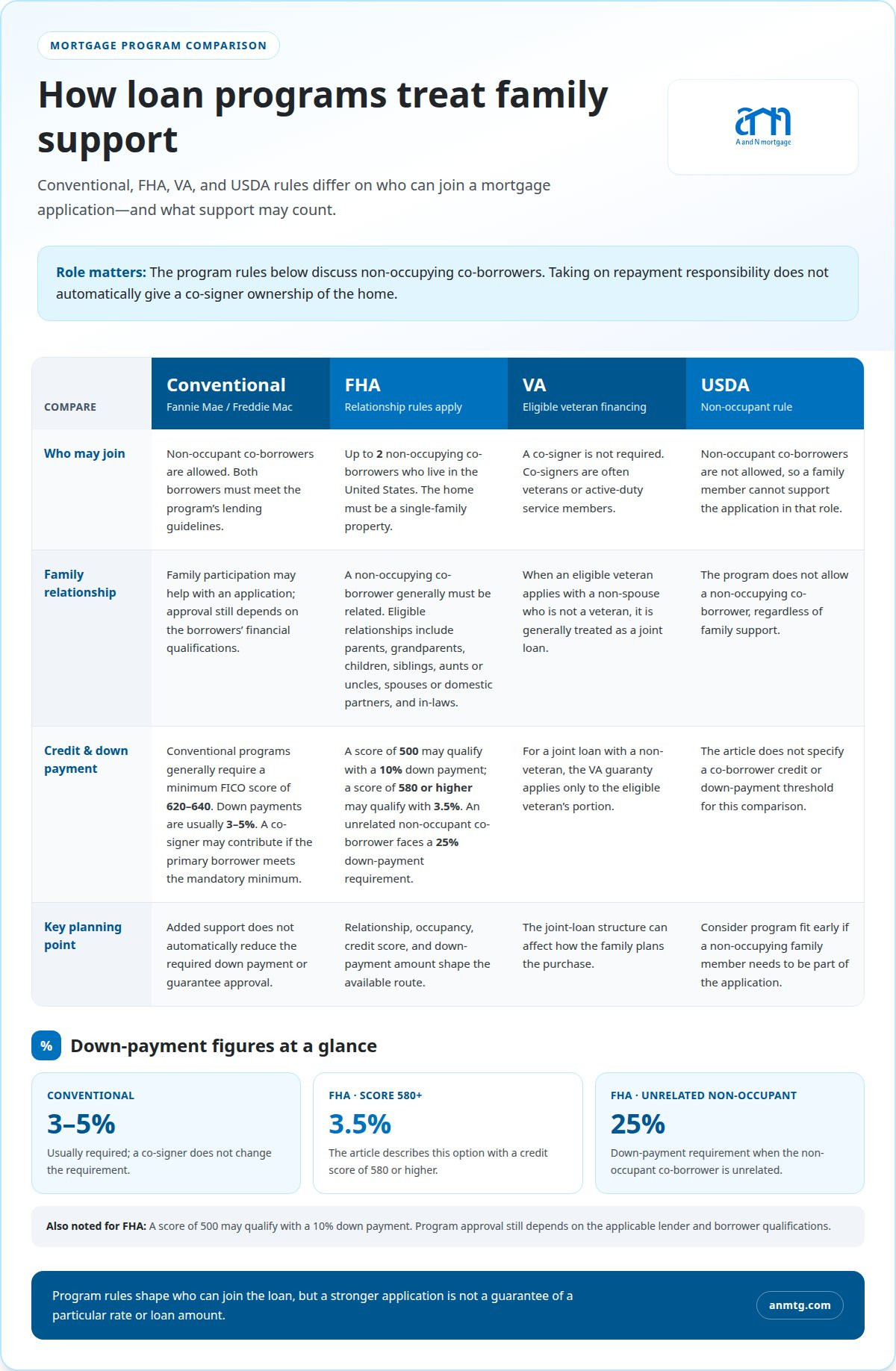
Loan programs have different rules for family members who won’t live in the home. The program affects who can join the application, what qualifications apply, and how the lender reviews it.
Fannie Mae and Freddie Mac allow non-occupant co-borrowers on conventional loans, but both borrowers must meet their lending guidelines. Many lenders look for a credit score of 620 or higher on conventional loans. A family member’s participation may help with a mortgage application, though approval still depends on the borrowers’ financial qualifications.
Conventional down payments are usually 3-5%, and adding a co-signer doesn’t change that requirement. A family member may also be able to help with the down payment through a documented gift, subject to program rules. This matters when planning funds: added support may help the application, but it doesn’t automatically reduce the amount needed to buy.
FHA allows non-occupying co-borrowers whose principal residence is in the United States. To get FHA’s maximum financing, a non-occupying co-borrower generally must be a family member, and the home is typically a one-unit property. Qualifying relationships include parents, grandparents, children, siblings, aunts or uncles, spouses or domestic partners, and in-laws.
FHA’s credit and down-payment thresholds create one possible route to homeownership. A borrower may qualify with a credit score of 500 and a 10% down payment, or a score of 580 or higher and a 3.5% down payment. An unrelated non-occupant co-borrower faces a 25% down-payment requirement. These distinctions make the relationship and the application structure important parts of planning.
VA loans don’t require a co-signer. When an eligible veteran applies with a non-spouse who isn’t a veteran, the arrangement is generally treated as a joint loan, and the VA guaranty applies only to the eligible veteran’s portion, which can mean a down payment and extra lender review. That structure can affect how the family plans its shared purchase.
USDA loans don’t allow non-occupant co-borrowers, so a family member can’t provide support in that role on a USDA application. Comparing program rules early can help determine whether conventional, FHA, VA, or USDA financing fits the planned purchase.
During the application, the lender assesses borrowers under the chosen program’s criteria. Credit score, the relationship between applicants, occupancy, and the source of the down payment can all affect the approval process. The loan is also subject to an appraisal and title review before closing.
For a conventional application, reviewing conventional loan options can help clarify how co-borrower eligibility and down-payment rules fit the family’s homeownership plans.
Co-signing can support a relative’s mortgage qualification, but it also creates a financial obligation. The central trade-off is helping someone buy a home while accepting responsibility without automatically gaining ownership rights.
A co-signer’s income and credit may help someone qualify when their own application falls short. That support can bring a family member closer to homeownership, though the lender still reviews the applicants and loan terms. A co-signer usually doesn’t lower the interest rate, though. Many lenders price the loan using the lowest qualifying credit score among the applicants, so the main benefit is often getting approved rather than getting a better rate.
A co-signer can help the borrower present a stronger application, but should discuss the expected role before signing. If the family intends to share the home and its equity, a co-borrower arrangement may better match those intentions. A co-borrower shares repayment responsibility and ownership, unlike a co-signer.
For a parent assisting an adult child, the key question is whether the goal is to support qualification or share ownership. A co-borrower typically makes mortgage payments from the start and shares ownership. A co-signer accepts repayment responsibility without gaining a claim to the property or its equity. Clarifying the difference helps prevent conflicting expectations about rights, payments, and the home’s future.
A co-signer is responsible for repaying the mortgage if the primary borrower can’t pay. This can mean covering missed payments, not simply offering occasional assistance. The obligation may last 15 to 30 years, so the signer should consider how payments could affect their finances throughout that period.
Missed payments or default can affect both the borrower’s and co-signer’s credit. The mortgage obligation may also make it harder for the co-signer to qualify for other borrowing, since lenders assess debts against income. The risk remains even though a co-signer generally has no ownership rights or say in managing the property.
Before agreeing, consider what could happen if the borrower’s income changes: the co-signer may need to cover the mortgage while still meeting their own expenses. The family should discuss how payment notices will be shared and what happens after a missed payment. These conversations don’t remove the legal repayment responsibility, but they can clarify how everyone plans to respond.
Co-signing is most suitable when the signer could manage the loan obligation if the borrower cannot. Weigh that capacity against the benefit to the borrower, and distinguish help with qualification from a shared investment. A family member seeking ownership or equity should discuss a co-borrower structure rather than assume co-signing provides those rights.
Before signing, treat the mortgage as a financial commitment, not simply a family favor. A co-signer may owe payments without owning the home, so agree on expectations with the primary borrower before closing. Discuss who will make each monthly payment, how you’ll learn about payment problems, and what happens if the borrower’s income changes.
Put the arrangement in writing. Set out the borrower’s payment responsibilities, how they’ll tell you about a missed payment, and how you’ll respond if they can’t pay. For example, a parent co-signing for an adult child might agree to receive payment updates and discuss a plan promptly if a payment is missed. Written expectations won’t erase the loan responsibility, but they can help prevent misunderstandings.
Build a realistic backup plan before signing. Consider setting aside an emergency fund equal to 3-6 months of mortgage payments. Use the actual expected payment when setting your savings target, and consider whether you could cover it alongside your own monthly housing and debt costs. If covering the mortgage would disrupt essential expenses, the commitment may exceed your available capacity.
Clarify the ownership arrangement before closing. A co-signer’s name doesn’t appear on the property title, and co-signers generally don’t have ownership rights or a say in managing the home. If you expect a share of the property or its equity, discuss that before signing. Repayment responsibility alone doesn’t provide those rights.
Consult a qualified legal or tax professional if you need help understanding a written family agreement, ownership expectations, or tax consequences. For example, if you expect to share the home’s equity, clarify that arrangement before closing instead of relying on an informal family understanding. Mortgage responsibility and property ownership are separate considerations.
Plan for what happens if circumstances change. Discuss whether a future refinance could remove you from the loan, and agree on a date or conditions for revisiting the plan. A refinance depends on the borrower qualifying independently, so don’t assume the change will happen automatically. Before signing, make sure you can manage the obligation if it takes longer than expected.
A co-signer remains responsible if the borrower misses payments or can’t repay. Planning ahead means agreeing how the family will respond to payment trouble and how the mortgage responsibility could eventually change.
Discuss a future refinance before the loan closes. The borrower may later refinance without the co-signer, but must qualify for the new loan independently. Set a target date, typically 2-5 years out, to revisit that goal. Treat it as a planning milestone, not an automatic release from responsibility.
Refinancing may remove a co-signer from the existing mortgage by replacing it with a new loan in the borrower’s name. It’s generally required when the current lender doesn’t approve another way to release the co-signer. A refinance can increase finance charges over the life of the new loan, so weigh the release against the new terms.
A loan modification may offer another path. Some lenders may allow a modification that removes a co-signer if the borrower demonstrates financial stability. The borrower and co-signer should discuss this possibility with the lender and understand that a modification differs from refinancing. Don’t treat a future modification or refinance as effective until responsibility for the loan has formally changed.
Agree on what happens after a missed payment. The co-signer is responsible for making payments if the borrower misses them or can’t repay, so decide how the borrower will report a problem and how funds will be arranged. Prompt communication gives the family an opportunity to address the payment before the problem grows, while the co-signer remains liable under the mortgage.
Ownership and loan responsibility are separate. A co-borrower is typically listed on the property title, shares ownership, and may be entitled to a share of the home’s equity. A co-signer generally has no ownership claim. If the family wants to change who owns the property, discuss the title and loan arrangements separately rather than assuming one change updates both.
Selling the home may be one way to address the mortgage obligation, depending on whether the sale proceeds cover it. Include this possibility in the family’s plan if the borrower can’t keep paying or refinancing isn’t workable. A sale resolves the loan through payoff, while changing ownership alone doesn’t necessarily remove anyone from the mortgage.
Write down a target refinance date, what to do after missed payments, and the family’s plan if a sale becomes necessary. Clear terms help everyone understand what happens next, including who is paying and which mortgage responsibilities could change.
A and N Mortgage Services, Inc. can help you understand how a family member’s support fits into a home loan application. If you’re weighing a co-signer’s role, consider the borrower’s financial profile alongside the loan program’s requirements. A clear view of income, credit, and existing debts can help frame the financing discussion and the responsibilities involved.
For families planning a home purchase, A and N Mortgage Services, Inc. offers conventional, jumbo, FHA, and VA loan options. Its personalized guidance can help borrowers understand available financing paths and prepare for the mortgage process, including questions about who will apply and how the loan may fit their plans.
Contact A and N Mortgage Services, Inc. to discuss your family’s mortgage questions and next steps.
Before co-signing a mortgage for a family member, align your family’s goals with the financing decision. Clarify the intended ownership arrangement, each person’s role, and what would make the commitment manageable over time. Bringing these questions into the mortgage discussion gives everyone a more useful starting point than focusing on approval alone.
A and N Mortgage Services can help borrowers explore how Conventional, Jumbo, FHA, and VA Loan options may fit their home purchase plans. The next step is a focused conversation about your family’s intended arrangement and financing needs.
Contact A and N Mortgage Services
Thoughtful preparation can help your family approach the decision with greater clarity and confidence.
A co-signer signs the mortgage and accepts responsibility for repayment if the primary borrower can’t pay. For example, a parent might support an adult child’s application without intending to own the home. Before signing, clarify whether the goal is to help with qualification or share ownership, since those arrangements create different rights and responsibilities.
Yes, you can co-sign a mortgage if you meet the lender’s financial requirements and the loan program permits the arrangement. The lender reviews your credit, income, debts, and assets as part of the application. Having a mortgage already doesn’t automatically prevent you from co-signing, but its payment may factor into the lender’s assessment of your finances.
A co-borrower applies for the mortgage with the primary borrower and shares repayment responsibility. Unlike a co-signer, a co-borrower typically shares ownership and may have a claim to the home’s equity. For instance, a parent helping an adult child buy a home with shared ownership intentions may consider applying as a co-borrower. Discuss ownership expectations before choosing an application structure.
No, co-signing alone doesn’t put your name on the property title or deed. Signing the mortgage doesn’t automatically give you ownership rights or a share of the home’s equity. If your family expects you to own part of the property, clarify the intended ownership arrangement separately before closing. For tax or legal implications, consult your personal advisors.
Yes, you may apply with a parent as a co-borrower or co-signer, depending on the loan program and your family’s goals. For example, a parent who will share ownership may be better suited to a co-borrower arrangement. A parent supporting qualification without seeking ownership may consider co-signing. The lender assesses applicants together under the chosen program’s requirements.
Yes, a qualified person may co-sign if the loan program allows it and the lender accepts the application structure. The person doesn’t always need to live in the home, but program rules can limit who may participate. For example, FHA has specific requirements for non-occupant co-borrowers, including relationship and property conditions. That’s why it’s important to consider program rules before applying.
It means accepting responsibility for the mortgage alongside a relative who is buying a home, even if you won’t live there or own it. If your relative can’t make a payment, you may have to pay under the loan obligation. Before agreeing, discuss how you’ll communicate about payments and what the family plans to do if the borrower later wants to refinance.
Requirements depend on the loan program and the lender’s review of the full application. Many conventional lenders look for a credit score of 620 or higher, while FHA guidelines allow scores as low as 500 with a 10% down payment, or 580 with a 3.5% down payment. Lenders also assess income, existing debts, assets, and debt-to-income ratio, so a score alone doesn’t establish qualification.
Welcome to a better mortgage experience! In just few minutes you can find out what you qualify for and explore multiple loan options and interest rates.
Complete our short and intuitive pre-approval interview to get started.