A smaller down payment doesn’t automatically make a mortgage the better deal. The doctor mortgage loan pros and cons involve more than the cash due at closing: eligible physicians and some other doctorate-trained professionals may be able to buy with little or no money down and avoid private mortgage insurance, while the interest rate or overall borrowing cost may be higher than with a conventional loan.
When weighing this option, consider both upfront affordability and long-term cost. Physician loan eligibility may include medical doctors, dentists, podiatrists, veterinarians, and optometrists, although qualifying rules vary by program.
This guide explains how physician loans work, who may qualify, and when a low down payment can help or leave you with less equity and a larger loan balance. It also outlines how rates, fees, monthly payments, and loan terms compare with conventional mortgages, so you can weigh the tradeoffs against your budget and how long you expect to stay in the home.
A smaller down payment can leave cash available for moving, student debt, and other expenses. The tradeoff is a larger mortgage balance and less equity from the start.
A down payment reduces the amount borrowed against a home’s purchase price. Some physician loans allow qualified borrowers to finance up to 100% of that price, while others require money down. A low-down-payment option can help conserve cash, but it doesn’t remove the need to qualify for the loan amount. The lender’s approval and the home price still shape how much a borrower can finance.
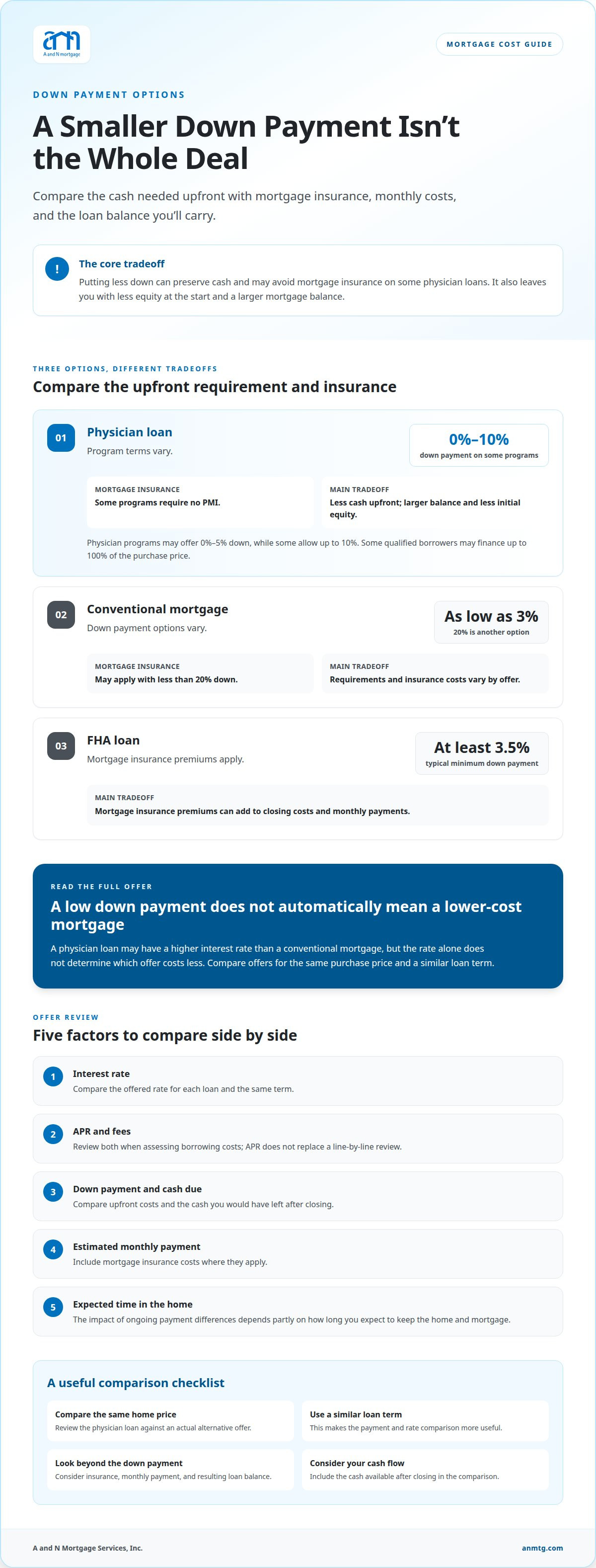
Some physician loans allow a down payment of 0% to 10% without private mortgage insurance (PMI). That can lower the cash needed at closing and avoid a separate monthly mortgage insurance payment. The tradeoff is that a smaller initial payment leaves less equity and a larger principal balance. Borrowers should consider both the cash preserved and the amount they’ll owe over the loan term.
Physician loan programs may offer down payments from 0% to 5%, while some allow up to 10%. Conventional mortgages may offer down payments as low as 3%, though borrowers putting less than 20% down may need PMI. These options differ in their upfront cash requirements and insurance costs. A 0% down payment preserves more cash initially, but finances the full purchase price.
There isn’t one down payment requirement for every mortgage. Physician loan terms vary by program, while conventional options can range from a low down payment to 20% or more. FHA loans typically require at least 3.5% down and require mortgage insurance premiums. Those premiums can increase monthly payments and closing costs, so the smallest down payment may not mean the lowest overall expense.
Compare the cash due at closing, mortgage insurance, monthly payment, and resulting loan balance. Don’t base your choice on the down payment alone.
Not automatically. A physician loan may have a higher interest rate than a conventional mortgage, but the rate alone doesn’t show which offer costs less. The doctor mortgage loan pros and cons depend on each loan’s interest rate, APR, fees, down payment, monthly payment, and how long you expect to keep the home.
Begin with offers for the same purchase price and a similar loan term. Compare the estimated monthly payment and APR on each Loan Estimate, along with upfront costs and the cash you would have left after closing. A physician mortgage with a higher rate may still suit you better if its other terms reduce costs or fit your cash-flow needs. A conventional loan may cost less overall when its full terms are more favorable.
APR offers another way to compare loans, but it shouldn’t replace a line-by-line review. Consider the interest rate, lender fees, estimated payment, and down payment together. Your expected time in the home matters too: a difference in ongoing payments has a different impact if you plan a short stay than if you expect to keep the mortgage for years. This side-by-side review makes the doctor mortgage loan pros and cons relevant to your plans.
“Conventional” describes a mortgage that isn’t backed by the U.S. government, according to the Consumer Financial Protection Bureau. That category is not a single loan structure with one set of costs. Conventional offers can differ in rate, fees, term, and payment, so an eligible physician should compare an actual conventional offer against the physician loan available for the same home.
Other mortgage types can help put the comparison in context. FHA loans require mortgage insurance premiums, which add to closing costs and monthly payments. VA borrowers generally pay a VA Funding Fee unless exempt. Include these costs alongside the rate and monthly payment rather than treating them as minor details. Each program has different terms, so focus on how the complete offer fits your finances.
Conventional alternatives can also include 80/20 and 80/10/10 loan structures. Their names indicate separate loan components, so compare the terms and payments of the full structure against a physician loan, not just one portion. A conventional mortgage may suit a borrower whose offer compares favorably across these criteria; a physician loan may suit someone whose priorities include its specific eligibility or payment features.
For a grounded comparison, review the terms side by side through conventional mortgage options and your physician loan offer.
Many physician mortgage programs look for a credit score around 700 or higher, though minimums vary by lender. Eligibility also depends on the professional degree, employment documentation, and the lender’s assessment of existing debts. These criteria matter for residents, fellows, and established physicians, whose income and work history may look different during training. Understanding the doctor mortgage loan pros and cons starts with knowing how these qualifications shape the available options.
Physician mortgage programs may serve holders of degrees in medicine, osteopathic medicine, podiatric medicine, dental medicine, dental surgery, veterinary medicine, and optometry. The eligible degree list can extend beyond medical doctors, but a professional title alone doesn’t establish eligibility. Credit, income, documentation, and program rules also factor into the review.
Some programs include dentists, podiatrists, veterinarians, and optometrists. Documentation for a recent graduate may differ from that for a conventional mortgage application: some physician lenders may accept medical school transcripts instead of two years of employment history. This can matter to a resident or fellow whose career is underway but whose employment record is still developing.
An executed employment contract can help document an upcoming role (our pre-approval checklist covers other documents). Some lenders accept a contract with a start date within 120 days of closing. This can be relevant when a resident or fellow is moving to begin a new position. The contract supports the employment picture, while the borrower’s credit, debts, and other application details remain relevant.
Student debt deserves close attention. Many medical school graduates carry six-figure student loan balances. Physician mortgage lenders generally treat medical school debt as less detrimental than conventional mortgage lenders do. Some programs use specialized methods to evaluate student-loan payments, which may help a borrower qualify despite a substantial balance.
This approach to debt is a potential advantage, not debt forgiveness: student loans remain part of the borrower’s financial obligations. A physician mortgage may expand financing options for a doctor whose education debt weighs heavily in a conventional mortgage review, but monthly repayment commitments still need to be considered alongside housing costs.
Consider a fellow with an employment contract, medical school debt, and a credit score near a program’s general benchmark. The contract may document future employment, while the lender evaluates credit and student-loan payments under its program rules. A conventional mortgage handles medical debt differently, so comparing both assessments can clarify which option better fits the borrower’s financial profile.
Review degree criteria, credit score, employment records, and student-loan payment calculations as separate parts of eligibility. Together, they show both the potential benefit of physician-specific underwriting and its limits. This is where the doctor mortgage loan pros and cons become specific to a borrower’s career stage, financial profile, and repayment obligations.
Completing residency can open a different borrowing conversation from buying during training. Some programs offer higher maximum loan amounts for established doctors. A higher maximum can help an established doctor consider homes at a higher price point, but it isn’t a recommended budget or automatic approval. The monthly payment and total debt still need to fit the borrower’s finances.
For eligible doctors, a physician loan may provide a larger borrowing ceiling (often above the 2026 conforming loan limit) alongside fixed-rate terms ranging from 15 to 30 years. Those terms give borrowers a choice about repayment pace. A 15-year term repays the balance over a shorter schedule, while a 30-year term spreads payments over more time. The payment amount and total interest differ with the loan balance, rate, and term.
Consider an attending physician comparing two homes, one requiring a loan below the program’s maximum and another closer to it. The higher ceiling may make the second home worth considering, but it doesn’t make the payment affordable by itself. Monthly income, student loans, other debts, and property ownership costs all affect how much room remains in the household budget.
Finishing residency changes a borrower’s career stage, but it doesn’t erase financial commitments built during training. Student loans may still require substantial monthly payments, and a new attending role may bring a different income pattern. An established doctor should base a mortgage decision on current obligations and expected income, not just the maximum loan amount or future earning potential.
Compare fixed-rate term options by looking at both the monthly payment and repayment period. A shorter term can mean a larger monthly commitment, leaving less room for student loans, savings, or other expenses. A longer term can lower the scheduled payment compared with a shorter term, while extending repayment. The right balance depends on the borrower’s budget and financial priorities.
Before choosing a loan amount, an established doctor can assess the offer in this order:
Completing residency and meeting the professional criteria may make an established doctor eligible, while the right loan amount depends on income, student loans, monthly cash flow, and the chosen term. Comparing these factors makes the program’s higher ceiling useful without turning it into a target.
A physician mortgage can preserve cash at purchase, but the maximum approval isn’t a personal budget. A home’s monthly payment is only one part of ownership. Moving expenses, repairs, utilities, property taxes, and student-loan payments can all draw on the same income. Account for these obligations before deciding how much house to buy (see the real costs of buying a house).
Start with expected monthly income and recurring commitments, including student loans, car payments, and household expenses. Then include home costs outside the principal-and-interest payment, such as utilities and maintenance. For example, a physician who uses most available cash for closing may have less flexibility when an appliance needs replacing or a repair comes up.
Cash reserves also give you options after closing. Available funds can help cover a move, furnish the home over time, or manage a temporary change in income. Using cash to reduce the mortgage balance may lower the amount borrowed, but leave less on hand for other needs. The right balance depends on your budget and upcoming expenses.
Residency and fellowship can involve another move for training or work. If you expect to relocate again soon, compare the costs of buying with the flexibility of renting. Buying can mean closing costs and ongoing home expenses, and a move may require selling sooner than planned. Your likely time in the home matters alongside the mortgage terms.
Build a simple decision picture before committing:
A lender’s maximum approval shows what you may be able to borrow, not what fits comfortably. For example, a physician with a new attending income may qualify for a larger payment but still prioritize student-loan repayment or savings. Choosing a lower home price can preserve flexibility, even when a larger loan is available. Affordability depends on the full household picture, not just the approval amount.
Use this framework to set a mortgage target that leaves room for ownership costs and other financial priorities. If a likely relocation, student debt, or limited cash after closing affects your decision, include it in the budget before settling on a home price.
Discuss your home financing options
A and N Mortgage Services, Inc. can help you assess whether a Doctor Loan fits your home-buying priorities. Consider this option when physician-specific features matter, such as keeping cash available for other expenses or weighing student debt alongside your mortgage payment. A sound comparison also considers the interest rate, fees, monthly payment, and expected time in the home.
If a conventional mortgage or another structure may better suit your needs, A and N Mortgage Services, Inc. also offers Conventional Loan, Jumbo Loan, and FHA Loan options. Reviewing these choices side by side can clarify the tradeoffs and help identify a loan path that fits your budget and plans.
Contact A and N Mortgage Services, Inc. to discuss your home financing options.
Your home financing decision should support more than the purchase itself. Before moving forward, decide what you need your finances to make room for next, whether that’s a career transition, student-loan repayment, or cash for other priorities. A clear priority can help you focus on the loan terms that matter most.
A thoughtful review of the doctor mortgage loan pros and cons can turn a complex comparison into a practical next step. A and N Mortgage Services, Inc. offers Doctor Loan, Conventional Loan, Jumbo Loan, and FHA Loan options, giving you different paths to consider as you plan your home financing.
Bring your goals and questions to A and N Mortgage Services, Inc. The next step is to discuss which loan structure fits your budget and plans.
Contact A and N Mortgage Services, Inc.
With a financing plan that fits your needs, you can approach your home purchase with greater clarity and confidence.
Physicians and some other doctorate-trained professionals may qualify, depending on the program. Eligible degrees may include medicine, osteopathic medicine, dentistry, podiatric medicine, veterinary medicine, and optometry. Lenders also assess credit, debts, income, and employment documentation. A recent graduate starting a first position may have a different application profile from an established doctor, so program criteria and supporting records matter alongside professional credentials.
Yes. A large approval can make a higher-priced home seem manageable, even if the full ownership costs strain your budget. Before choosing a purchase price, set a monthly housing limit that leaves room for student-loan payments, repairs, utilities, and savings. If a larger home would leave little room for those priorities, a lower price can preserve flexibility, even if the lender approves more.
Not automatically. A physician mortgage may offer terms that account for a doctor’s career stage or education debt, but that doesn’t make every offer better than a conventional mortgage. “Better” depends on your priorities and the specific loan terms. A doctor with substantial student debt may value specialized underwriting, while another borrower may prefer a conventional offer with a more favorable overall payment and cost structure.
Yes. How long you expect to stay in the home can affect whether buying is more attractive than renting, because purchasing involves closing and ongoing ownership costs. A Chicago physician expecting another move for training or work may value flexibility more than someone planning to stay longer. Consider the likely timeline, possible relocation, and selling costs alongside the monthly payment before choosing a home and loan structure.
One less obvious tradeoff is how the loan’s rate structure affects payments over time. Some physician adjustable-rate mortgages have an initial fixed-rate period ranging from 5 to 10 years, and some have a 30-year total term. A payment that begins at a fixed rate may later change under the loan terms. Review the adjustment structure and consider whether future payment changes fit your plans.
Potential advantages include keeping more cash available at purchase, avoiding private mortgage insurance under some programs, and having student-loan payments considered in a specialized way. These features may help borrowers whose finances are shaped by medical training or an upcoming job transition. The practical benefit depends on how the borrower uses the cash and whether the full loan terms support their budget and homeownership plans.
The central risk is taking on a mortgage that seems affordable at approval but leaves too little room in the household budget. A low down payment can also mean starting with less equity and a larger balance. Consider how the payment fits alongside student loans, maintenance, and other goals. Eligibility benefits don’t replace a realistic spending plan or make a high purchase price sustainable by default.
A doctor mortgage loan is a home-financing option designed for eligible medical professionals and, in some programs, other doctorate-trained borrowers. Programs may differ in the degrees they accept and how they assess employment and debt. Some physician mortgages are intended for a primary home or one-unit property rather than a second home or investment property. The property’s intended use is an important part of determining whether the loan fits.
Welcome to a better mortgage experience! In just few minutes you can find out what you qualify for and explore multiple loan options and interest rates.
Complete our short and intuitive pre-approval interview to get started.