A two-year history is the usual benchmark for getting a mortgage with commission income, but it isn’t an absolute requirement. In some cases, Fannie Mae and Freddie Mac may accept as little as 12 months of commission history, depending on factors such as your work history and whether your earnings appear stable and likely to continue.
It’s understandable to worry that variable pay could make a mortgage harder to qualify for, especially if your commission has changed from year to year. Lenders commonly average commission earnings over the previous two years to estimate qualifying monthly income, and a shorter or changing record can affect how much they count.
This article explains when lenders may consider a shorter commission history, which income records they typically review, and how they calculate an average. You’ll also learn how the commission income a lender accepts can affect your debt-to-income ratio and borrowing capacity, helping you understand what may shape your mortgage options.
Your borrowing capacity partly depends on how much commission a lender considers stable and likely to continue. A two-year history is a common benchmark, although some loan guidelines may allow a shorter record.
Income stability means a lender can document your commission earnings and determine that they’re likely to continue. This matters because qualifying income helps determine how much you can put toward a mortgage payment each month. Lenders review your commission history, its consistency, and whether your employment supports continued earnings. A rising income may help, but the trend must appear sustainable rather than temporary. When getting a mortgage with commission income, consistent records can help explain changing pay.
Work history shows how long you’ve earned commission and whether your experience supports continued income. A two-year record in a commissioned role is typical, but a shorter history isn’t automatically disqualifying. Fannie Mae and Freddie Mac may accept 12 months of commission history in some cases. Prior experience in the same industry, employment history, and income stability can matter when the record is shorter.
A two-year income history gives lenders a broader view of changing commission earnings. For example, $90,000 in the first year and $110,000 in the second averages $100,000 annually, or $8,333 monthly. That figure can help establish qualifying income, while lenders also assess whether earnings are likely to continue. A shorter history can make your work background more important.
The two-year benchmark is common, but it isn’t universal. For FHA loans, commission income may qualify after at least one year in the same or a similar line of work, if it’s reasonably likely to continue. A move to a similar role can provide relevant work context, while a change in field may make the earnings history harder to assess.
Some applicants have 18 months of commission history rather than two full years. Fannie Mae or Freddie Mac may consider as little as 12 months in some cases. Prior industry experience and earnings stability are among the factors weighed. A shorter timeline does not automatically establish eligibility; it gives the lender less history to evaluate.
To estimate borrowing capacity, consider qualifying income alongside monthly debts and credit information. If a lender counts less commission than you earn, the income used in your application will be lower. When earnings fluctuate, previous income and evidence of continued employment can help explain the pattern. Getting a mortgage with commission income means understanding that lenders assess your whole application, not commission alone.
The key distinction is between commission you receive and income a lender accepts for qualification. Lenders assess documented earnings, job continuity, and whether your pay arrangement supports future income. That assessment shapes the monthly income used to evaluate borrowing capacity, and different loan guidelines may treat the same history differently.
No. Two years is a common work-history benchmark, but some FHA programs may allow less. FHA guidelines may allow commission income after one year in the same or a similar line of work, if it’s reasonably likely to continue.
Commission income documents show how you’re paid, how much you’ve earned, and whether the income continues. They help a lender assess your commission arrangement and calculate the qualifying income for your application.
A typical file may include two years of employer W-2 forms, recent pay stubs, and two years of tax returns. A commissioned worker may also provide 30 days of recent paycheck stubs. Together, these records give the lender a view of reported income and current payments. The exact documentation depends partly on whether you’re a W-2 employee or self-employed.
For FHA loans, lenders typically review your most recent pay stub along with records of prior years’ earnings. They may also need signed tax returns or tax transcripts obtained directly from the IRS, especially when commission makes up a large share of your pay.
Preparing your documents means reviewing income records before submitting a mortgage application. Complete records help a lender identify how you’re paid and what income your application supports.
A mortgage lender can organize your available records, identify missing items, and clarify whether your application needs employee or self-employed documentation. This preparation helps present your commission history clearly, especially when pay stubs, tax returns, and employer records cover different periods or show different amounts.
For example, a lender reviewing an FHA application will look at how large a share of your total earnings comes from commission, since that can affect the documentation needed. For a shorter history, employment in the same or a similar line of work provides relevant context. Clear records also help explain changes in commission payments without treating an isolated pay period as the full income picture.
Before applying, gather the recent pay stub and available tax and employer records. A lender can then review whether the income arrangement is documented and whether the file reflects the applicable loan requirements. If commission makes up a large share of your earnings, tax-return requirements can shape what the lender needs to obtain. If your records show a shorter work history, the same or similar work background can help explain the timeline.
For a clearer application, discuss how your recent pay records and tax documents fit together with a mortgage professional. Our pre-approval checklist covers the other documents to gather. A well-organized file makes the income evidence easier to assess; the lender still evaluates the full application and its supporting documents.
FHA, VA, and USDA programs can count commission income when records support it, but their evaluation details differ. Conventional guidelines may allow a history of 12 to 24 months when positive factors reasonably offset the shorter record.
For a conventional loan, a lender evaluates whether your commission income is documented and stable, along with your overall financial profile. A shorter commission history may be considered when other positive factors reasonably offset it. The length of your record matters, but it’s only one part of the review. Salary, employment history, and consistent earnings can provide context for the income used.
FHA guidelines distinguish commission from other employment earnings. Commission income may qualify after at least one year in the same or a similar line of work, if it’s reasonably likely to continue. If you’ve earned commission for two years or more, the U.S. Department of Housing and Urban Development says FHA calculates it using the average from the previous two years.
VA qualification uses a different averaging detail: commission income must be averaged over the previous two years to count as effective income. USDA lenders review both current pay-period earnings and year-to-date earnings. If USDA commission income varies by 20% or more from the previous 12 months, lenders must analyze and document that variance before treating the income as stable and dependable.
These differences matter because loan programs can assess the same pay history under different guidelines. For example, a borrower with a shorter commission record may have a conventional option if positive factors offset the shorter history. FHA’s one-year provision focuses on work in the same or a similar field and continued earnings. VA’s two-year averaging rule specifically addresses how commission becomes effective income.
Commission is defined by how it’s earned, not simply by the title on a pay stub. HUD 4000.1 treats income as commission income when payment is contingent on conducting a business transaction or performing a service. That distinction helps establish which income rules apply. An employer’s compensation arrangement and the records showing how payments are calculated can therefore shape the lender’s review.
No single credit score or salary figure determines how commission is treated across conventional, FHA, VA, and USDA programs. The lender applies the relevant loan guidelines, documents your earnings, and evaluates your entire application. Choosing a program means understanding which income history and calculation method fit your documented employment and commission pattern.
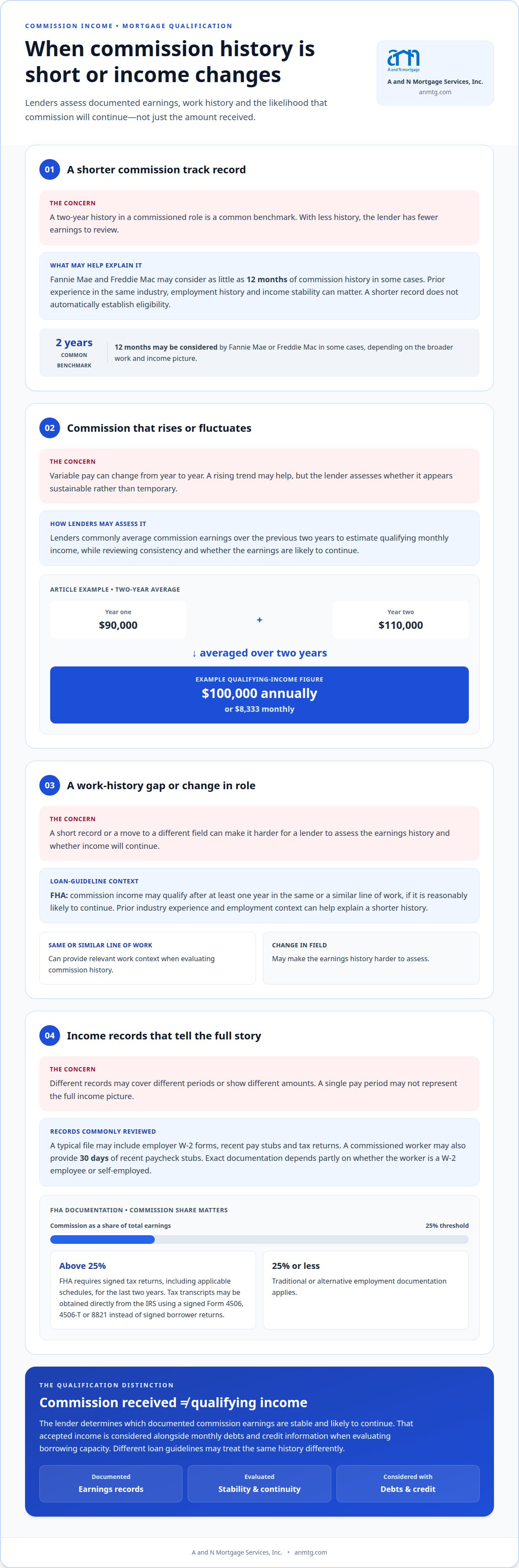
Mortgage lenders commonly average commission earnings over the previous two years to calculate monthly qualifying income. They review documented payments across that period and use the resulting average alongside other application details. For FHA loans, the U.S. Department of Housing and Urban Development says commission earned for two years or more is calculated using the previous two years’ average.
The basic calculation divides total commission by the number of months represented. For example, $66,000 earned over 21 months averages about $3,143 per month. That monthly amount gives lenders a consistent income figure to consider, rather than relying on one strong commission payment or one unusually slow month.
This calculation turns a changing income pattern into an estimate of qualifying income.
When a commission earner also receives base pay, lenders may combine eligible salary with average commission. For instance, a $50,000 base salary plus $40,000 in average annual commission produces $90,000 in total qualifying income annually. The commission component must still be supported by the borrower’s records and assessed for stability.
Averages can also reveal direction. Consider commission earnings of $75,000 in year one, $110,000 in year two, and $95,000 in year three. The middle year is higher, but the most recent year falls. Lenders may view rising income positively, but when the latest year is lower they may question whether the higher average will continue and could base qualifying income on the lower, more recent figure.
For a real estate agent, commission depends on completed transactions, so payment timing can vary. Lenders use documented income to calculate an average; a contract’s potential earnings target doesn’t replace commission already received. Current pay-period and year-to-date figures can also matter for USDA loans, which analyze both.
The qualifying average is not necessarily the same as the commission shown on your latest pay stub. If the recent payment is unusually high or low, the longer record helps put it in context. For example, $3,143 monthly from the 21-month illustration represents the period average, not a promise of identical future payments. That distinction helps explain how lenders translate variable earnings into income for mortgage qualification.
Commission affects borrowing capacity only to the extent a lender includes it in your qualifying income. The income a borrower can use and their monthly debts together shape mortgage affordability and the debt-to-income ratio.
Mortgage affordability reflects the relationship between qualifying income, debts, and the housing payment a borrower can manage. Commission recognized by the lender can increase the income used for qualification, which may support a larger loan amount. The difference depends on how much commission the lender accepts, not simply how much appeared in a recent payment.
For example, adding eligible commission to a base salary increases the income considered in your application. That can leave more room between your existing obligations and a proposed mortgage payment. Still, consider your personal monthly expenses: qualifying for a payment and comfortably affording it are different things.
Debt-to-income ratio compares monthly debt payments with monthly income. For example, $3,200 in monthly debts against $5,000 in monthly base pay produces a 64% DTI. If the lender also counts $3,000 a month in documented commission, qualifying income rises to $8,000 and the same debts produce a 40% DTI.
The example shows why accepted commission can materially change qualification: the debt amount stays at $3,200, while the income denominator increases. If the lender accepts only part of the commission, the resulting DTI falls between those two figures. The calculation uses qualifying income, not every commission dollar received.
Borrowing capacity depends on more than your debt-to-income ratio. A lender considers the commission supported by your application, your existing debts, and the proposed housing payment. If variable earnings have changed, the income accepted for qualification may differ from your latest pay, affecting the loan amount supported by your overall financial picture.
Consider a borrower applying with base pay and commission. If the commission is documented and included, it can increase the income used in the debt-to-income calculation. If some earnings are excluded, debt obligations account for a larger share of qualifying income. The same debts can therefore produce different ratios depending on how much commission the lender recognizes.
Use the lender’s qualifying-income figure to understand what an estimate represents. If it’s lower than your recent take-home income, the difference may reflect commission not included for qualification, rather than a change in your actual earnings. Conversely, additional qualifying commission can lower your calculated debt-to-income ratio without changing your monthly debt payments. This distinction helps you interpret an estimate realistically.
When planning a purchase, compare the proposed payment with the income used for qualification and your own monthly budget. A stronger debt-to-income ratio based on commission doesn’t mean you should put every additional dollar toward housing. First understand which commission the lender counts, then assess the resulting payment against your regular obligations.
Discuss how documented commission may affect your borrowing capacity with A and N Mortgage Services, Inc..
A and N Mortgage Services, Inc. helps borrowers understand how commission earnings fit into a residential mortgage application. If your income varies, personalized guidance can help you consider how its documented history and stability relate to your financing options.
Whether you’re exploring a Conventional Loan, Jumbo Loan, FHA Loan, or VA Loan, the right program depends on your income profile and broader borrowing needs. A mortgage professional can explain what lenders consider and how those factors may shape your application, helping you approach the next step with a clearer picture.
Contact A and N Mortgage Services, Inc. to discuss your mortgage options.
If you’re getting a mortgage with commission income, consider how the financing fits your broader plans, not just the amount a lender may approve. Think about what payment feels manageable alongside your other commitments, and how changing earnings could affect your comfort with that payment over time.
A and N Mortgage Services can help you explore whether a Conventional Loan, Jumbo Loan, FHA Loan, or VA Loan aligns with your homebuying needs and income profile. A conversation can connect your goals with a mortgage path and clarify what matters as you move toward an application. Your circumstances and income details will shape the discussion.
Discuss your mortgage options with A and N Mortgage Services
With a thoughtful plan and informed support, you can take your next step with greater confidence.
Two years is the common benchmark, but the required history depends on the loan program and your work background. Some conventional loan cases may accept 12 to 24 months when positive factors support the shorter record. FHA commission income may qualify after one year in the same or a similar line of work if it’s reasonably likely to continue. A recent job change can make continuity especially relevant.
You can still apply, but the lender will assess how you’re paid and what documentation supports your earnings. A self-employed borrower or someone paid through 1099s may have different income records and qualification considerations than a W-2 employee. For example, the lender may need to interpret tax-return income alongside current commission records. The important distinction is whether the income can be documented and evaluated as stable.
A projected on-target earnings figure alone doesn’t show commission already earned. For a U.S. mortgage application, lenders assess documented commission income and whether it appears stable and likely to continue. If your employment agreement lists OTE, treat it as context, not a substitute for payment records. For example, a target that hasn’t yet resulted in paid commissions may not support the same qualifying income as a documented earnings history.
Often, yes. Mortgage documentation for commission earners commonly includes two years of tax returns, alongside W-2s and/or 1099s and recent pay stubs. Requirements can also depend on the loan program and how large a share of your total earnings comes from commission. The lender uses records together to assess reported income, current employment, and how commission payments are structured.
Affordability depends on the qualifying income a lender accepts, your monthly debts, and the payment that fits your budget. As a Chicago buyer with commission income, distinguish the lender’s qualification estimate from your personal comfort with variable earnings. If commissions vary seasonally, for example, consider whether the housing payment remains manageable during a slower period. A pre-approval estimate can help frame your home search, but your budget should reflect your own cash-flow needs.
There isn’t one borrowing amount for every commission earner. Lenders consider accepted income alongside debts and other application details, including credit and employment information. A borrower with substantial commission may qualify for less than expected if only part of that income is supported for qualification. Documented commission can increase the income considered. Start by reviewing your complete financial picture, not your highest-earning month.
Your required down payment depends on the mortgage program and your overall application; commission income alone doesn’t determine it. For example, FHA and conventional loans can have different qualification criteria, so the appropriate down payment may differ too. Your available funds and loan structure also affect your plans. Discussing the down payment alongside income documentation can help you understand how upfront funds and commission-based qualification fit together.
Many applicants should be ready to show a two-year commission record, but some cases allow a shorter history. FHA may consider commission earned for at least one year in the same or similar line of work when it’s likely to continue. Fannie Mae and Freddie Mac may accept as little as 12 months in some cases. Work experience and documented stability can help explain a shorter timeline.
Welcome to a better mortgage experience! In just few minutes you can find out what you qualify for and explore multiple loan options and interest rates.
Complete our short and intuitive pre-approval interview to get started.