A down payment below 20% typically means mortgage insurance becomes part of the picture, according to the Consumer Financial Protection Bureau. But it protects the lender, not you, if you fall behind on payments. Understanding how mortgage insurance works starts with that distinction: it helps lenders manage risk while letting borrowers qualify for a home loan with a smaller down payment.
It’s understandable to wonder why you’re paying for coverage that doesn’t directly protect your home or finances. The key is knowing which type applies and when its cost may end. Conventional loans may require private mortgage insurance (PMI), while FHA loans have mortgage insurance premiums (MIP), with different rules for paying and ending coverage.
This guide explains how borrower-paid mortgage insurance affects your monthly payment, why lenders require it, and how PMI and FHA premiums differ. You’ll also learn what can affect cancellation, so you can understand the cost over the life of your loan.
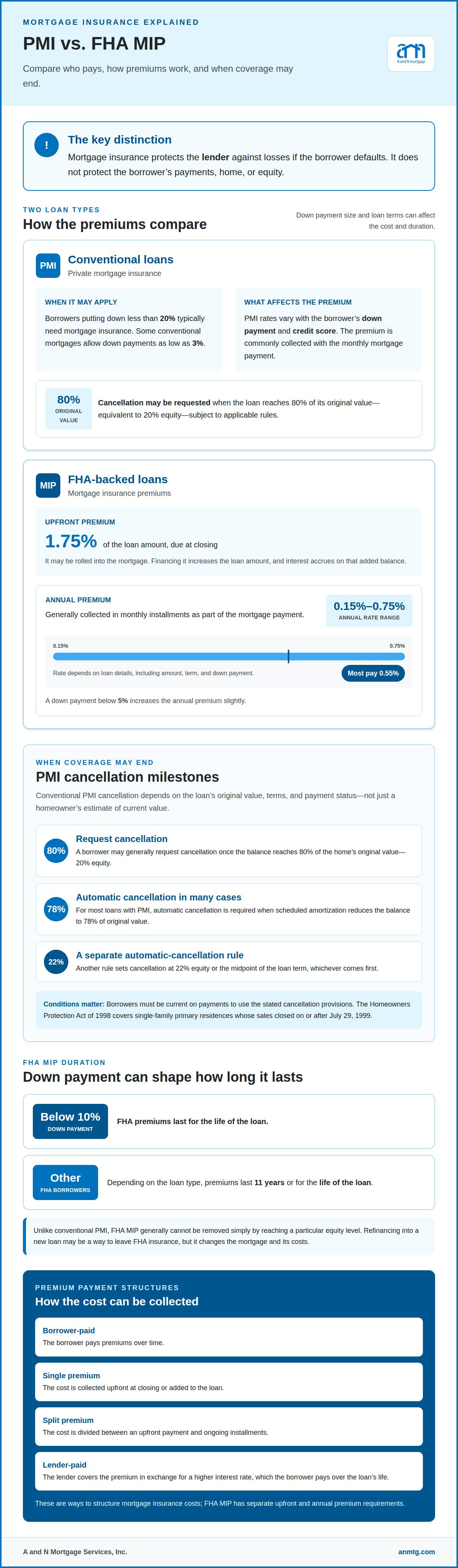
In the United States, borrowers putting down less than 20 percent of a home’s purchase price typically need mortgage insurance, according to the Consumer Financial Protection Bureau. On a conventional loan, this is usually private mortgage insurance, or PMI.
PMI protects the lender if a borrower defaults. It doesn’t cover the homeowner’s payments or protect their equity. The lender arranges the coverage, while the borrower typically pays the premium with their monthly mortgage payment. This added cost can make a lower down payment possible, but it increases housing expenses until coverage ends.
Mortgage insurance can help buyers purchase sooner without saving a larger down payment, leaving more cash available for other needs. The trade-off is an added premium and mortgage interest costs. A larger down payment reduces the amount borrowed and may help avoid PMI on a conventional loan.
Home equity is the difference between a home’s value and the amount still owed on its mortgage. For conventional borrowers, building equity can bring the loan closer to PMI cancellation, lowering monthly payments once coverage ends. Equity may grow as mortgage payments reduce the principal or as the home’s value changes. However, cancellation rules can depend on the loan’s original value and terms.
Conventional PMI has cancellation thresholds tied to the mortgage balance and original home value. A borrower may generally request cancellation once the loan reaches 80 percent of its original value, equivalent to 20 percent equity. For most loans with PMI, automatic cancellation is required when amortization reduces the balance to 78 percent of its original value. PMI must also end once the loan reaches the midpoint of its amortization schedule, such as year 15 of a 30-year loan, if you’re current on payments, even if the balance hasn’t reached 78 percent yet.
The Homeowners Protection Act of 1998 covers single-family primary residences whose sales closed on or after July 29, 1999, according to the Consumer Financial Protection Bureau. Borrowers must be current on payments to use the stated cancellation provisions. These thresholds explain why the scheduled balance, rather than a homeowner’s estimate alone, matters when considering a request.
To request cancellation, contact your mortgage servicer and ask about its PMI cancellation process. Submit a written request and any required supporting information, then keep making your regular payments until the servicer confirms the change. If the loan reaches the applicable automatic-cancellation threshold, the servicer should follow the relevant terms. Check your next statement to confirm whether the PMI charge has ended.
FHA mortgage insurance premiums apply to FHA-backed loans, including loans with a down payment of 20% or more. A borrower with a U.S. FHA-backed mortgage typically pays an upfront mortgage insurance premium of 1.75% of the loan amount, according to the U.S. Department of Housing and Urban Development. The premium is due at closing, though borrowers may roll it into the mortgage. Financing it increases the loan amount, so interest accrues on that added balance.
FHA insurance also includes an annual premium, generally collected in monthly installments as part of the mortgage payment. Annual rates range from 0.15% to 0.75% of the average outstanding loan balance, and most FHA home buyers pay 0.55%. The precise rate depends on loan details, including the loan amount, term, and down payment. A down payment below 5% increases the premium slightly.
How long the monthly premium lasts depends on the down payment and loan terms. FHA borrowers putting down less than 10% pay premiums for the life of the loan. Borrowers who put down 10% or more generally pay the annual premium for 11 years. Unlike conventional PMI, FHA MIP generally cannot be removed simply by reaching a particular equity level. Refinancing into a new loan may be a way to leave FHA insurance, but it also changes the mortgage and its costs.
Premium payment methods explain how the insurance cost is collected, not whom it protects. With borrower-paid insurance, the borrower pays premiums over time. A single-premium arrangement collects the cost upfront, either at closing or by adding it to the loan. A split-premium arrangement divides the cost between an upfront payment and ongoing installments. With lender-paid insurance, the lender covers the premium in exchange for a higher interest rate, which the borrower pays over the loan’s life. These are common ways to structure mortgage insurance; FHA MIP has separate upfront and annual premium requirements.
Refunds depend on the premium and the transaction. Upfront FHA MIP may be partially refundable if a borrower refinances into another FHA loan within three years. Tax treatment also depends on the year and household circumstances: premiums were not deductible for tax years 2022 through 2025. Beginning in tax year 2026, borrower-paid premiums may be deductible for homeowners who itemize and meet the income limits, so check with a tax professional. The premium itself doesn’t protect the borrower from foreclosure; it protects the lender against losses if the borrower defaults. For a closer look at conventional coverage, see our guide to private mortgage insurance (PMI).
Private mortgage insurance, or PMI, is coverage associated with conventional loans that have smaller down payments. Some conventional mortgages allow down payments as low as 3%, and PMI rates vary with the borrower’s down payment and credit score. The premium is commonly collected with the monthly mortgage payment. It protects the lender against losses if the borrower defaults, rather than covering the borrower’s payments or protecting their home equity.
PMI and FHA mortgage insurance differ in both loan type and structure. PMI may apply to eligible conventional loans, while FHA mortgage insurance premiums are required on FHA-backed loans, including those with larger down payments. Conventional PMI may be canceled under applicable conditions as the loan balance falls; FHA premiums follow separate duration rules. Refinancing can change the loan type and insurance arrangement, but it also replaces the existing mortgage with a new one.
If a borrower defaults, PMI can pay the lender for foreclosure losses, up to a predetermined amount. It doesn’t pay the borrower’s monthly mortgage installments or erase the debt. For example, a conventional loan with 25% mortgage insurance coverage limits the insurer’s share to the coverage amount. The lender remains exposed to losses beyond that coverage, so PMI reduces risk without transferring every possible loss to the insurer.
Mortgage insurance and related fees differ across conventional, FHA, VA, and USDA loans. Conventional loans may require PMI with a low down payment, while FHA loans charge MIP. VA-backed loans have no monthly mortgage insurance premium, but borrowers pay an upfront funding fee. USDA loans charge an upfront guarantee fee and an annual guarantee fee.
These distinctions matter because “insurance” can refer to different charges and protections. For VA loans, the funding fee varies with factors such as service history, down payment, disability status, and prior VA loan history. USDA guarantee fees are paid at closing and over time. Neither charge is the same as conventional PMI, which is associated with conventional financing and a lower down payment.
Mortgage protection insurance, often shortened to MPI, serves a different purpose from PMI. PMI responds to lender losses following mortgage default. Mortgage protection insurance, by contrast, can provide a death benefit to the lender if the insured homeowner dies during the policy period; its coverage generally tracks the outstanding mortgage balance. A lender cannot require a borrower to obtain mortgage life insurance. Keep the distinction in mind: PMI relates to loan risk, while MPI addresses a separate life-insurance need.
For a concrete conventional example, a borrower putting 10% down on a $400,000 property finances a $360,000 mortgage that requires mortgage insurance. That PMI requirement reflects the loan’s relationship to the home’s value, while the premium itself depends on factors such as credit and down payment. Understanding those separate pieces helps clarify what the monthly charge covers and how it differs from FHA, VA, or USDA fees.
A mortgage lender faces a greater potential loss when a borrower defaults early in repayment. The home serves as collateral, but foreclosure may not recover the full unpaid balance and related losses. Mortgage insurance transfers part of that risk to an insurer. It doesn’t remove the borrower’s obligation to repay or cover missed payments on their behalf.
For a conventional loan, lenders may require private mortgage insurance when the down payment is below 20% of the home’s purchase price. That coverage can help a borrower qualify without first saving a larger down payment. A lower down payment also means the lender finances a larger share of the property’s value, increasing its exposure if foreclosure follows default.
Consider a conventional mortgage with 25% mortgage insurance coverage. If the borrower defaults, the insurer may cover eligible lender losses up to that predetermined amount. The lender remains responsible for losses beyond that coverage. Insurance therefore limits some losses; it doesn’t guarantee that the lender recovers the entire balance.
Lender-paid mortgage insurance, or LPMI, changes who pays the premium, not who benefits from the protection. The lender covers the insurance cost in exchange for a higher mortgage interest rate. The borrower pays that higher rate until the loan is paid off. This can avoid a separate PMI charge in the monthly payment, but the higher rate remains part of the loan’s cost.
The lender arranges mortgage insurance as part of the loan process. After approval, an insurer’s commitment to insure a loan is generally effective for 120 days, before coverage is activated. This commitment period supports the transaction while the loan proceeds toward closing. The insurance protects the lender under its terms, rather than acting as a personal safety net for the homeowner.
Cancellation depends on the insurance type and loan terms. Conventional borrowers may be able to cancel borrower-paid PMI under qualifying conditions, while LPMI’s higher interest rate generally continues until the loan is paid off. This difference matters when comparing offers: a separate premium may end, but a rate-based cost can continue. The initial payment structure can therefore affect the total cost over time.
Government-backed loans use different insurance or guarantee-fee structures, so conventional PMI rules don’t automatically apply to FHA, VA, or USDA financing. FHA loans use mortgage insurance premiums, VA loans charge a funding fee instead of a monthly mortgage insurance premium, and USDA loans include guarantee fees. These programs manage lender or program risk through their own terms, not conventional PMI coverage.
With borrower-paid mortgage insurance, the borrower pays for coverage that protects the lender. On a conventional loan, BPMI is commonly collected monthly alongside principal, interest, taxes, and other housing costs. That separate charge can make a lower down payment workable, but it doesn’t protect homeowners from missed payments, foreclosure, or loss of equity. The practical questions are how the premium is collected and when it can end.
Monthly BPMI spreads the premium across mortgage payments instead of requiring a large payment at closing. The amount depends on factors such as the loan balance, down payment, and credit profile. The premium may also change as the balance declines, depending on the loan terms. Distinguish the PMI charge from principal and interest: removing PMI can lower your monthly total without changing the scheduled principal-and-interest payment.
Single-premium mortgage insurance works differently. The borrower pays the premium as a lump sum at closing or finances it into the mortgage. Financing adds the premium to the amount borrowed, and interest accrues on that additional amount over time. Paying upfront avoids adding it to the balance, but uses cash that could otherwise go toward closing expenses or household reserves. The trade-off is between upfront cash and borrowing costs.
A split-premium arrangement divides the insurance cost between an upfront payment and installments made with monthly mortgage payments. It can reduce the ongoing charge compared with paying the entire premium over time, while requiring less cash upfront than a single premium. The right structure depends on available funds, how long you expect to stay in the home, and how each option affects total borrowing costs. Compare these factors together, not just the first payment.
BPMI’s cancellation rules are another key distinction. Borrowers may generally request cancellation when the loan reaches 20% equity, and most PMI must be automatically canceled at 78% of the home’s original value through scheduled amortization. The applicable provisions require the borrower to be current on payments. Home value increases alone may not establish the scheduled threshold, so the loan balance and original value remain central to the calculation.
BPMI isn’t life insurance or mortgage protection insurance. The Federal Housing Administration’s MIP applies to FHA loans under different rules, while BPMI is associated with conventional financing. Lender-paid coverage is different as well: the lender pays the premium, but the borrower pays a higher interest rate that continues until the loan is paid off. Understanding who pays, what the coverage protects, and how it ends helps borrowers compare the full mortgage structure.
A and N Mortgage Services, Inc. helps Chicago homebuyers understand how insurance fits into their financing choices. If you’re weighing a conventional, jumbo, FHA, or VA loan, the team can help you consider insurance requirements alongside your down payment and monthly payment.
Contact A and N Mortgage Services, Inc. to compare loan options and discuss how mortgage insurance may shape your decision.
Contact A and N Mortgage Services, Inc.
Understanding how mortgage insurance works is one part of choosing a mortgage that fits your finances. Consider how much cash you want available after closing, what monthly payment feels manageable, and how long you expect to keep the loan. These priorities can help you assess insurance alongside the loan structure, rather than treating it as an isolated charge.
A clear comparison helps you focus on the trade-offs that matter most to your household. Consider which parts of the mortgage are fixed, which may change over time, and how future plans could affect your financing. A and N Mortgage Services, Inc. can help you discuss home loan options and how insurance fits into your decision.
Discuss your mortgage options with A and N Mortgage Services, Inc.
With a thoughtful plan and guidance from A and N Mortgage Services, Inc., you can approach your next home financing decision with greater confidence.
Yes, borrower-paid PMI on a conventional loan can generally be canceled when you meet the applicable requirements. If you’re asking, “How does mortgage insurance work after closing?”, the servicer collects the premium according to your loan terms. Check your mortgage statement for the current principal balance, then compare it with the loan’s original value. Your payment history also matters: the stated cancellation provisions require you to be current.
The most direct way to avoid PMI on a conventional loan is to make a down payment of at least 20% of the home’s purchase price. For example, on a $300,000 purchase, around $60,000 is 20%. Some borrowers use a second mortgage to keep the primary loan below 80% of the home’s value, but that adds another loan to consider when comparing total borrowing costs.
Private mortgage insurance typically costs roughly 0.2% to 2% of the loan amount annually. The monthly amount varies with the loan and borrower, so the percentage range is more useful for understanding the scale than predicting an exact payment. Ask how the premium is collected and whether it can change over time. Include it in your housing-payment estimate alongside principal, interest, taxes, and other applicable costs.
PMI is generally required for a conventional mortgage when the down payment is less than 20% of the home’s purchase price. The lender uses the loan-to-value relationship, along with the loan program’s requirements, to determine whether coverage applies. This differs from FHA mortgage insurance, which follows FHA loan rules. A borrower refinancing a conventional mortgage may also face PMI if their home equity is below 20%.
In the United States, borrowers putting down less than 20% typically need mortgage insurance, according to the Consumer Financial Protection Bureau. How does mortgage insurance work across loan types? The loan determines the charge: conventional loans may require PMI, FHA loans require MIP, VA-backed loans have an upfront funding fee, and USDA loans use guarantee fees. These charges have different terms and aren’t interchangeable.
PMI pricing reflects the amount borrowed, the down payment, and the borrower’s credit score. A larger down payment reduces the loan relative to the property value, while the credit score also influences the rate applied. Two borrowers financing similar homes may therefore have different PMI costs if their credit profiles or down payments differ. The premium calculation depends on loan details, not just the purchase price.
For a conventional loan, a borrower can generally request PMI cancellation once the balance reaches 80% of the home’s original value, provided payments are current. Contact the mortgage servicer and follow its written request process. For most PMI loans, automatic cancellation is required when scheduled amortization brings the balance to 78% of original value. Review a later mortgage statement to confirm the charge has stopped.
Welcome to a better mortgage experience! In just few minutes you can find out what you qualify for and explore multiple loan options and interest rates.
Complete our short and intuitive pre-approval interview to get started.