A foreclosure doesn’t automatically rule out a future home loan, and the VA path may reopen sooner than you expect. For many borrowers, getting a mortgage after foreclosure means meeting a waiting period and showing that their finances have recovered. Conventional loans backed by Fannie Mae generally require seven years after a foreclosure, or three years with documented extenuating circumstances; VA loans typically have a two-year wait.
It’s understandable to assume every loan has the same waiting period, but the timeline depends on the loan type and your circumstances. A VA borrower may be considered after one year if acceptable credit has been reestablished, the foreclosure resulted from circumstances outside the borrower’s control, and other VA and lender requirements are met.
This guide explains how to identify the date that starts the waiting period, check whether you may use a VA loan again, and understand the conventional loan path after foreclosure. You’ll also learn what lenders may weigh as you rebuild your credit and prepare your finances, so you can focus on next steps that fit your situation.
Start by identifying the foreclosure date used by the loan program, then count its waiting period. The timeline differs for foreclosures, short sales, and deeds-in-lieu.
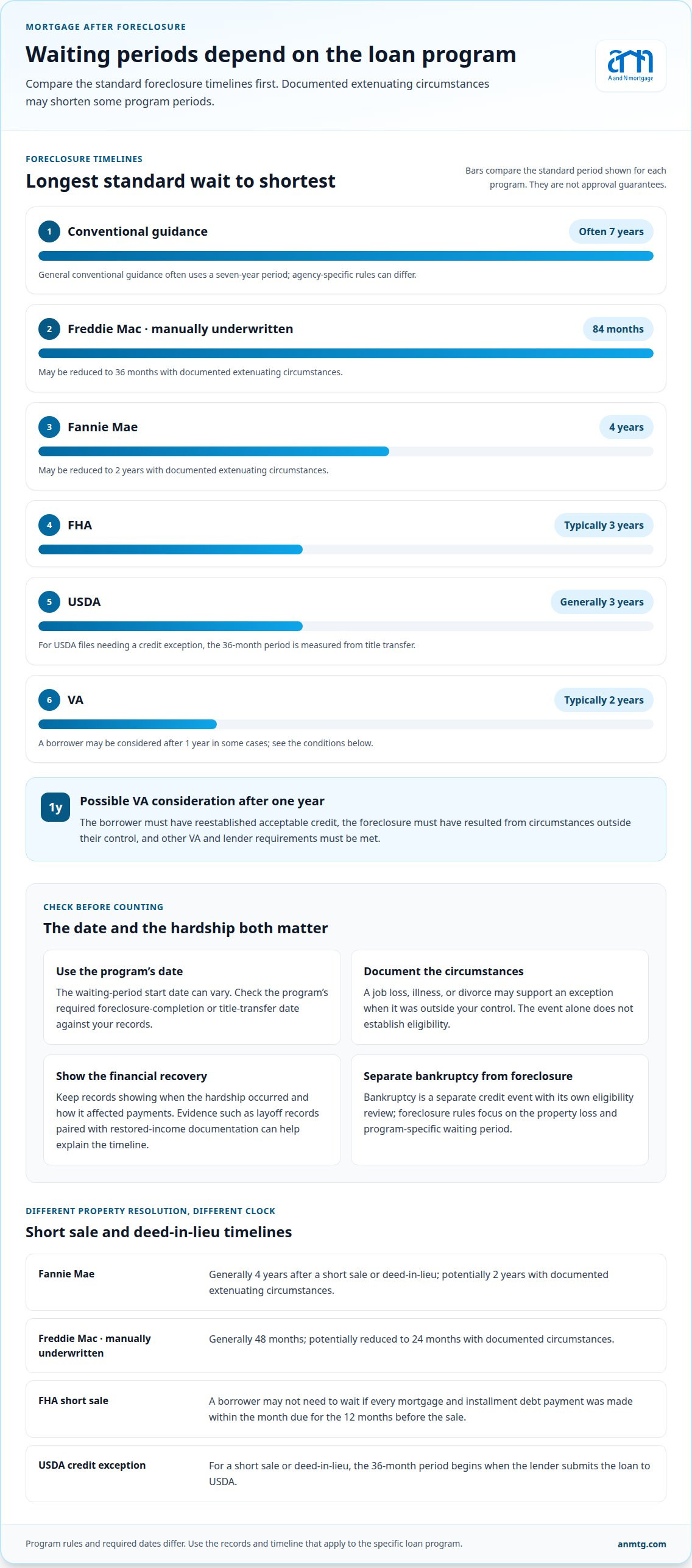
Match the foreclosure to the loan program before estimating when you can apply. Fannie Mae generally requires seven years after a foreclosure, or three years with documented extenuating circumstances. Freddie Mac manually underwritten loans generally require 84 months after foreclosure completion, reduced to 36 months for documented extenuating circumstances.
FHA typically requires three years, and VA loans typically require two years. USDA generally requires three years after foreclosure completion. For USDA files needing a credit exception, the 36-month period is measured from title transfer. Don’t assume one program’s date or timeline applies to another.
Gather records if a one-time event outside your control caused the foreclosure. A documented job loss, illness, or divorce may support an exception or a shorter waiting period. Lenders may consider the hardship and evidence that your finances recovered; the event alone doesn’t establish eligibility.
Keep documents that show when the hardship occurred and how it affected your ability to make payments. For example, layoff records paired with evidence of restored income can help explain the timeline. Also distinguish bankruptcy from foreclosure: bankruptcy is a separate credit event with its own eligibility review, while foreclosure guidelines focus on the property loss and its program-specific waiting period.
Identify whether the home was foreclosed or resolved through a short sale or deed-in-lieu, because the timelines differ. Fannie Mae generally requires four years after a short sale or deed-in-lieu, with a possible reduction to two years for documented extenuating circumstances. Freddie Mac manually underwritten loans generally require 48 months, potentially reduced to 24 months with documented circumstances.
For FHA, a borrower may not need to wait after a short sale if every mortgage and installment debt payment was made within the month due for the 12 months before the sale. Keep payment records for that period. USDA’s 36-month credit-exception timing after a short sale or deed-in-lieu begins when the lender submits the loan to USDA.
Ask which program rule and date apply to your file, rather than relying on a single general timeline. The waiting periods described here vary by loan type, and a lender may evaluate an exception when you document a qualifying hardship. State foreclosure processes can affect the dates in your records, so use the recorded completion or title-transfer date required for the specific program.
Keep the foreclosure completion notice, title-transfer records, and any short-sale or deed-in-lieu documents together. Compare those dates with the relevant program period before planning an application. Separately, if mortgage debt was forgiven, the Internal Revenue Service says the exclusion for forgiven debt on a main home covers debt discharged before January 1, 2026, or under a written arrangement made before that date, so it’s worth checking the tax side with a tax professional.
Yes. A VA loan may be possible after foreclosure, usually after a two-year waiting period. In some cases, a borrower may be considered after one year if specific conditions are met.
Assess the VA timeline and your financial profile together. A borrower may be considered after one year when acceptable credit has been reestablished, the foreclosure resulted from circumstances outside the borrower’s control, and other VA and lender requirements are met. The VA doesn’t set a minimum credit score, but many lenders look for 620 or higher, and the score is only one part of the application.
Prepare to document stable income, savings and other assets, monthly debts, and housing expenses. Lenders consider whether your income can support the proposed payment alongside existing obligations. Your debt-to-income ratio compares monthly debt payments with gross monthly income. Lower recurring debts can show more room in your budget, while employment and asset records help establish financial stability.
Review your credit reports and address errors before submitting an application. Check that account balances, payment histories, and the foreclosure record are accurate. Dispute incorrect entries with the reporting company, and keep copies of supporting documents and dispute results.
Build a consistent record of on-time payments and avoid taking on unnecessary debt. A foreclosure can hurt credit, but lenders also assess your recent payment history and overall financial picture. Prepare pay stubs, bank and brokerage statements, and tax returns to document your recovery.
Compare FHA thresholds if your credit profile makes a VA application difficult. FHA permits a 3.5% down payment for borrowers with a credit score of 580 or higher. For scores from 500 to 579, FHA permits a 10% down payment. These thresholds help frame another route, though lenders assess the full application.
Eligible VA borrowers can obtain a loan with no down payment. That does not remove the need to show you can manage housing costs, debts, and other obligations. A foreclosure may affect how a lender assesses risk, which can influence the rate and loan costs offered. Specific terms depend on the loan and your overall qualifications.
Organize your finances before applying. List monthly debts, verify income documents, and set aside records showing available assets. This preparation makes it easier to explain changes since the foreclosure, such as returning to steady work or reducing outstanding balances.
Compare the VA path with FHA based on your credit score, available savings, and monthly obligations. If you’re ready to review possible loan paths, explore VA loan options as part of your planning.
An extenuating circumstance is a one-time event outside your control that contributed to foreclosure, such as job loss, illness, or divorce. Lenders may consider a shorter waiting period when you document both the hardship and your financial recovery.
After foreclosure, be prepared to provide pay stubs, bank and brokerage statements, tax returns, and records explaining the hardship and your recovery.
Build a clear timeline of the hardship and foreclosure. Note when the event occurred, how it affected your income or ability to make payments, and when your finances began to recover. For example, a layoff followed by resumed employment puts the missed payments and subsequent recovery in context.
Keep your explanation focused on the documented event. A general statement that finances were difficult doesn’t show how a specific circumstance affected you. Tie each part of the timeline to a record or financial change, such as reduced income followed by pay stubs showing you returned to work.
Collect records that support both the event and your current ability to repay. Prepare pay stubs, bank and brokerage statements, and tax returns to show your current finances. Add documents that establish the hardship, such as records related to a layoff, divorce, business failure, or major health problem.
Organize the documents by date and label what each one demonstrates. For instance, place the hardship record before income documents showing your recovery. This makes it easier to understand the connection between the event, the foreclosure, and your current financial position.
Connect the hardship evidence to the applicable loan rule. Fannie Mae generally requires seven years after a foreclosure, or three years with documented extenuating circumstances. The exception depends on documenting the circumstances, so explain why the event was outside your control and how your finances have changed since.
Don’t assume the same exception applies to every mortgage type. A shorter period is not automatic, and an explanation without supporting documents may not establish the circumstances. Keep your account specific to the event and the loan path you’re considering.
Review your credit reports alongside the hardship file. Foreclosure information generally remains on a credit report for seven years from the date of the first missed payment leading to foreclosure. Check that the reported history aligns with your records and that the timeline you submit is consistent.
Before applying, arrange your file to answer three practical questions: what happened, how did it affect payments, and what shows recovery? Include current income and asset records, then keep copies of the complete package. A concise, dated explanation can help a lender assess your request for an exception.
Use these steps to organize a federal loan review after foreclosure. CAIVRS and prior government-backed loan losses deserve attention alongside your income, debts, and credit history. If you’re getting a mortgage after foreclosure, knowing which loan program was involved helps focus that review.
Identify whether a previous mortgage involved a government-backed program. Record the loan type, property, foreclosure completion date, and any balance or loss connected with the account. Keep final statements and foreclosure records together. These details give the lender a clear starting point for reviewing your prior loan history and current application.
Separate the foreclosure timeline from other financial events. A divorce, job loss, or illness may explain payment difficulties, but it doesn’t replace the need to document the loan history. Include dates and records that connect the event to missed payments and the foreclosure’s completion.
Ask for the CAIVRS review to be considered with your full application, rather than treating your credit score as the only measure. Organize records of federal housing debt, payment history, and any resolution or repayment. If a previous government-backed loan involved a loss, identify the program and keep the related notices.
Keep your explanation factual. For example, distinguish a prior federal loan loss from an unrelated credit account, then provide records for each. This helps the lender assess relevant government-backed loan history without confusing it with general credit activity.
For a prior USDA loss, note the specific seven-year rule. A previous USDA loss within the past seven years can affect eligibility, and the lender may need USDA to approve a credit exception. Assemble the loan records and relevant hardship documents, such as evidence of a layoff, business failure, major health problem, or divorce.
Show both what caused the difficulty and how your finances changed afterward. Current pay stubs, tax returns, and bank statements can document income and assets. If you’re getting a mortgage after foreclosure, a dated explanation can connect those records to the earlier USDA loss and support a review of an exception.
Prepare the broader repayment picture before seeking approval. List monthly debts, current income, and available assets so the lender can assess your application and income ratio. Include housing costs and any payment obligations that began after foreclosure. Accurate figures help distinguish a resolved past hardship from ongoing pressure on your budget.
Keep your file consistent across credit reports, loan records, and the application. If a report contains an error, gather the supporting account document and dispute outcome. Clear dates and matching records help the lender assess your federal loan history, current finances, and possible next steps.
A conventional home loan can be an option after foreclosure, but the waiting period is only one part of eligibility. If you’re getting a mortgage after foreclosure, the property’s intended use, loan review method, down payment, credit history, and current finances also matter.
Choose the property’s intended use before estimating your timeline. Conventional financing after foreclosure generally must be for a principal residence. A second home or investment property, and conventional cash-out refinancing, are generally unavailable until seven years have elapsed.
This distinction can change your plan. If you intend to buy a home to live in, assess purchase eligibility under the applicable guidelines. If you want an investment property, don’t assume the principal-residence timeline applies. Getting a mortgage after foreclosure for a primary residence follows a different path from financing an investment property.
Compare Fannie Mae and Freddie Mac requirements, including the underwriting method. Fannie Mae generally requires seven years after a foreclosure, or three years with documented extenuating circumstances. Freddie Mac manually underwritten loans generally require 84 months after foreclosure completion, reduced to 36 months for documented extenuating circumstances.
Fannie Mae’s three-year extenuating-circumstances path comes with limits: until seven years have passed, the loan-to-value ratio is capped at 90%, which means at least 10% down on a purchase. The applicable rule depends on the loan path and review, so don’t treat one timeline as universal.
Prepare for the down payment and credit review together. Conventional mortgages backed by Fannie Mae or Freddie Mac typically require a minimum down payment of 3%, while the three-year Fannie Mae path requires at least 10% down. Many lenders still look for a credit score of 620 or higher on conventional loans.
In November 2025, Fannie Mae removed the hard 620 minimum credit score for loans run through its Desktop Underwriter system. That change concerns this automated underwriting system; it doesn’t mean every conventional application qualifies regardless of credit. Payment history, outstanding balances, income, and overall ability to repay remain relevant to the lender’s review.
Match your documentation to the specific guideline. Provide records showing the foreclosure completion date, current income, assets available for the down payment, and outstanding debt balances. If you’re relying on extenuating circumstances, include evidence of the event and your financial recovery with the application.
The key takeaway: conventional eligibility doesn’t have one fixed waiting period. A principal-residence purchase may follow a different route from an investment purchase, and Fannie Mae and Freddie Mac rules differ. Compare the applicable path with your credit, funds, and documented circumstances before setting a purchase timeline.
Explore conventional loan options
A and N Mortgage Services, Inc. can help you assess mortgage options after foreclosure and understand how your timeline, credit history, income, and debts fit the application process. Personalized guidance can clarify which loan route aligns with your circumstances and what financial records may support your next step.
Consider reaching out when you’ve gathered records of your current finances or want to understand how loan options differ. A focused review can help you plan a more informed path toward a home purchase.
Contact A and N Mortgage Services, Inc. to discuss your mortgage questions.
Your path to getting a mortgage after foreclosure can begin with a practical question: which loan route best fits your plans and current finances? Use the timeline and records you’ve assembled to focus the next conversation on what you can act on now, what needs more time, and which details may affect your application.
A and N Mortgage Services, Inc. offers conventional, jumbo, FHA, and VA loans, giving you options to discuss as you consider your next home financing step. A focused review can help connect your circumstances with a suitable loan path, without assuming one program fits every borrower. Bring your questions and the financial picture you’ve prepared, then work through the available choices with a clear sense of your priorities.
Taking the next step doesn’t require having every decision settled. Start with the information you have, identify what you still need to understand, and move forward at a pace that feels manageable.
Contact A and N Mortgage Services, Inc.
Your next chapter can start with an informed conversation.
It depends on the mortgage program and your circumstances. Typical timelines include three years for FHA, two years for VA, and three years for USDA after foreclosure completion. Conventional guidelines differ: Fannie Mae generally uses seven years, with a possible three-year period when you document qualifying hardship. Before planning a purchase, identify the loan program and the foreclosure date its guidelines use. A Chicago home purchase follows these same federal program timelines.
It can be, but the applicable period depends on the program and documentation. Fannie Mae generally requires four years after a short sale or deed-in-lieu, potentially reduced to two years for documented extenuating circumstances. Freddie Mac’s manually underwritten loans generally use 48 months, potentially reduced to 24 months. For an FHA short sale, a borrower may not need to wait if all mortgage and installment debt payments were made on time for the preceding 12 months.
Yes. A foreclosure doesn’t permanently prevent you from buying a home, though eligibility depends on the loan program and your current finances. For example, if you’re considering an FHA purchase, organize income records, current debt information, and available down-payment funds while preparing for the relevant waiting period. A Chicago buyer should also consider whether the planned home will be a principal residence, since conventional eligibility can differ for investment properties.
For a completed foreclosure, FHA’s typical waiting period is three years. The FHA short-sale provision is different: it may allow a borrower to proceed without waiting when every mortgage and installment debt payment was made within the month due during the 12 months before the sale. That short-sale condition does not establish an earlier FHA path after a completed foreclosure.
A foreclosure can damage your credit history, and the record generally remains on a credit report for seven years from the date of the first missed payment leading to foreclosure. For example, review each report for inaccurate account balances or dates, then keep relevant account documents with any dispute. Lenders may also consider newer payment behavior and current debts, so consistent payments after the foreclosure help show how your finances stand today.
Some nonprime lenders may consider a mortgage soon after foreclosure completion, but those loans can carry higher interest rates, higher fees, and less favorable terms. Before choosing that route, compare the borrowing costs and repayment obligations with the risks of waiting to strengthen your credit history. For example, a borrower with restored income but recent credit problems can weigh immediate access to financing against the potential benefit of allowing more time for recovery.
Expect bankruptcy and foreclosure to be considered as separate events in your mortgage history. Keep the bankruptcy discharge paperwork, mortgage account records, and foreclosure completion documents together so the dates and account status can be reviewed clearly. The fact that a mortgage was included in bankruptcy doesn’t, by itself, show that a foreclosure waiting period has been met. The loan program and documented history still matter.
There is no single timeline for every mortgage. FHA and USDA typically use three years, VA typically uses two years, and conventional requirements depend on the applicable Fannie Mae or Freddie Mac path. A VA borrower may be considered after one year if acceptable credit has been reestablished, the foreclosure resulted from circumstances outside the borrower’s control, and other requirements are met. Identify your intended loan program first, then organize records around its criteria.
Welcome to a better mortgage experience! In just few minutes you can find out what you qualify for and explore multiple loan options and interest rates.
Complete our short and intuitive pre-approval interview to get started.