A family gift can cover some or all of a home’s down payment, but family member gifting down payment rules depend on the loan program and property. Conventional, FHA, VA, and USDA loans each set conditions, including who may give the money and how the gift must be documented. The funds must be a gift, not a loan the homebuyer is expected to repay.
It’s understandable to want clear answers before family members transfer money. A gift can make buying a home more achievable, but unclear donor eligibility or missing paperwork can complicate mortgage approval. Knowing the rules early helps everyone plan the transfer and avoid surprises.
This article explains what qualifies as a down payment gift, which family relationships may be accepted, and what lenders typically expect in a gift letter and transfer records. It also compares conventional, FHA, VA, and USDA rules, then outlines alternatives to a family gift so you can consider an approach that fits your purchase.
A down payment gift is money given to a borrower for a home purchase with no expectation of repayment. In the United States, family members may contribute funds when the mortgage program accepts the donor and property type, and the lender’s documentation requirements are met. These family member gifting down payment rules matter because a transfer treated as a repayable loan can affect mortgage qualification.
Eligible donors are people or organizations a loan program allows to contribute funds without repayment. Parents, siblings, children, grandparents, relatives by marriage, fiancés, and domestic partners may qualify under some programs. Conventional rules can recognize relatives by blood, marriage, adoption, or legal guardianship. Friends and unrelated individuals are more program-dependent, so their eligibility cannot be assumed across mortgage types.
Donor rules can differ even within a loan category. FHA programs may accept a close friend with a meaningful interest in the borrower’s life, an employer, a charitable organization, or a labor union. A gift from someone involved in the transaction, such as a builder or real estate broker, may be restricted for a VA loan. The donor’s role matters as much as the relationship.
Gift funds may help cover some or all of the down payment on a primary or secondary residence, subject to the loan’s terms. For a primary home, lenders generally allow gift funds to cover the full down payment when program requirements are met. A second home can have different contribution rules, particularly for conventional financing, where the property and down payment structure affect how much must come from the borrower.
An investment property is different: mortgage gift funds cannot be used for its down payment. That distinction makes the home’s planned use important before the donor transfers money. A primary residence, a second home, and an investment property may each trigger different rules, even when the same family member provides the funds.
Mortgage type determines which donors qualify and how funds can be used. Conventional programs may accept gifts from eligible relatives or romantic partners, while FHA donor rules can include certain close friends and organizations. USDA gifts may come from any donor without an interest in the transaction. Each program also has separate rules about whether funds can cover closing costs or reserves.
VA borrowers aren’t required to make a down payment, but gift funds may support an optional down payment, closing costs, or the funding fee. They can’t count toward VA underwriting reserves. USDA loans also don’t require a down payment; gifts may cover closing costs, but not financial reserves. Distinguish down payment money from reserve funds when assessing eligibility.
For 2026, an individual can give up to $19,000 to each recipient without reducing the lifetime gift and estate tax exemption, according to the Internal Revenue Service. The Internal Revenue Service sets the United States lifetime gift and estate tax exemption at $15 million per individual in 2026. These federal tax amounts address the donor’s tax position, not whether a mortgage lender accepts the funds.
A donor generally must file IRS Form 709 when a gift to a recipient exceeds the annual gift tax exclusion, even if no gift tax is due, according to the Internal Revenue Service. The Internal Revenue Service states that gifts exceeding the lifetime gift and estate tax exemption are subject to a 40% tax rate. So, a family member doesn’t automatically owe gift tax just for helping with a down payment; the annual exclusion, prior taxable gifts, and lifetime exemption affect the outcome.
A mortgage gift letter and clear transfer records help show that down payment funds are a gift, not borrowed money. A lender may also need to trace the deposit to its source, so coordinate the paperwork before the donor sends the funds.
A complete file connects the donor, the gift letter, and the money reaching the borrower’s account or closing. The lender typically wants the donor’s name and relationship to the borrower, the gift amount, transfer details, property address, and confirmation that repayment isn’t required. For a conventional loan, program rules determine which donors qualify, while lender documentation shows how the transfer occurred.
Donor records can help establish the funds’ origin. A lender may request the donor’s bank statement or proof of the transfer, then compare the amount with the gift letter. If the borrower already received the money, bank statements may be requested when it has been in the account for less than 60 days. The donor should notify the lender early, before sending funds.
Timing matters. Many lenders prefer to have the gift letter in hand before or at the time of the transfer, so the loan file identifies the funds correctly from the start. A small $100 birthday check may not need documentation, but a planned home down payment gift should be discussed with the lender before it arrives. That distinction helps avoid treating a sizable deposit as unexplained income or borrowed money.
Transfer records document the path from donor to borrower or closing, which matters if the lender needs to source a deposit. Use a traceable method, such as an electronic bank transfer or certified check, and keep the receipt or transaction confirmation. Cash deposits can complicate mortgage approval because they don’t clearly show who provided the money.
For example, if a donor’s gift letter lists one amount but the borrower’s account shows a different deposit, the lender may need more records to reconcile them. A wire sent to the title company can place the funds in escrow, while the wire confirmation helps document the transfer. Match the transfer amount to the gift letter and retain statements showing the transaction.
Missing signatures, late gift letters, unexplained deposits, or inconsistent amounts can prompt follow-up and slow review. If gifted funds will make up part or all of the down payment, early notice gives the lender time to explain which records belong in the file. For help understanding how gift documentation fits a mortgage application, see our pre-approval checklist.
A down payment gift isn’t the only way to reduce the cash needed at closing. Buyers can consider assistance programs, seller-paid costs, securities, or a family-funded mortgage buydown, while weighing repayment, interest, and documentation.
State and local first-time homebuyer programs can set their own conditions for gifted funds. Some may permit a family contribution alongside assistance, while others may limit eligible sources or require the buyer to meet specific program terms. Review how assistance applies to your purchase before treating it as interchangeable with a family gift.
Cash is the simplest alternative to a family down payment gift, but a family advance that must be repaid is a loan, not a gift. Repayment and interest can affect a buyer’s monthly obligations and mortgage qualification. For an intra-family loan, the IRS publishes the Applicable Federal Rate monthly; a written agreement can clarify the repayment terms.
Securities offer another possible source of funds, but selling them can have tax consequences. In the United States, a recipient of gifted securities generally takes the donor’s cost basis and holding period. That history can affect capital gains tax when the assets are sold. A family member transferring property is different from providing cash: it changes the asset being transferred rather than simply supplying down payment funds.
A family contribution can also fund a temporary mortgage buydown instead of reducing the initial down payment. In a 2-1 buydown, the rate is reduced by 2 percentage points in the first year and 1 percentage point in the second, before the full rate applies in year three. For example, on a $400,000 30-year loan with a 6.5% note rate, principal and interest would be about $2,528 a month at the full rate, about $2,027 in year one at 4.5%, and about $2,271 in year two at 5.5%, savings of roughly $500 and $255 a month.
That structure changes payment timing, not the underlying loan balance. If the household budget can manage the full payment after the introductory period, a buydown may help ease the transition. If the main obstacle is cash needed at closing, down payment assistance or a permitted gift may address a different need.
Seller-paid closing costs can also preserve some buyer cash for the down payment. FHA allows seller contributions of up to 6% of the sales price; Fannie Mae allows 3% to 9%, depending on occupancy and loan-to-value; and VA limits seller concessions to 4%, not counting normal closing costs. These are seller contributions toward closing costs, not family gifts, and applicable loan rules determine how they fit the purchase.
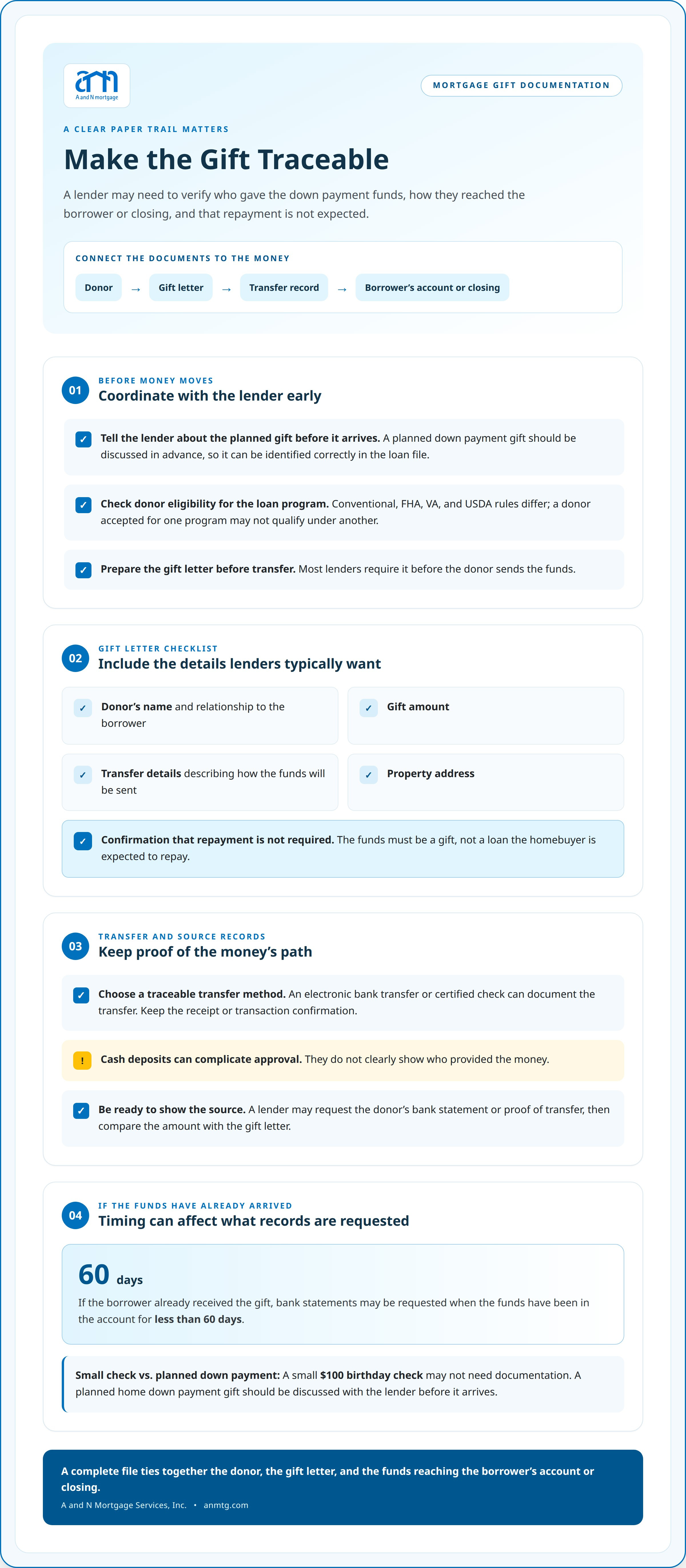
A gift letter records the donor, the funds, and the understanding that the money won’t be repaid. For homebuyers, accurate details help connect the gift to the mortgage application and the funds used at closing.
A mortgage gift letter typically identifies the donor and their relationship to the borrower, states the gift amount, describes the transfer, names the property address, and confirms that repayment isn’t expected. The amount and transfer details should match the deposit or payment shown in the loan file.
That last point matters. If a letter describes one amount but the borrower’s account shows another, the lender may need additional records to explain the difference. A changed transfer plan, such as sending funds to the title company instead of the buyer’s account, should also be accurately documented.
Use the lender’s gift letter form when one is provided, since it can organize the information in the format used for the application. The donor should enter their full name and relationship to the homebuyer, the gift amount, the property address, and how the funds will be transferred. Both the donor and borrower should complete any signature fields the form requests.
Review each entry before submitting the form. For example, the donor’s name should match the name shown in supporting bank records, and the gift amount should match the intended transfer. If the property address changes during the purchase, update the letter to identify the home tied to the mortgage application.
The letter is one part of the file, not a substitute for transfer evidence. A lender may request donor bank statements or proof of the transfer, then compare those records with the letter. Keep the donor’s statement, electronic transfer confirmation, or certified-check record available so the source and amount can be traced.
Timing can affect the records required. If gifted money has been in the borrower’s account for less than 60 days, a lender may request bank statements showing where it came from. Tell the lender about the planned gift before the donor sends it, and follow its sequence for completing the letter and transferring funds.
For example, if a parent plans to wire a gift to the title company, the letter should describe that route, and the wire receipt should document it. If the funds instead arrive in the buyer’s account, retain the account record showing the deposit. Avoid cash deposits, which can make the source harder to trace.
A properly completed letter also helps distinguish gift money from a loan. If the donor expects repayment, the transfer isn’t a gift as described in the letter. Inconsistent statements about repayment can raise questions about the borrower’s credit obligations and may require clarification before closing. Keep the wording truthful, complete the requested signatures, and ensure the transfer records are consistent.
The loan program and property type determine how gift funds can be used toward a home purchase. Compare the rules for the intended purchase, since a primary residence, second home, and investment property can have different requirements.
A qualifying conventional mortgage can require a down payment as low as 3%. Eligible donors may include relatives by blood, marriage, adoption, or legal guardianship, as well as certain romantic partners. Gifts can cover some or all of the down payment, closing costs, or reserves, subject to the loan’s property-specific rules.
For listed conventional property types at 80% loan-to-value or less, Fannie Mae and Freddie Mac don’t require a minimum contribution from the borrower’s own funds. Above 80% loan-to-value, requirements can change. For a second home above that threshold, Fannie Mae and Freddie Mac require the borrower to contribute 5% from personal funds. For a 2-4 unit primary residence above 80% loan-to-value, Fannie Mae requires 5%; Freddie Mac has no minimum contribution requirement for that scenario.
FHA loans can have down payment requirements as low as 3.5%, and an eligible gift can cover the full minimum down payment on a primary residence. FHA donor rules include close friends with an interest in the borrower’s life, employers, charitable organizations, and labor unions. More distant relatives, such as cousins, generally fall outside FHA’s family-member definition, although a cousin may still qualify as a close friend with a documented interest in the borrower.
For homebuyers, both donor eligibility and property type matter. The FHA gift eligibility described here concerns a primary residence, not an investment purchase. Confirming the property’s planned use and donor relationship early helps identify which program rules apply.
VA loans don’t require a down payment, though borrowers may choose to make one. Gift funds can go toward an optional down payment, closing costs, or the funding fee, but not underwriting reserves. A builder, developer, real estate agent, or broker with an interest in the transaction can’t provide VA gift funds.
USDA loans also have no down payment requirement. Gift funds may cover closing costs, but they can’t count as financial reserves. A USDA donor must have no interest in the transaction. For either program, keep the gift’s purpose distinct from monthly reserves, and retain relevant bank statements and transfer records.
Explore conventional loan options
A and N Mortgage Services, Inc. helps homebuyers understand how a family contribution fits their mortgage plan. If you’re preparing to use gifted funds, the right loan program can affect donor eligibility, required documentation, and how much of the down payment the gift may cover.
Discuss your purchase plans and gift details as you consider a Conventional Loan, Jumbo Loan, FHA Loan, or VA Loan. A and N Mortgage Services, Inc. can guide you through financing options relevant to your situation and explain how the loan choice connects to your down payment and application.
For guidance on your home financing options, contact A and N Mortgage Services, Inc.
A family contribution can shape more than the amount you bring to closing. Use your plans for the home, your relationship to the donor, and the funds available to guide the financing conversation. Understanding family member gifting down payment rules can help you identify which details to discuss before moving ahead.
A and N Mortgage Services, Inc. offers Conventional, Jumbo, FHA, and VA loan options, with personalized guidance to help you navigate home financing. If you’re weighing a family gift against another funding approach, discuss how your planned purchase and mortgage choices fit together. The next step is a financing plan that reflects your circumstances and keeps the gift’s role clear.
Contact A and N Mortgage Services, Inc.
With a thoughtful plan in place, you can approach your home purchase with greater clarity and take the next step at a pace that works for you.
There’s no single mortgage gift limit that applies to every purchase; the loan program and property type shape what can be used. Gift funds may cover the full down payment on a primary residence when the program permits it, while some other purchases require buyer funds. The tax exclusion is separate: according to the Internal Revenue Service, an individual can give up to $19,000 to each recipient in 2026 without reducing the lifetime exemption.
A down payment gift can help buyers purchase a home sooner or keep more cash available for other expenses. It may be a poor fit if the donor expects repayment, the loan program doesn’t accept that donor, or the property type restricts gift use. For example, a borrower buying an investment property can’t use mortgage gift funds for its down payment. Consider the donor’s budget and mortgage conditions together.
A gift letter is a written statement documenting money given toward a home purchase without an expectation of repayment. It typically identifies the donor and relationship, gift amount, property address, transfer details, and confirms that repayment isn’t required. For example, if a parent sends funds to a buyer’s account, the letter should accurately describe that transfer. The lender uses it alongside account or transfer records to understand the funds in the loan file.
Donor eligibility varies by loan type. Conventional programs can accept qualifying relatives and certain romantic partners; FHA rules may include eligible close friends, employers, charitable organizations, and labor unions. VA funds can’t come from an interested transaction party, such as a builder or broker. USDA gifts may come from a donor without an interest in the transaction. A cousin, for instance, may need to qualify as a close friend under FHA rules even though conventional rules accept relatives by blood.
Use a traceable transfer, such as an electronic bank transfer or certified check, and retain the confirmation. The lender may compare the transfer amount with the gift letter and request donor bank statements or proof of funds. If money has been in the borrower’s account for less than 60 days, statements may be needed to show its source. Avoid cash deposits, which make the trail harder to establish during mortgage review.
A family member may cover the entire down payment on some primary-residence loans, but the answer depends on program and property rules. Conventional loans can require the borrower to contribute personal funds in certain higher loan-to-value situations. For example, a second home above 80% loan-to-value has a 5% own-funds contribution requirement under Fannie Mae and Freddie Mac rules. The purchase’s occupancy and unit type can change the requirement.
A down payment gift must be genuine and not subject to repayment. If the donor expects the buyer to return the money, it’s a loan, not a gift, and shouldn’t be described otherwise in the mortgage file. For example, a parent who plans to receive monthly repayments has created a debt obligation. That arrangement can affect the borrower’s finances and mortgage qualification, so distinguish a gift clearly from family lending.
Rules depend on both the mortgage program and how the property will be used. A primary residence may allow a different gift amount than a second home, while investment properties can’t use mortgage gift funds for their down payment. Conventional, FHA, VA, and USDA programs also differ on eligible donors and permitted uses. For Chicago homebuyers, identifying occupancy and property type early helps clarify which gift rules apply to the purchase.
Welcome to a better mortgage experience! In just few minutes you can find out what you qualify for and explore multiple loan options and interest rates.
Complete our short and intuitive pre-approval interview to get started.