Your mortgage debt-to-income ratio compares your monthly debt payments with your gross monthly income, before taxes and other deductions. According to the Consumer Financial Protection Bureau, calculate it by dividing total monthly debt payments by gross monthly income and multiplying by 100. Understanding how debt-to-income ratio is calculated for a mortgage starts with knowing which payments count in that total.
It’s easy to focus on the mortgage payment alone, but lenders also consider other qualifying monthly debts. The Consumer Financial Protection Bureau says mortgage DTI is calculated by dividing all monthly debt payments by gross monthly income.
This guide explains what DTI measures, which monthly payments are generally included, and how to calculate the percentage with a clear example. You’ll also learn how front-end DTI, based on housing costs, differs from back-end DTI, which includes housing and other debts. Understanding both helps you see what the figure says about your mortgage budget.
Debt-to-income ratio, or DTI, compares monthly debt payments with gross monthly income. For a mortgage, it shows how much income is already committed before adding a new housing payment.
Gross monthly income is income before taxes, retirement contributions, and other deductions. The Consumer Financial Protection Bureau says mortgage DTI is calculated by dividing monthly debt payments by gross monthly income. To convert annual income into a monthly amount, divide it by 12. For example, a $60,000 annual salary equals $5,000 in gross monthly income. Using the right income figure matters because a take-home amount would make the comparison different.
DTI is the percentage left when total monthly debt payments are divided by gross monthly income and multiplied by 100. The Consumer Financial Protection Bureau describes the mortgage calculation as dividing all monthly debt payments by gross monthly income. Add the qualifying payments for one month, then compare that total with one month of gross income. This keeps the time periods consistent. A monthly debt total divided by annual income would not give the intended DTI percentage.
The resulting percentage indicates how much gross income goes toward the debts included in the calculation. A 33 percent DTI means those monthly payments equal 33 percent of gross monthly income. The figure helps determine how existing obligations relate to income, but it is not the same as a full household budget: everyday spending is not automatically part of the debt total.
For credit cards, DTI generally uses the minimum monthly payment, not the full outstanding balance. Add the applicable monthly payment for each qualifying debt when totaling obligations. Using a card’s entire balance instead of its minimum payment would not reflect the monthly amount used in the calculation. Keep balances separate from payment figures.
Focus the calculation on monthly obligations. A listed monthly minimum payment belongs in the debt total; a balance alone is not a monthly payment. Keeping the two separate makes the result more useful when estimating mortgage DTI or recalculating after a change in debt or income.
A borrower with $6,000 in gross monthly income and $2,000 in monthly debt payments has a 33 percent DTI: $2,000 divided by $6,000, multiplied by 100. For another income illustration, $60,000 in annual gross income becomes $5,000 per month after dividing by 12. Keep the debt and income figures on the same monthly basis before calculating the percentage.
Lenders review the information on a mortgage application against supporting records to verify income and monthly debt payments. This helps establish which figures belong in the calculation. For a joint application, both borrowers’ income and debt payments can be included, producing a combined DTI rather than a ratio based on one applicant alone.
Mortgage DTI can include the projected housing payment and other recurring debts, but not every household expense. Which debts count affects the percentage lenders use to assess an application.
Front-end DTI compares housing expenses with gross monthly income, including the expected mortgage payment, property taxes, homeowners insurance, and homeowners association dues. These costs help show the share of income committed to the home itself. For example, a projected mortgage payment of $1,500 per month is included as a housing obligation when calculating the ratio. The payment is estimated for the home being financed, rather than based only on a borrower’s current rent.
Back-end DTI includes housing costs plus qualifying recurring debts, such as car loans, student loans, credit card payments, and child support or alimony obligations. Adding these payments gives a broader view of monthly commitments than housing costs alone. For a joint mortgage application, both borrowers’ debts enter the calculation, so combining incomes does not make one borrower’s obligations disappear.
Separate debt payments from ordinary household spending. Ordinary household expenses are generally treated differently from recurring debt payments in DTI calculations. Rent is typically excluded from mortgage DTI because lenders assume the borrower will stop paying rent after buying a home. The projected costs of the new home, however, are relevant to the calculation.
Credit card debt is generally represented by its minimum monthly payment, not the full balance. Car and student loan payments also count as monthly obligations, and other debts may count if they involve recurring payments. Use the correct monthly amount for each debt: a balance is not the same as the payment due each month.
For a practical example, if the projected housing costs include a $1,500 mortgage payment, that amount belongs in the housing portion of the calculation. Back-end DTI then adds eligible payments such as auto or student loans. The resulting monthly debt total is compared with gross monthly income to produce a percentage. This makes it possible to see how existing debts change the overall picture, even when the mortgage payment itself stays the same.
Understanding which expenses count can help you interpret a lender’s DTI estimate while applying. For a list of documents to gather, see our pre-approval checklist, and consider how the projected home payment and recurring debts fit together.
The mortgage DTI formula compares qualifying monthly debt payments with gross monthly income. Divide total monthly debt payments by gross monthly income, then multiply the result by 100 to get a percentage. According to the Consumer Financial Protection Bureau, mortgage DTI uses all monthly debt payments divided by gross monthly income. If you’re asking, “how is debt-to-income ratio calculated for a mortgage?” the key is using matching monthly figures.
DTI = (total monthly debt payments ÷ gross monthly income) × 100
Use monthly figures on both sides of the calculation. Convert annual income to gross monthly income, and use monthly debt payment amounts. This avoids comparing annual income with monthly obligations. The same method answers “how is debt-to-income ratio calculated for a mortgage?” whether you’re estimating your own DTI or reviewing a lender’s figures.
For example, a borrower earning $84,000 per year has gross monthly income of $7,000. If qualifying monthly debt payments total $2,200, divide $2,200 by $7,000, then multiply by 100. The result is a 31.4% DTI. The percentage represents the share of gross monthly income committed to the debts counted in that calculation.
To work through the formula, organize the figures in this order:
Match the numerator to the ratio you’re calculating. A front-end calculation uses housing costs; a back-end calculation includes housing costs and other qualifying debts. With the same income figure, the percentage changes when the debt total changes.
For example, paying down a credit card can change the monthly payment used in the calculation. A student loan payment also contributes to monthly debt, while the loan balance alone does not replace its payment. If a payment changes, update the monthly total before dividing. The formula reflects payment obligations, not simply the sum of account balances.
A DTI calculation estimates a borrower’s monthly debt burden; it does not determine mortgage approval or denial. Lenders assess the full mortgage application through their loan review process. Accurate monthly debts and gross income establish the percentage, while the loan program and other application details inform the broader decision.
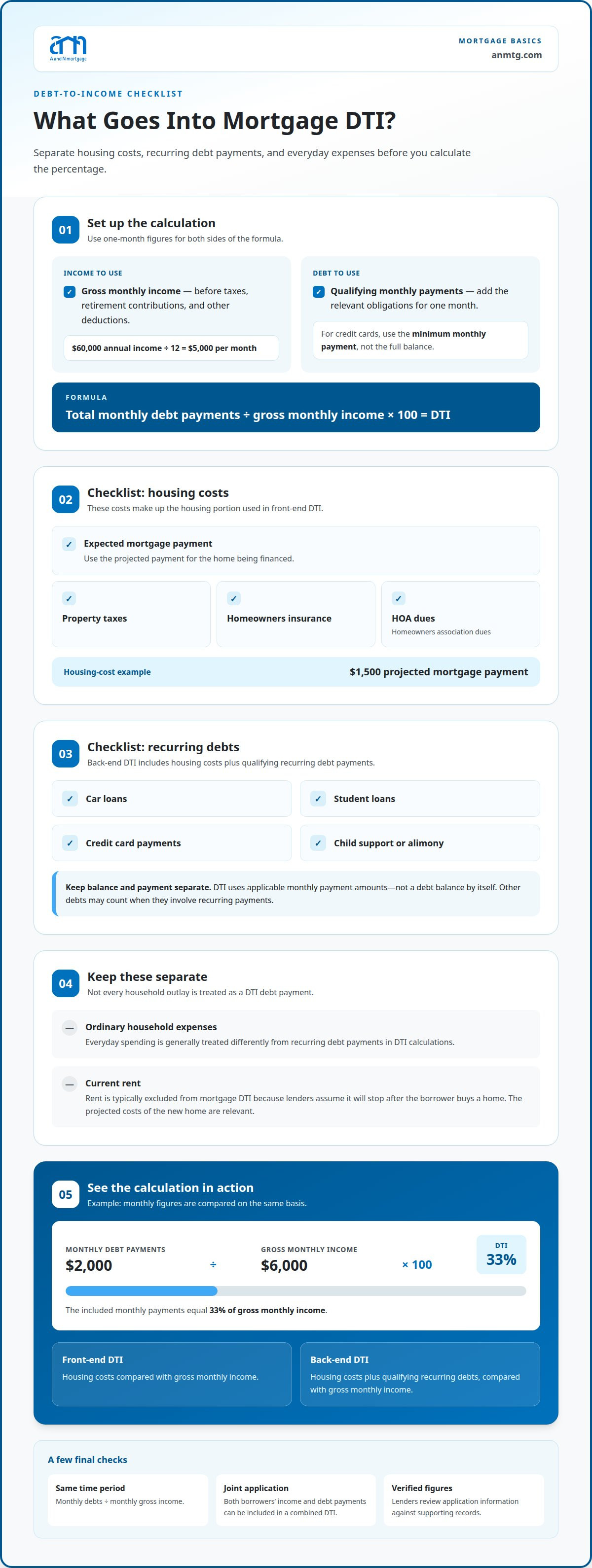
Front-end and back-end DTI measure different parts of a mortgage budget. The front-end ratio focuses on housing costs; the back-end ratio adds other monthly debt payments.
To calculate your DTI, divide the relevant monthly payment total by gross monthly income, then multiply by 100. For the front-end ratio, use housing expenses. For back-end DTI, include housing costs and qualifying recurring debts. Lenders can use both views to understand how a proposed payment fits alongside existing obligations.
The front-end housing ratio generally includes the mortgage payment, property taxes, homeowners insurance, and homeowners association dues. Keeping housing costs manageable relative to income can help borrowers assess a mortgage payment. This gives borrowers a way to assess the housing payment separately from car loans, student loans, and credit card payments. The estimated payment can depend on loan terms and interest rate, so those details affect the ratio’s numerator.
Back-end DTI provides the broader comparison. It combines housing expenses with monthly payments such as auto loans, student loans, and credit card minimums. The 28/36 rule suggests housing costs should not exceed 28% of gross monthly income and total debt should stay at or below 36%. These percentages are useful reference points, not a single approval rule for every loan.
Consider two co-borrowers whose combined gross monthly income is $10,000. Their estimated housing payment, including principal, interest, property taxes, and homeowners insurance, is $2,100, producing a 21% front-end ratio. Their car and student loan payments total $1,100 monthly. Add those debts to the housing payment, and their total monthly debts are $3,200, resulting in a 32% back-end ratio. The two calculations differ because the back-end numerator includes additional payments.
A back-end ratio of 36% or less is often used as a general target, while some lenders may consider higher ratios depending on the borrower’s credit profile and other factors. Many conventional loans allow up to 45%, and some programs may go as high as 50% with strong compensating factors. Those figures don’t mean every application at that level qualifies. Loan program, underwriting, and the full financial picture also matter.
Compare both ratios to see which part of the budget has the greatest effect. If the front-end percentage is within a preferred range but the back-end figure is higher, existing debt payments may account for the difference. If both ratios are elevated, the planned housing payment may be a significant factor. This comparison helps clarify what each percentage shows before you interpret a mortgage decision.
Debt-to-income ratio, or DTI, expresses monthly debt payments as a percentage of gross monthly income. It gives lenders a way to assess how much income is already committed to recurring debt, rather than looking at the size of each balance alone. A 50% DTI means at least half of gross monthly income goes toward counted debt payments. That leaves less income available for a new obligation.
DTI measures monthly payment capacity, not a complete household budget. Groceries, utilities, and gas generally aren’t included in the debt total, even though they affect day-to-day spending. Two borrowers with identical DTI percentages may have different budgets once those expenses are considered. DTI helps frame mortgage affordability, but it doesn’t describe every financial commitment.
A lower DTI generally indicates lower risk to lenders because less income is committed to debt payments. A higher percentage can mean less room for a new mortgage payment, particularly when existing obligations include a car loan, credit card minimums, or a student loan. DTI alone does not determine approval. Loan type and the rest of the application also shape how lenders assess a borrower’s ability to repay.
DTI and credit score measure different things. A credit score reflects credit information, while DTI compares debt payments with income. Credit bureaus don’t track income, so DTI doesn’t directly change a borrower’s credit score. Paying down a credit card may lower the monthly payment used in DTI, while card use and payment history relate to credit records. These are connected parts of a mortgage application, but they are not interchangeable measures.
Consider a borrower with $3,000 in monthly debt payments and $6,000 in gross monthly income. The DTI is 50%, meaning half of that gross income goes toward the debts counted. Lenders may be reluctant to extend more credit at this level, since a proposed mortgage payment would add another obligation. The calculation describes the relationship, not the borrower’s full financial position or the final lending decision.
The key is to read DTI as a proportion, not a score or universal cutoff. The percentage compares qualifying monthly debt with gross monthly income; it doesn’t show whether a borrower pays every bill on time or how much remains after ordinary expenses. When reviewing a mortgage estimate, distinguish DTI from credit score, account balances, and household spending. Each describes a different part of the financial picture.
A DTI calculator can illustrate the percentage, but its result is educational and does not constitute credit approval or denial. For a useful estimate, use monthly income and payment figures and understand which debts are included. This makes the result easier to interpret without treating it as a promise of approval or a complete measure of mortgage readiness.
A and N Mortgage Services, Inc. helps Chicago borrowers understand how DTI fits into a residential mortgage application and explore loan options suited to their circumstances. If you’re considering a conventional, jumbo, FHA, or VA loan, the team can guide you through home financing and explain how monthly obligations relate to your application.
Reach out as you prepare to apply, compare possible loan paths, or consider how existing debts may affect your mortgage plans in Chicago. Discussing your income, monthly payments, and home financing goals can give you useful context for the next step.
Contact A and N Mortgage Services, Inc. to discuss your mortgage questions.
Understanding how debt-to-income ratio is calculated for a mortgage gives you a clearer starting point for discussing your home financing plans. DTI can frame a conversation about your budget, existing obligations, and mortgage options that may suit your circumstances. The right fit depends on the full application and loan program.
A and N Mortgage Services, Inc. offers conventional, jumbo, FHA, and VA loans, with personalized guidance through the home financing process. If you’re preparing to apply or deciding which direction to explore, a conversation can connect your DTI questions with practical next steps.
Take the process one decision at a time. A clearer picture of your finances and financing goals can help you move forward with confidence.
Contact A and N Mortgage Services, Inc.
Divide qualifying monthly debt payments by gross monthly income, then multiply by 100. Keep both figures on a monthly basis and use debts relevant to the ratio being assessed. Front-end DTI uses housing costs, while back-end DTI also counts other qualifying debts. The result is a percentage, not a dollar amount or credit score. Those two ratios can differ because their debt totals differ.
Gross monthly income is what you earn in a month before taxes and other deductions. For a salaried applicant, it reflects monthly earnings before amounts are withheld from a paycheck. This differs from take-home pay, which is the amount received after deductions. DTI uses gross income to compare monthly obligations with earnings.
The 28/36 rule is a budgeting guideline: housing costs should generally use no more than 28% of gross monthly income, while total monthly debt should stay within 36%. These figures are planning benchmarks, not a guarantee of mortgage approval or a universal limit for every loan.
You can lower DTI by reducing qualifying monthly debt payments, increasing gross monthly income, or doing both. Paying down a credit card may reduce the minimum payment counted in the calculation; avoiding a new recurring loan payment can also keep the debt total from rising. After a change, recalculate using updated monthly figures. The effect depends on how much the debt total or income changes.
DTI shows how much income is already committed when a proposed mortgage payment is added to existing obligations. A higher ratio leaves a smaller share of gross income outside those counted payments; a lower ratio generally means less income is committed to debt. DTI is one part of mortgage affordability, not a complete household budget, since costs such as groceries and utilities generally aren’t counted as debts.
DTI can show whether projected housing costs fit alongside recurring debts, but it doesn’t capture every cost of owning a home. Property taxes, homeowners insurance, and homeowners association dues can contribute to the housing calculation. Ordinary household expenses still affect your budget even when they aren’t counted as debt. Consider both the DTI percentage and your broader monthly spending when assessing affordability.
DTI stands for debt-to-income ratio, a measure used in mortgage lending to compare monthly debt obligations with income. It describes payment burden, not how much a borrower owes in total. A credit card balance and its monthly payment, for example, are different figures. DTI focuses on the payment amount used in the calculation, so don’t confuse it with total account balances.
A back-end DTI of 36% or less is a common planning target, while mortgage lenders generally prefer 43% or less. A suitable range depends on the loan program, lender, and full application, so one percentage doesn’t determine approval in every case. Treat lower DTI as more room between income and debt payments, then consider how the proposed housing payment changes your monthly obligations.
Welcome to a better mortgage experience! In just few minutes you can find out what you qualify for and explore multiple loan options and interest rates.
Complete our short and intuitive pre-approval interview to get started.