The government doesn’t set U.S. mortgage rates directly, and a Federal Reserve rate cut doesn’t automatically make a home loan cheaper. Understanding how mortgage interest rates are determined starts with the bond markets, where Treasury yields and investor demand for mortgage-backed securities help shape the rates lenders offer. Inflation, employment, housing conditions and global events can also shift those markets.
It’s understandable to expect mortgage rates to move in step with the Federal Reserve, especially when its decisions affect other borrowing costs. But mortgage rates reflect broader market expectations, and lenders also consider details such as the loan type and borrower’s financial profile when setting an individual offer. This article explains how those forces work together, why rates can change even when the Fed moves in the opposite direction, and what influences the rate on a 30-year mortgage. With that context, rate changes can feel less mysterious and easier to factor into a home financing decision.
No. The Federal Reserve influences financial conditions, but it doesn’t set U.S. mortgage rates directly. Economic activity and investor expectations shape the market rates lenders use.
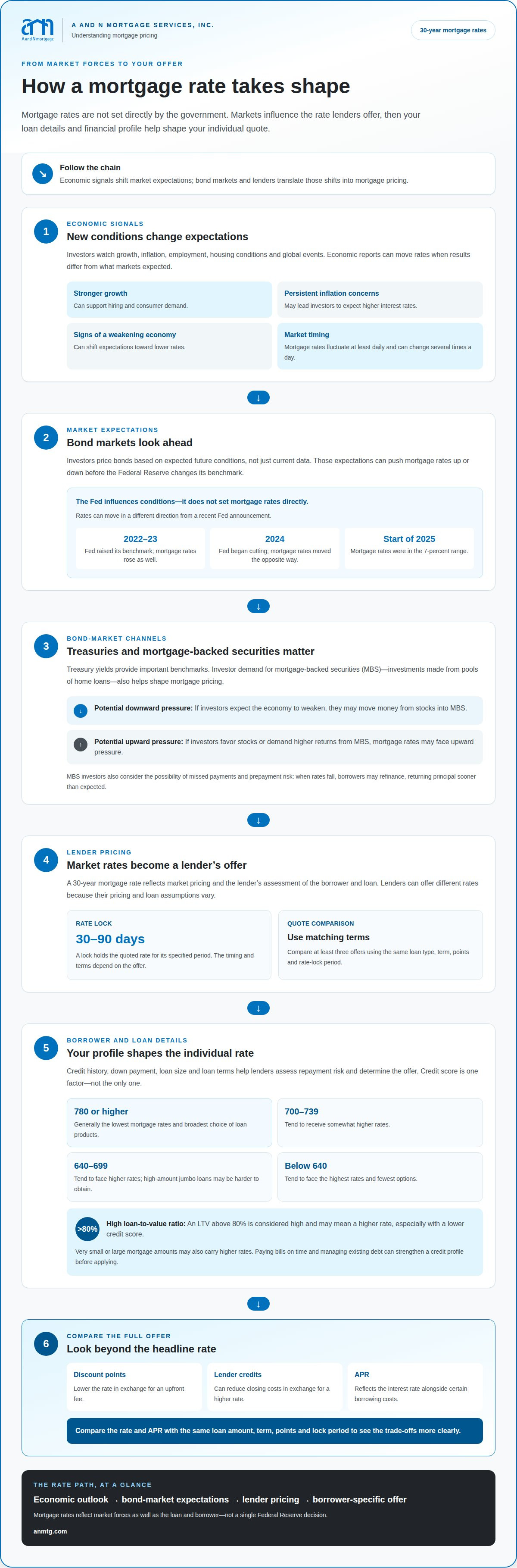
Economic conditions are the signals of growth, employment, and financial confidence that influence borrowing costs. They matter because a mortgage rate can move even when the Federal Reserve makes no new announcement. The Fed raised its benchmark rate in 2022 and 2023, and mortgage rates rose as well. It began cutting rates in 2024, yet mortgage rates moved in the opposite direction and started 2025 around 7 percent. Lenders can also offer different rates because their pricing and loan assumptions vary. Compare at least three offers using the same loan type, term, points, and rate-lock period.
Growth and inflation expectations are forecasts for how the economy and prices may change. They matter because investors price bonds based on expected future conditions, not just current data. Stronger growth can support hiring and consumer demand, while concern about persistent inflation may lead investors to expect higher interest rates. Those expectations can push mortgage rates up before the Federal Reserve changes its benchmark. Conversely, signs of a weakening economy can shift expectations toward lower rates. The economic outlook helps explain why mortgage rates don’t always move in line with a recent Fed announcement.
Mortgage-backed securities, or MBS, are investments made from pools of home loans. Their market prices affect mortgage rates because lenders and investors consider the returns buyers demand. When investors expect the economy to weaken, they may move money from stocks into MBS, potentially pushing mortgage rates lower. If investors favor stocks or demand higher returns from MBS, rates may face upward pressure. This relationship shows that mortgage rates reflect competition for investment funds, not just the cost of short-term borrowing. It also helps explain why financial markets can move before changes appear in household economic data.
Economic reports give investors new information about growth, inflation, and employment. Their effect depends partly on whether the reported results differ from market expectations. Mortgage rates fluctuate at least daily and can change several times a day as reports and expectations shift. That creates a timing consideration for borrowers comparing an offer with a later rate. In the United States, a mortgage rate lock generally lasts 30 to 90 days. A lock holds the quoted rate for its specified period, while the timing and terms depend on the offer. Discussing the lock period alongside the rate helps make comparisons more meaningful.
A 30-year mortgage rate reflects market pricing and the lender’s assessment of the borrower and loan. Credit history, down payment, loan size, and loan terms help shape the individual offer.
Credit history records how a borrower has managed debt and payments. Lenders use it to assess repayment risk. A stronger record can support a lower rate because it signals less risk to lenders and investors. Credit scores summarize that history, but a score is only one factor alongside the loan amount, down payment, and mortgage type.
In the United States, borrowers with scores of 780 or higher generally receive the lowest mortgage rates and have the broadest choice of loan products. Scores from 700 to 739 tend to receive somewhat higher rates, while scores from 640 to 699 tend to face higher rates and may make high-amount jumbo loans harder to obtain. Scores below 640 tend to face the highest rates and fewest options. Paying bills on time and managing existing debt can strengthen a credit profile before applying.
Credit risk can also matter to investors in mortgage-backed securities, or MBS. Because these securities pool home loans, investors consider the possibility that borrowers may miss payments. Prepayment risk matters too: when rates fall, borrowers may refinance, returning principal to investors sooner than expected. These risks can affect the returns investors require and, in turn, influence mortgage pricing.
Down payment and loan size also influence the offer: a loan-to-value ratio above 80% is considered high and may mean a higher rate, especially with a lower credit score. Very small or large mortgage amounts may also carry higher rates.
Points, lender fees, and rate locks affect how an offer’s interest rate compares with its overall borrowing cost. Discount points lower the rate in exchange for an upfront fee; lender credits can reduce closing costs in exchange for a higher rate. The annual percentage rate, or APR, reflects the interest rate alongside certain borrowing costs, helping borrowers compare offers beyond the headline rate.
Compare offers with the same loan amount, term, points, and lock period. A lower quoted rate may require more upfront points, while a higher rate may come with lender credits. A rate lock holds the offered rate for its stated period, and its terms determine whether the quote remains available through closing. Comparing both the rate and APR helps show the trade-off.
For a clearer comparison of mortgage options and terms, see what a Loan Estimate reveals about your lender and review the full cost of each offer.
Treasury yields provide important benchmarks, while mortgage-backed securities connect investor demand to mortgage pricing. Together, they help explain why mortgage rates can shift even when the Federal Reserve holds its benchmark rate steady.
For a simple comparison, Fannie Mae’s analysis focuses on the 10-year Treasury note. Lenders and investors also benchmark mortgage rates using a blend of 5-, 7-, and 10-year Treasury notes. These yields reflect what investors expect from the economy and interest rates over time. Expectations for future short-term rates matter because they can influence longer-term bond yields before the Federal Reserve changes policy. For example, in December 2020, the 10-year Treasury note rate was 0.93 percent. Its monthly average was 4.8 percent when mortgage rates reached their cycle high in October 2023.
The 10-year Treasury yield is a guide, not a direct formula for a mortgage offer. The spread between 10-year Treasury rates and 30-year mortgage rates is usually about 2 percentage points. It widened to around 3 percentage points for a time in 2023. That difference reflects factors including investor demand, uncertainty, and the risks attached to mortgage-backed securities. As a result, Treasury yields can fall without mortgage rates falling by the same amount. Borrowers may see the connection in market movement, but not a one-for-one change in their quoted rate.
Mortgage-backed securities, or MBS, are bundles of thousands of mortgages. Their market prices affect the yields investors receive, and mortgage rates are based on the yield of 30-year mortgage-backed securities. When MBS prices rise, their yields fall; when prices fall, yields rise. That inverse relationship is central: lenders account for the returns investors demand when pricing loans that may be sold into the secondary market. The government-backed role of Fannie Mae and Freddie Mac helps support investor confidence in these securities, while the mortgages themselves provide real estate collateral.
The Federal Reserve bought trillions of dollars in mortgage-backed securities during the pandemic, adding a major buyer to the market. When demand for MBS increases, prices can rise and yields can fall, putting downward pressure on mortgage rates. When investors require higher returns, MBS prices can weaken and yields can climb. Treasury yields, MBS pricing, and expectations for future short-term rates work together, rather than moving as one government-set rate. Tracking both bond markets offers a clearer explanation of mortgage-rate changes.
Geopolitical events can change investors’ expectations about growth, inflation, and risk. Their effects on mortgage rates depend on how Treasury and mortgage-backed securities markets respond, so a global shock doesn’t automatically push rates in one direction.
During geopolitical uncertainty, some investors may seek assets they consider safer, including U.S. Treasury securities. Greater demand can raise Treasury prices and lower yields, potentially putting downward pressure on mortgage rates. The opposite can happen if an event raises concerns about government borrowing, inflation, or the reliability of future returns. Investors may then require higher yields, influencing mortgage pricing.
Inflation expectations create another path from global events to home financing. A disruption to energy supplies, for example, can raise energy costs and change expectations for broader price increases. If bond investors expect inflation to persist, they may demand higher yields to protect their returns. This can affect the rates offered to homebuyers, even when an event occurs outside the United States. The impact depends on the expected economic consequences, not simply the event’s location.
Treasury securities and mortgage-backed securities don’t always react in the same way. During a market shock, investors may buy Treasuries while reassessing the risks and returns of mortgage-backed securities. That can widen the difference between Treasury yields and MBS yields, limiting how much a Treasury yield decline translates into a lower mortgage rate. For borrowers, this helps explain why a bond-market headline may not match the movement in a lender’s offered rate.
The market’s response can change as new information arrives. An event may initially increase demand for Treasury securities, then shift expectations as investors focus on inflation or government financing. Mortgage pricing follows these changing assessments through bond yields, MBS prices, and the returns investors require. A headline alone can’t show whether rates will move higher or lower next.
For homebuyers, the practical question is how a market move affects a specific loan offer and monthly payment. Compare quoted rates and APRs for the same loan structure, since points and lender credits can change the trade-off. A change in the quoted interest rate affects borrowing costs over time, but the payment also depends on the amount borrowed and loan terms. Reviewing the complete offer gives more useful context than reacting to a single geopolitical headline.
Global events are one influence among several, not a direct rate-setting mechanism. Treasury markets, MBS pricing, and inflation expectations determine how an event affects mortgage pricing. Following those connections can help borrowers understand why rates respond differently to similar headlines and why a lender’s offer may not move in line with Treasury yields.
Inflation, employment, and housing conditions shape the economic outlook investors use to price bonds. Their influence reaches mortgage rates through expectations for future growth, prices, and borrowing demand. These forces interact rather than setting mortgage rates through a single indicator. For homebuyers, that means one report rarely explains every rate movement. The broader pattern matters, including whether inflation is easing, hiring is strengthening, or housing demand is changing.
The Federal Reserve has a 2-percent inflation target. Inflation matters to mortgage markets because investors consider whether rising prices may persist and reduce the future value of fixed bond payments. If inflation appears persistent, investors may seek higher yields, which can put upward pressure on mortgage rates. If price pressures ease, expectations may shift in the other direction. The Federal Reserve’s target offers context for interpreting inflation data, but it doesn’t directly determine a lender’s mortgage offer.
Employment data provides another signal. Strong job growth can reflect a resilient economy, supporting household spending and demand for credit. That outlook can contribute to higher market yields and mortgage rates. By contrast, rising unemployment in the United States is generally followed by falling mortgage rates, as investors may expect weaker growth and lower future rates. The relationship isn’t automatic: bond markets respond to the report and how it compares with investors’ expectations.
The pandemic illustrates how employment and inflation expectations can shift together. In spring 2020, stay-at-home orders brought layoffs and furloughs during a recession, and U.S. mortgage rates fell further after already being low. As the economy recovered and jobs returned, rates rose. A few years after plunging to pandemic record lows, U.S. mortgage rates rose to nearly 8% in late 2023. Those changes show why employment trends matter alongside inflation and market expectations.
Housing conditions add another layer. Strong homebuyer demand can increase borrowing activity, while limited housing availability can put pressure on home prices. These conditions may affect market expectations for growth and inflation, as well as investor views of mortgage-backed securities. For example, when borrowers refinance as rates fall, investors may receive principal sooner than expected. Housing activity therefore affects both mortgage demand and the investment characteristics of those loans.
For borrowers, these indicators offer context, not a day-by-day rate forecast. When reading an employment or inflation report, consider whether it changes expectations for future prices, growth, or interest rates. Then view the market response alongside the specific loan terms and borrower details that shape an offer. This approach connects economic headlines to mortgage pricing without treating any one statistic as a promise of a particular rate.
A and N Mortgage Services, Inc. can help you understand how market conditions and borrower details shape a mortgage offer. When you’re ready to move from following rate trends to assessing a home loan, its guidance can clarify how loan terms and your financial profile fit together.
Conventional, Jumbo, FHA, and VA Loans serve different borrower and financing needs. Understanding their differences can help you consider which option fits your circumstances, alongside the rate, points, and other offer terms. A mortgage professional can walk you through these factors so you can make a more informed decision.
Contact A and N Mortgage Services, Inc. to discuss your home financing questions.
Understanding how mortgage interest rates are determined can help you approach financing decisions with more confidence. The next step is to connect market conditions with the loan structure and terms that fit your plans. A and N Mortgage Services, Inc. offers Conventional, Jumbo, FHA, and VA Loans, with guidance to help you understand how different options relate to your home financing goals.
Rather than focusing on a headline rate alone, consider the full offer and how its terms align with your budget and timing. A mortgage professional can help you review the details and identify questions to resolve as you move forward. The right conversation can turn market information into a practical decision for your home purchase.
Contact A and N Mortgage Services, Inc.
Take the next step at a pace that feels right for you, with clear information to support your decision.
Mortgage rates reflect market conditions and details of the specific loan and application. Understanding how mortgage interest rates are determined can make an offer easier to assess. For example, borrowers may receive different rates because their loan amounts, down payments, credit profiles, or points differ. Inflation expectations, employment data, and bond markets can also affect lender pricing. Review the full offer, not just its headline rate.
Mortgage types differ in eligibility, structure, and how risk is shared, so their pricing can differ too. Government-backed insurance or guarantees can reduce lender risk for some programs, potentially contributing to lower rates. Conventional and jumbo financing have different terms and borrower requirements. Compare options using the same purchase details and consider the full costs and conditions: a lower advertised rate alone doesn’t show which loan best fits your situation.
No market signal can reliably tell you exactly where mortgage rates will go next. To understand market expectations, follow Treasury yields and bond-price changes alongside inflation, employment, and Federal Reserve news. Consider how markets respond after economic reports, too: a result that differs from expectations can quickly change yields. Use these indicators as context when discussing timing, rather than treating a forecast as a promise about the rate you’ll receive.
In the United States, how mortgage interest rates are determined depends on market benchmarks, lender pricing, loan features, and borrower details. Location can matter too: rates may vary by state, and some loan amounts or types can make county-level pricing relevant. For a practical comparison, keep the loan amount, term, down payment, points, and lock period consistent across offers. That makes it easier to see which differences come from pricing rather than changed terms.
The Federal Reserve sets a short-term benchmark, not the mortgage rate a lender offers. Treasury yields provide longer-term market signals, while mortgage-backed securities prices influence the returns investors seek from home loans. These measures can move in different directions, so a change in the federal funds rate doesn’t guarantee a matching mortgage-rate change. For example, a Fed rate cut may coincide with rising mortgage rates if bond investors revise their expectations upward.
A credit score helps lenders assess repayment history, while the debt-to-income ratio compares recurring debt payments with income. A lower ratio and stronger credit profile can support more favorable pricing because they indicate a borrower may be better positioned to manage payments. Income also helps lenders assess repayment ability, though income alone doesn’t set the rate. Lenders evaluate these details alongside the loan amount, down payment, and program.
Loan program and repayment term affect pricing because they have different structures and risk considerations. FHA, VA, or USDA programs may sometimes have lower rates when government insurance or guarantees reduce lender risk. Shorter-term mortgages generally have lower interest rates and overall costs, but higher monthly payments. A 15-year and 30-year offer should therefore be compared by both rate and payment, alongside program requirements and the borrower’s intended time in the home.
A fixed-rate mortgage keeps the same interest rate for the loan’s term, so its initial pricing reflects market conditions and borrower details when the offer is made. An adjustable-rate mortgage begins with an introductory rate, then changes according to its adjustment terms. That initial rate may be lower than a fixed-rate mortgage’s rate, but later adjustments can change the payment. Compare the introductory period and future adjustment terms before choosing.
Welcome to a better mortgage experience! In just few minutes you can find out what you qualify for and explore multiple loan options and interest rates.
Complete our short and intuitive pre-approval interview to get started.