Mortgage underwriting can take anywhere from a few days to a few weeks. If you’re asking, “How long does underwriting take for a mortgage?” the answer depends on how quickly the lender receives and reviews your documents, the complexity of your finances, and the property details.
Waiting for a decision can feel stressful, especially when your home purchase is moving forward on a schedule. Underwriting is one part of the mortgage process, not the entire period from application to closing. Missing documents or unanswered questions can extend the review.
This article explains what underwriters review, what can slow the timeline, and how income, credit, assets, debts, and property checks may affect the pace. You’ll also learn what happens when the lender requests more information, so you can better understand where your application stands and what to expect next.
Underwriting can take a few days to several weeks, while the full mortgage process also includes the application, property review, and closing. The timeline depends on how quickly the lender can assess your finances and the property.
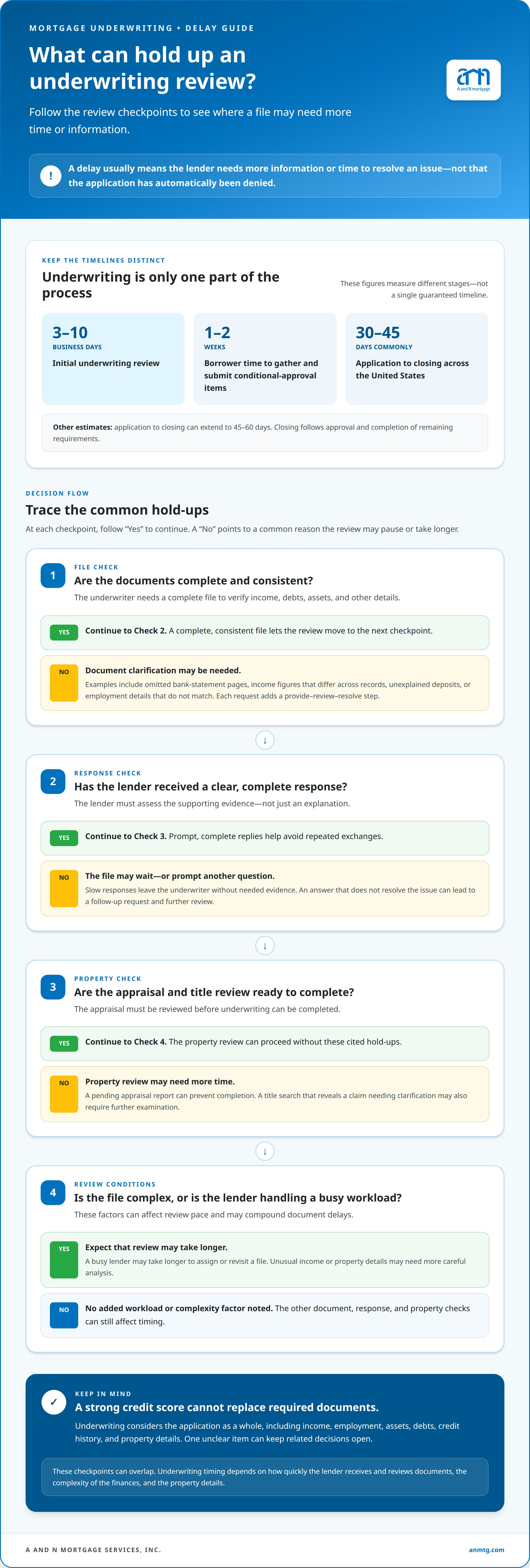
An initial underwriting review often takes several business days to about two weeks, but the full application-to-closing timeline is longer. Many purchase loans close in roughly 30 to 45 days, and some take longer when conditions, appraisal questions, or title issues come up.
These periods measure different parts of the process. Underwriting assesses your ability to repay, credit history, and property value. Closing follows after approval and completion of the remaining requirements. Knowing the difference helps explain why an underwriting update does not necessarily mean the home purchase is ready to close.
Underwriting typically moves from an initial file review to conditions, a final review, and a decision. Lenders may first use automated systems to assess whether an application meets requirements. An underwriter can review the file manually when circumstances do not fit the system’s formula.
The underwriter evaluates income, debts, credit, and the property appraisal. The appraisal must be reviewed before underwriting can be completed. If information or documents are outstanding, the lender issues conditions. Once those are addressed, the underwriter reviews them and may approve, deny, or pend the application. Each stage gives the lender a chance to resolve a different part of the file.
Conditional approval means the lender has identified remaining requirements before making a final decision. Gathering and submitting the requested items can take anywhere from a day or two to a couple of weeks, so this stage can extend the timeline.
The timeline depends on what the conditions require and how promptly complete information reaches the lender. A missing document or an answer that raises a new question can lead to further review. The lender must assess whether the submitted items satisfy the conditions. Conditional approval alone does not mean the file is clear to close.
Approval means the underwriter has accepted the application at that stage. Conditional approval means requirements remain, while denial means the application was not approved. A file may also be pended when the underwriter needs more information before deciding.
These outcomes describe the status of the application, not necessarily the closing date. After the file is clear to close, final review and closing preparation remain. The Consumer Financial Protection Bureau says borrowers must receive the Closing Disclosure at least three business days before closing. That disclosure period is separate from underwriting, so a decision and a scheduled closing are not the same milestone.
Underwriting slows when an application leaves questions unanswered or required information arrives in pieces. Even a strong credit score cannot replace documents needed to verify income, debts, assets, or the property. A delay usually means the lender needs more information or time to resolve an issue, not that the application has automatically been denied.
Missing documents directly delay the process because the underwriter cannot complete a review using an incomplete file. For example, a bank statement with omitted pages or income figures that differ across records may prompt a request for clarification. Each request adds a step: you provide the item, the lender reviews it, and the underwriter decides whether it resolves the question.
Inconsistencies can matter even when they have a straightforward explanation. A deposit that does not match regular payroll, or employment details that differ between records, may need supporting information before the review can proceed. Because the application is assessed as a whole, one unclear item can keep related decisions open.
Your response time affects how quickly an underwriting condition can be cleared. If you need time to locate a document, the file may wait before review continues. If your response raises another question, the lender may request additional information. Clear, complete replies help avoid repeated exchanges, while an unanswered request leaves the underwriter without the evidence needed to finish that part of the assessment.
For instance, an explanation of an unusual account entry may lead to a follow-up if the supporting records do not show when or why the funds appeared. The underwriter assesses the evidence, not just the written explanation. Prompt communication also lets the lender know when a document is taking longer to obtain.
Some delays arise outside your financial documents. The underwriter needs to review the appraisal, and property or title issues may require further examination. If the appraisal report has not arrived, or a title search reveals a claim that needs clarification, the lender may be unable to complete the property review.
Application volume and loan complexity also affect the pace of review. A lender handling a busy workload may take longer to assign or revisit files, while unusual income or property details may need more careful analysis. These factors can compound document delays, particularly when the underwriter needs information from several sources.
A lender can help limit avoidable back-and-forth by organizing the file, explaining requests clearly, and identifying missing information early. The borrower still needs to provide accurate documents and respond to follow-up questions. For a list of what to gather before you apply, see our pre-approval checklist, and consider working with a professional who can help clarify what the lender needs at each stage.
The lender uses your mortgage application and supporting records to verify income, assets, debts, and employment. Complete, consistent documents help the review proceed without avoidable follow-up.
The application gives the lender a structured account of your finances, and supporting documents help verify its details. A processor collects and organizes the file before underwriting; the underwriter then checks whether the records support the application.
For example, stated income can be compared with pay stubs and tax filings, while bank statements show available assets and account activity. If a figure differs between documents, the lender may need an explanation or an updated record. The underwriter must assess both the original information and any clarification, which can affect the timeline.
The Loan Estimate is a separate, early-stage document. According to the Consumer Financial Protection Bureau, a lender must deliver it within three business days of receiving a complete mortgage application. It outlines estimated loan terms and costs, while underwriting later verifies the borrower and property information behind the proposed loan.
Common records help the lender check income, savings, and the source of funds. Applicants commonly provide recent pay stubs covering about 30 days and bank statements covering the most recent two months. Underwriters often review W-2 or 1099 forms and, for self-employed borrowers or those with certain income types, personal and business tax returns, typically for up to two years.
A large deposit without an obvious source may prompt questions. Matching names, dates, and figures across records makes it easier for the lender to verify what each document represents.
Preapproval is an early assessment based on application information and documents, not the same as completing underwriting. A preapproval can often be issued within a few days once the lender has your documents, though it can take longer if more verification is needed.
That early review helps identify issues before the mortgage file moves further. However, the lender still verifies details during underwriting and may request updated records or explanations. If your income includes wages and business earnings, for example, you may need records supporting each source. Timely, complete responses help the lender assess the file without unnecessary exchanges.
During underwriting, the lender checks whether your credit and current finances support the requested mortgage. Credit history, income, assets, debts, monthly payments, employment, and the property appraisal each contribute a different part of the picture.
You can think of the review in three connected areas: credit, capacity, and collateral. Credit is how you have managed past obligations; capacity considers income and existing debts against the proposed payment; collateral is the property securing the mortgage. A question in any area may prompt requests for more records or an explanation before the lender can finish reviewing your application.
A credit report gives the lender details about accounts, balances, payment history, and outstanding obligations. U.S. mortgage lenders pull reports from one or more of the three main credit bureaus. The underwriter considers the report alongside your income and debts, rather than treating one score as the entire decision.
Many lenders look for a credit score of at least 620 for a conventional loan, although Fannie Mae removed its hard 620 minimum for loans run through Desktop Underwriter in November 2025. A score is not a complete assessment by itself: the lender also reviews credit history, monthly obligations, and the loan program’s requirements. A lower score, missed payments, or a discrepancy on the report can lead to further review or requests for supporting information.
Capacity depends on whether verified income can support the mortgage payment alongside other debts and expenses. The lender considers employment status, debt-to-income ratio, and income consistency. A new job or employment change during processing can slow the review because the lender may need to assess how it affects your earnings and eligibility.
Assets matter, too. They show the funds available to you, while account activity may raise questions that need an explanation. For example, a large deposit may require documentation showing its source. The underwriter evaluates those records alongside your other finances, rather than assuming the deposit represents stable income.
Financial changes during review can alter the picture the lender has already assessed. Taking on new debt may increase your monthly payments, and closing a credit card account can affect your credit profile. These changes may trigger updated checks or additional requests, adding review steps and affecting the timeline.
Keeping the lender informed about a change helps clarify what happened and which records may be relevant. Responding accurately and consistently gives the underwriter a clearer basis for reassessing your credit, capacity, and collateral before making a final decision.
Underwriting moves at different speeds because each file combines borrower, property, and lender factors. An appraisal, variable income, missing information, loan complexity, and application volume can all affect how quickly an underwriter reaches a decision.
Property review is one timing factor. Scheduling the appraisal, completing the inspection, and delivering the report can take a week or more, depending on appraiser availability and the property. If the report raises questions about the home’s value or condition, the lender may need to review the issue before assessing the property as security for the loan.
Your finances can add review steps, too. Self-employment and variable income may require closer examination to establish your ability to repay. A recent employment change can also prompt further questions. For example, the lender may need to understand how a new role affects your income before completing its assessment.
Loan type and file complexity matter. Government-backed loans such as FHA and VA mortgages have their own property and documentation requirements, which can add review steps. A file with unusual income, property, or title details may also need additional review. Conditions can lead to multiple reviews if a submitted answer or document raises a new question.
The lender’s workload affects how quickly each review begins and continues. Application volume can influence how long it takes an underwriter to examine a file or revisit it after receiving new information. Your documentation matters, too: accurate, complete records submitted promptly reduce avoidable back-and-forth, while missing items leave questions open.
To support a smoother review, the lender can organize the file, explain documentation requests, and identify possible issues early. Applicants can help by submitting requested records promptly, communicating if an item will take longer, and including explanations for unusual credit-report entries or account activity. For example, if a bank statement covering the past 60 days includes an unfamiliar deposit, a clear explanation and supporting records can help the underwriter assess it.
Each factor affects a different part of the review. Addressing an outstanding request may help, while an appraisal or lender workload remains outside your control.
A and N Mortgage Services, Inc. can help you understand how the underwriting timeline fits your mortgage application and what information the lender may need. The Chicago-based lender offers personalized guidance through the financing process, helping you consider how your financial situation and property details relate to options such as Conventional, Jumbo, FHA, and VA loans.
Consider reaching out when you’re preparing to apply, have received underwriting conditions, or need help understanding what may be holding up a decision. A clear conversation about your application can help you understand the next steps in your home financing process.
Contact A and N Mortgage Services, Inc. to discuss your mortgage questions.
Knowing how long underwriting takes for a mortgage can help you approach your purchase with clearer expectations. The next useful step is understanding how your financing needs fit the process. A thoughtful conversation can turn questions about your application into a clearer view of the decisions ahead.
A and N Mortgage Services, Inc. offers Conventional, Jumbo, FHA, and VA loans. Discussing your goals and circumstances can help you consider which option may suit your home financing plans and what information will help move your application forward.
You don’t need every detail figured out before asking for guidance. Bring the questions that matter most, such as how your application will be reviewed or what the lender may need to assess your situation. An informed next step can make the path ahead feel more manageable.
Contact A and N Mortgage Services, Inc.
With the right guidance, you can move into your next mortgage conversation prepared to make decisions with greater confidence.
Mortgage underwriting can take from a few days to several weeks. When estimating how long underwriting takes for a mortgage, separate the underwriter’s review from the full purchase timeline. An application with straightforward finances and complete property information may move through review faster than one needing additional analysis. The lender’s workload and how quickly the file receives the information it needs also affect the pace.
Yes, a lender can deny a mortgage after conditional approval if the application no longer meets requirements or outstanding conditions aren’t satisfied. A change in employment or newly discovered information, for example, may affect the lender’s assessment before final approval. Conditional approval is a positive step, but it isn’t the final decision. Keep the lender informed about material changes and respond accurately to requests for clarification.
No. Underwriting may reach a decision before the loan is ready to close. After the lender clears the file, final review and closing preparation remain, including delivery of the Closing Disclosure. The Consumer Financial Protection Bureau says borrowers must receive that disclosure at least three business days before closing. If you receive an approval update, ask what milestone it represents: approval and completed closing are distinct stages.
Delays often arise when the lender is waiting for information, a property review needs attention, or an application requires additional analysis. If income records don’t clearly explain a deposit, for example, the underwriter may need supporting evidence before resolving the question. Appraisal or title concerns can also hold up a decision. A complete response to each request helps the lender address the specific open issue.
Conditional approval means the lender has approved the application subject to remaining requirements. The underwriter may still need a document, clarification, or confirmation before issuing a final decision. The conditions identify what remains unresolved; they don’t mean the loan is already clear to close. Read each request carefully and provide information that directly addresses it, so the lender can assess whether the condition has been met.
In the United States, underwriting may take a few days to several weeks, depending on the application and property review. An initial review often takes several business days to about two weeks, while additional questions or outstanding requirements can extend the process. This refers to underwriting, not the entire period from mortgage application to closing. Ask which stage your file is in to interpret a timeline update accurately.
There’s no single standard turnaround time; it varies by lender, loan program, and how complete the file is. A first review may come back within days, while the full path to final approval can take several weeks. Estimates can differ from the initial review period because conditions, later reviews, and property information may add time. For a useful comparison, find out whether a quoted turnaround refers to the underwriter’s first review, the final decision, or the full path to closing. Those milestones measure different parts of the mortgage process.
There isn’t a separate fixed timeline for each loan type. FHA, VA, and USDA mortgages have additional program requirements that can add review steps, while the complexity of an individual file and its outstanding requirements also affect timing. Property questions or documentation needs, for example, may add review steps regardless of loan program. The best estimate depends on the specific file and where it stands in the review process.
Welcome to a better mortgage experience! In just few minutes you can find out what you qualify for and explore multiple loan options and interest rates.
Complete our short and intuitive pre-approval interview to get started.